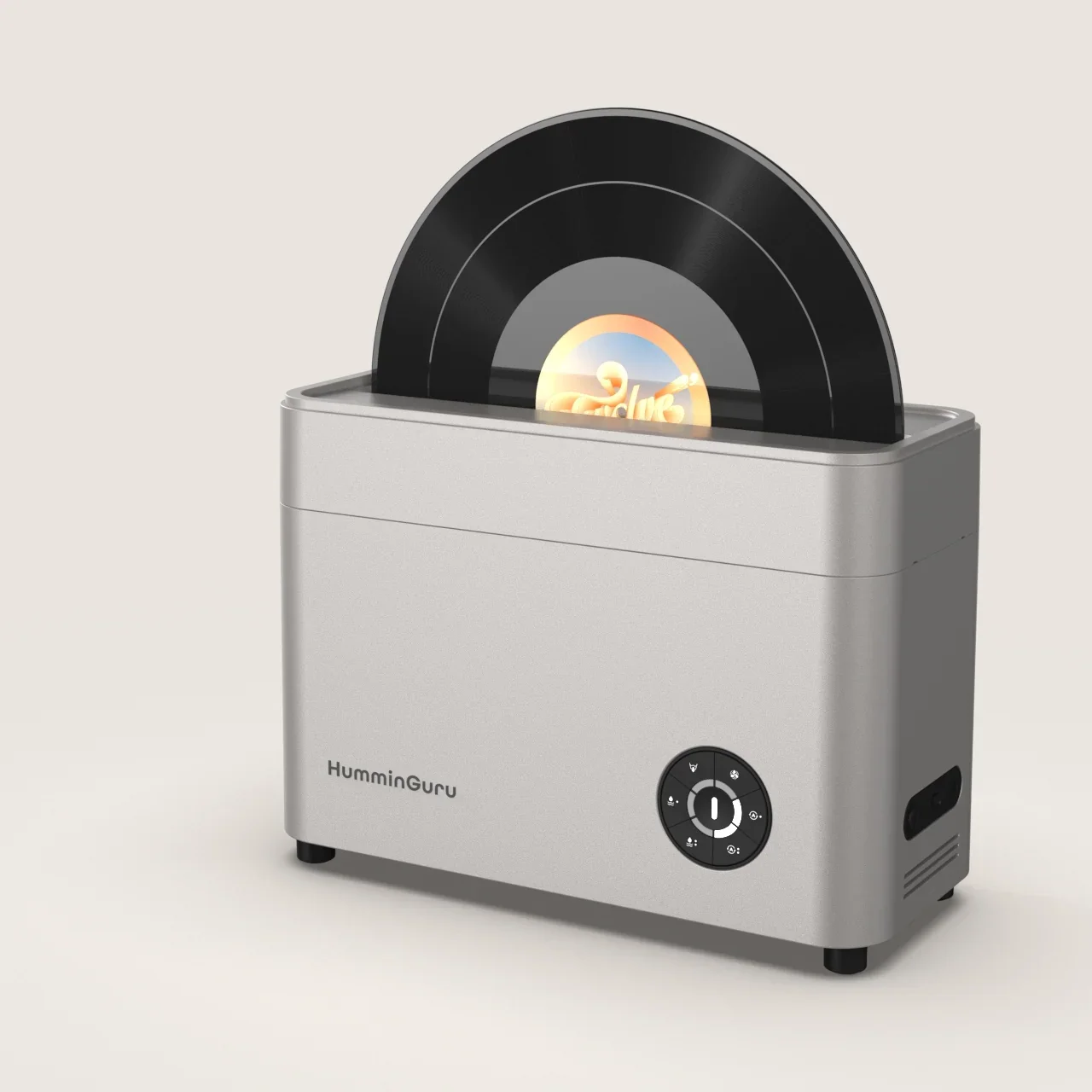
HumminGuru NOVA HG05
Introduction
For many record collectors, ultrasonic cleaning has long represented an appealing, if expensive, approach to record care. The HumminGuru NOVA HG05 promises to make that technology considerably more accessible, combining fully automatic ultrasonic cleaning and drying in a compact machine. Available directly from its Hong Kong manufacturer for approximately $700 before shipping and import charges, the NOVA typically sells through U.S. retailers for around $840.
I’ve relied on a VPI 16.5 vacuum record-cleaning machine for approximately thirty years, and it continues to serve me remarkably well. More recently, several weeks evaluating the $3,600 Degritter Mark II showed me what ultrasonic cleaning could accomplish. The prospect of a machine offering similar cleaning technology for less than one-quarter of that price was intriguing, to say the least.
What could HumminGuru accomplish at this price? How effective would the cleaning be, and what compromises might be involved? I approached the NOVA as a product in its own right, interested in how it might fit into my record-care routine.
Over the following weeks, it delivered some very quiet playback, along with results that were less straightforward. Living with the machine also revealed strengths and limitations that weren’t apparent at first. Its cleaning ability, however, gave me good reason to keep exploring.
The HumminGuru Story
HumminGuru is the creation of Happy Well International Enterprise, a Hong Kong-based company that entered the record-cleaning market with the original HG01 through a Kickstarter campaign in late 2020. More than 1,100 backers supported the project, attracted by the prospect of a compact, fully automatic ultrasonic cleaner costing a few hundred dollars at a time when established alternatives commonly sold for several thousand.
The HG01 employed two 40 kHz ultrasonic transducers and a removable water reservoir, combining cleaning, automatic drainage, and forced-air drying in a single machine.
The NOVA HG05 develops that basic concept with an upgraded ultrasonic power-drive system and a new feature called Ultrasonic Frequency Sweep. Rather than operating at a single fixed frequency, the system varies the frequency around 40 kHz to distribute cavitation energy more evenly throughout the cleaning bath, promoting more uniform cleaning across the record surface. The NOVA also introduces more powerful drying fans, a countdown display, and adjustable record-support rollers that accommodate 7-, 10-, and 12-inch records without the separate adapters required by the original machine. It retains the twin 40 kHz transducers and compact stainless-steel cleaning chamber, along with the original proposition: relatively affordable, convenient ultrasonic record cleaning.
Unpacking and Setup
My introduction to the HumminGuru NOVA was not particularly encouraging. The machine arrived from Amazon in its retail carton, without an additional shipping box, and the packaging had clearly taken a beating along the way.
Fortunately, the NOVA and its accessories were in pristine condition. Jacqueline Ng at HumminGuru subsequently explained that Amazon sometimes removes the manufacturer’s protective outer carton during fulfillment. Nevertheless, I would prefer to see equipment like this shipped with that additional protection.
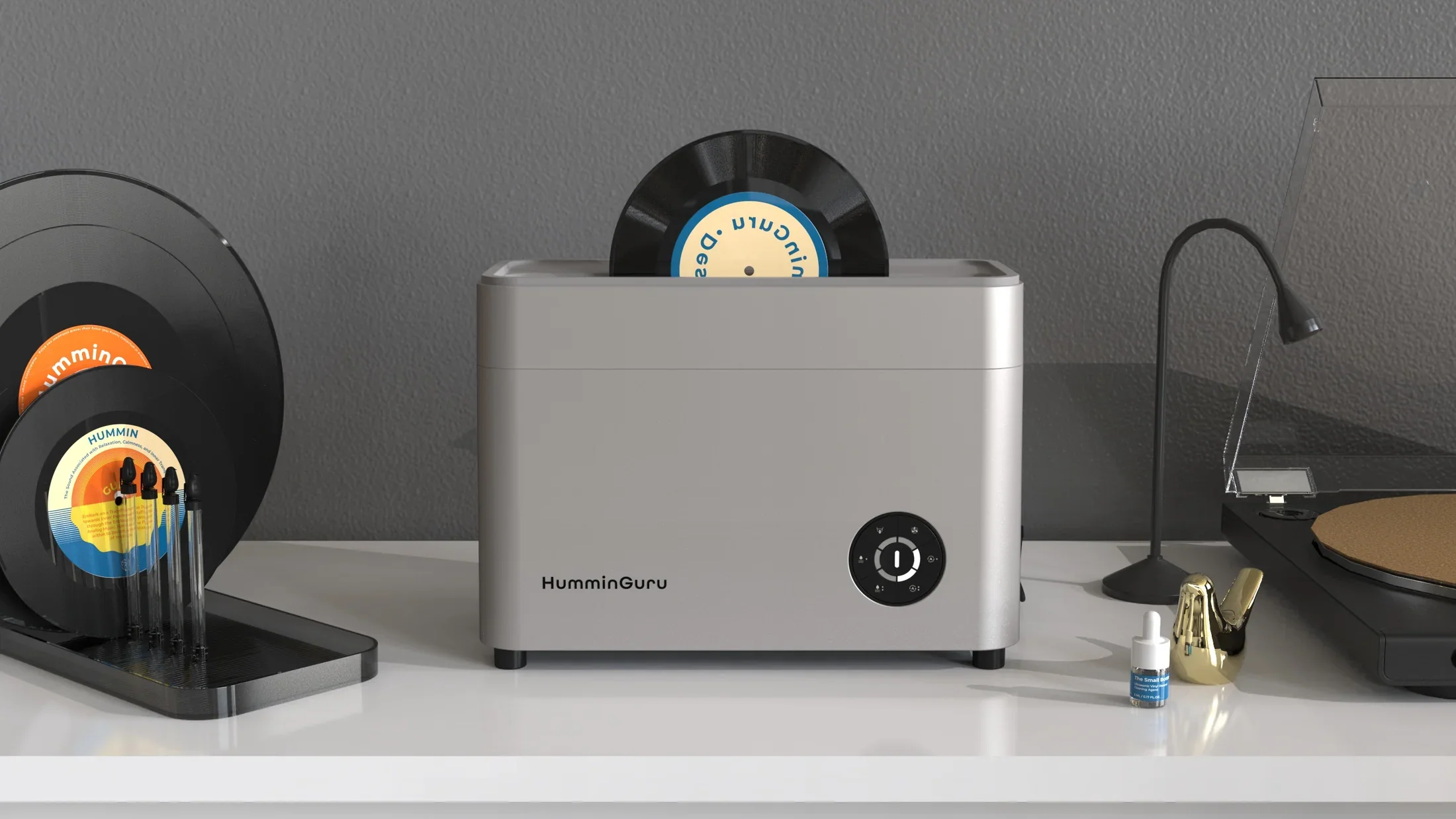
Once unpacked, the NOVA made a favorable impression. Measuring approximately 13.4 inches wide, 5.9 inches deep, and 10.3 inches high, and weighing just 7.5 pounds, it’s a compact machine. Its lightweight ABS plastic housing surrounds a narrow stainless-steel cleaning basin, with a removable water reservoir below. Everything is neatly assembled and readily accessible.
The accessories include a clever multifunction tool for removing the basin filter, checking the water level, and adjusting the record-support rollers, along with a filling funnel, replacement filters, international power adapters, and a small bottle of cleaning fluid. The lid also converts into a drying rack, although I didn’t test that feature or the adjustments for smaller records.
I initially set the NOVA up in a small, unused kitchen area to observe its water handling and operating noise. For 12-inch LPs, I filled the reservoir to the appropriate mark, then poured the water into the cleaning chamber through the supplied funnel, keeping it centered over the opening to avoid spills into the housing.
Having become accustomed to the Degritter’s automated water handling, I initially found the prospect of manually transferring water before each record a little daunting. The NOVA drains automatically after cleaning, but the water must be poured back into the chamber for the next record. In practice, the funnel made this considerably easier than I anticipated. Once, out of habit, I inserted a record and pressed Start without adding water, but caught the oversight almost immediately and paused the machine, with no apparent harm.
Lowering a record into the basin required some care. The hard plastic surrounding the opening, although rounded, made me wish for a protective rubber lip, and proper seating in the horizontal support slot at the bottom proved essential for reliable rotation. Once I understood the arrangement, handling became straightforward, with the label safely above the waterline. I would also recommend checking that the machine sits level with a small bubble level, although this isn’t mentioned in the instructions.
I began with distilled water alone, selecting the five-minute Deep Auto cleaning program and six-minute drying option. I wanted to establish that records emerged completely dry before trying the shorter drying setting or introducing HumminGuru’s cleaning fluid.
Initial Impressions
At the touch of a button, the record began rotating and ultrasonic cleaning started immediately. Unlike the Degritter, which can be programmed to rotate the record through the water before the ultrasonics engage, the NOVA has no preliminary soaking stage. I found myself wishing for a short period of rotation to allow the surface to become thoroughly wetted before cleaning began.
I also noticed a slight but continuous up-and-down movement as the record rotated, rising and falling by a few millimeters at regular intervals. Although this didn’t appear to interfere with cleaning, the mechanism lacked some of the refinement I’d experienced with the Degritter.
The NOVA occasionally produced a distinct squealing or whistling sound during cleaning, in addition to the fairly steady hiss or buzz I was accustomed to hearing from an ultrasonic cleaner. I couldn’t tell whether it originated with the ultrasonic system or the record transport. Checking the water level and experimenting with the cleaning fluid didn’t seem to affect it. The machine continued to operate normally, but the source of these unfamiliar sounds remained uncertain.
After cleaning, the NOVA automatically drained the water into its reservoir and began drying. This sequence worked reliably from the beginning. Labels remained dry, and the six-minute setting consistently left the records completely dry. I was particularly pleased with the drying performance, which was also relatively quiet compared with the Degritter.
I began with inexpensive used records and thrift-store finds, preferring to become familiar with the machine before introducing new or particularly valuable pressings. These also presented some interesting cleaning challenges.
Cleaning Methods and Chemistry
My preference is to remove obvious dust and surface grime before placing a record into an ultrasonic cleaning machine, using my VPI 16.5, although a simple manual wet cleaning would serve much the same purpose.
HumminGuru also recommends preliminary cleaning for particularly dirty records. There’s little reason to introduce easily removable contamination into a small bath that will be reused for several records. My intention was to let the NOVA address whatever remained after the obvious surface dirt had been removed.
Throughout the evaluation, I listened before and after each cleaning stage. For records receiving preliminary VPI cleaning, this meant assessing their existing condition, listening again after the VPI, and then after the NOVA. Selected records that appeared clean went directly into the NOVA. In some cases, I followed with a rinse or Degritter treatment, listening again to identify when improvements occurred.
I began with distilled water alone, which tended to bead on the vinyl rather than form a continuous film. This wasn’t particularly surprising, given its relatively high surface tension, but it raised a question about how thoroughly the bath was reaching the groove surfaces. Would HumminGuru’s recommended fluid improve wetting, and would that translate into better cleaning?
After five or six records, I also noticed that the water had become visibly cloudy, even though some had already been cleaned and rinsed on the VPI. I couldn’t determine what was entering the bath or where it originated. This became a recurring concern, which I’ll discuss later.
For the next bath, I added two drops of HumminGuru’s supplied cleaning fluid to fresh distilled water. Wetting improved noticeably, although its appearance varied. Some records developed a fine, mist-like coating; others showed long trails of water following the grooves, or occasionally a continuous, glossy sheet across the playing surface.
I couldn’t explain these differences with certainty. Vinyl formulation and previous cleaning treatments may have played a role. Regardless, the fluid consistently improved surface coverage over distilled water alone. Whether that meant more effective cleaning would have to be answered through listening.
At the two-drop concentration, foam formed on the reservoir water after drainage, and bubbles appeared when I poured it back into the chamber. I never observed foam on the record itself.
Because I wasn’t performing a separate rinse, I wanted to use as little fluid as possible while maintaining satisfactory wetting—the same approach I had taken with the Degritter. For subsequent baths, I reduced the concentration to one drop. Wetting remained satisfactory and reservoir foam diminished noticeably, although some bubbles persisted during pouring. I observed no visible residue on the records after drying.
Listening Tests and Results
Ultimately, the measure of any record-cleaning machine is what happens when the stylus enters the groove. A record can look immaculate and still produce an irritating amount of surface noise, while another with visible signs of wear may play surprisingly quietly. For me, the question was whether the NOVA could make an audible difference.
My initial experiments with thrift-store records produced mixed results. Some improved, while others showed little change. Preliminary VPI cleaning often removed much of the contamination before they reached the NOVA, and some remaining noise may have reflected permanent groove damage.
As the evaluation progressed, I selected better-preserved audiophile pressings whose manufacturing quality gave me reason to expect excellent playback. Although I knew little about their previous handling, they appeared clean enough to go directly into the NOVA after preliminary listening.
My SweetVinyl SugarCube SC-1 Mini provided a useful additional perspective. This digital audio component identifies and removes ticks and pops during vinyl playback. Its Monitor function let me hear the noise being removed independently of the music and compare it before and after cleaning. This wasn’t a scientific measurement, but it complemented normal listening.
One of the most satisfying results came from Sonic Fireworks, an audiophile direct-to-disc recording that appeared quite clean but exhibited scattered ticks and light crackle. After a ten-minute Heavy cleaning cycle in the NOVA, followed by six minutes of drying, both sides played with quiet backgrounds. The SugarCube’s Monitor function was virtually silent. No additional rinsing or cleaning was necessary, making this an especially convincing example of what the NOVA could accomplish on its own.
Another satisfying result came from an RCA Living Stereo shaded-dog pressing of Mahler’s Symphony No. 4, performed by Fritz Reiner and the Chicago Symphony Orchestra. I didn’t have this recording in my collection, and the prospect of finding an excellent original pressing was exciting. The record appeared beautifully preserved, and preliminary listening revealed only a little low-level crackle and a few ticks near the opening. I decided to put it directly into the NOVA. Following cleaning, those distractions had disappeared, leaving a quiet playing surface. The vinyl itself emerged looking spectacular, with a clean, glossy, reflective finish. It was precisely the kind of result I’d hoped for when I first examined the record.
George Winston’s Winter into Spring, on Windham Hill, offered a somewhat different experience. Pressed on audiophile-grade vinyl, this solo-piano recording should have been an ideal listening experience. Unfortunately, surface noise was interrupting the quiet spaces between musical passages. A preliminary cleaning on the VPI brought some improvement, but the record was still not as quiet as I had hoped. After cleaning in the NOVA, however, the background became beautifully quiet, allowing the natural resonance and decay of individual piano notes to emerge without distraction.
At that point, I decided the record deserved a permanent place in my collection. Although it was already playing beautifully, I gave it one final cleaning in the Degritter, simply because I wanted to give this particular record a little extra attention before putting it away.
Another satisfying rescue involved a thrift-store copy of Dick Schory’s Music for Bang, Baaroom and Harp. This has long been one of my favorite recordings, and the copy appeared clean and free of visible damage. I hoped it might become an excellent second copy for my collection.
The VPI performed much of the initial cleanup, producing a substantial improvement in playback. The NOVA then provided a further refinement, bringing the record to a level of quiet playback I hadn’t expected. Although I subsequently ran it through the Degritter, I could hear no additional improvement. The result was a beautiful 1S pressing that had been transformed from a promising thrift-store discovery into a record I was delighted to keep.
Not every record responded so favorably to the NOVA alone. An inexpensive thrift-store copy of Lew Davis and His Orchestra’s Delicado, on Command Records, presented a more complicated challenge. Despite a ten-minute Heavy cycle in the NOVA using two drops of HumminGuru’s cleaning fluid, the audible improvement was modest. Most of the ticks remained, and the background crackle diminished only slightly.
I then gave the record a gentle distilled-water rinse on the VPI, lightly brushing and vacuuming each side. The difference was immediately audible. The background was quieter, with less crackle and fewer ticks. A subsequent cleaning in the Degritter brought a smaller additional improvement, although some low-level crackle and a few repeating ticks remained.
Nevertheless, the successive treatments had transformed the record into a thoroughly enjoyable listening experience. The music was recorded at a sufficiently high level that the residual surface noise was largely overshadowed once the performance began, allowing the recording’s considerable sonic qualities to shine through.
I can’t say precisely why the distilled-water rinse made such a difference. It may have removed residual cleaning fluid or loosened contamination remaining after ultrasonic treatment. Listening after each stage identified when improvements occurred, but couldn’t establish their cause. The experience raised a question about the NOVA’s single-reservoir arrangement and the potential benefit of a separate rinse.
Taken together, these experiences demonstrated that the NOVA could produce excellent cleaning results, particularly with well-manufactured records whose surface noise responded to ultrasonic treatment. They also illustrated the limits of restoring noisy records and the possible value of a separate rinse.
Operation and Longer-Term Observations
Over the course of the evaluation, the NOVA became easier to live with than my initial impressions had suggested. Pouring water into the chamber soon became second nature, and I could hold the next record in one hand while pouring through the supplied funnel with the other. I experienced no significant spills or persistent difficulties.
The compact footprint remained an advantage, and the automatic wash, drain, and dry sequence required little attention once a cycle began. Throughout the evaluation, the machine completed its cleaning and drying cycles reliably.
I occasionally noticed a faint warm-plastic odor during operation, something I had also experienced with the Degritter during particularly intensive cleaning sessions. In neither case was it accompanied by any apparent malfunction.
Unlike my experience with the Degritter, I didn’t encounter automatic cooling interruptions during the NOVA sessions. The difference in their thermal-protection thresholds may help explain why. The Degritter Mark II initiates cooling when its cleaning water reaches 95°F (35°C), while the NOVA’s protection system activates at a considerably higher 131°F (55°C). The NOVA provides no continuous temperature readout, however, so I couldn’t determine how warm the water became during extended sessions.
My reservations about mechanical refinement remained, but in day-to-day use, the NOVA proved more convenient and dependable than I had initially anticipated.
Filtration and Water Management
My principal concern with the NOVA involves its approach to filtration.
Unlike systems that continuously circulate and filter the bath during ultrasonic cleaning, the NOVA holds the water in the chamber throughout the wash. It does, however, employ two stages of filtration when the water is drained and returned to the removable reservoir. The water first passes through a filter at the bottom of the cleaning chamber, then through a second filter in the reservoir. Neither provides continuous filtration during the cleaning cycle.
After approximately five or six cleaning cycles, the water frequently appeared cloudy, with fine suspended material visible. This occurred with both distilled water alone and HumminGuru’s cleaning fluid. Yet the washable white filter in the reservoir showed little visible discoloration, even after repeated use.
I rinsed the filter with distilled water, flushing it against the normal direction of flow as a precaution, but saw no obvious reason to replace it. To assess its effectiveness, I poured some of the cloudy bath water into a glass beaker and examined it. After emptying and rinsing the beaker, I poured the remaining water through the filter and into the beaker for comparison. I could see no appreciable difference in clarity. Although this was only a visual comparison, it left me uncertain about how effectively the filter was removing fine suspended material.
For a separate experiment, I prepared a fresh Degritter bath and installed a new filter. I then cleaned approximately ten records previously processed in the NOVA, some of which had also received preliminary VPI cleaning. Each received a standard two-revolution cycle.
Afterward, the Degritter filter had visibly darkened.
Material had been collected during that subsequent processing, but the experiment did not establish its origin, whether it had remained on the records after NOVA cleaning, or whether contamination had been redeposited during the earlier cycles. Taken together with the cloudy NOVA baths, however, it reinforced my preference for more comprehensive filtration.
Based partly on other owners’ experiences, I adopted a limit of approximately five records per bath early in the evaluation. My observations supported that practice, particularly with used vinyl. Fortunately, the NOVA requires only about 380 milliliters of water. With distilled water costing approximately $1.50 per gallon in my area, a fresh bath costs about fifteen cents, making frequent changes an inexpensive precaution.
HumminGuru offers an additional reservoir that could be used for a separate distilled-water rinse. I didn’t evaluate this arrangement, but it would require removing the record, exchanging the water, refilling the cleaning chamber, and initiating a separate rinse cycle. By contrast, the Degritter Mark II has a programmed two-reservoir rinse function that prompts the operator to exchange tanks after washing, then automatically continues with rinsing and drying without removing the record. Collectors who already own a vacuum record-cleaning machine can also perform a separate distilled-water rinse on that machine, as I did with Delicado. That experience suggested that rinsing can sometimes make an important audible difference, although whether a second NOVA reservoir would have produced the same improvement remains unanswered.
Some owners reportedly wash several records in succession, temporarily placing them in the supplied drying rack before changing the water and rinsing the batch. I didn’t evaluate this approach.
Warranty, Service and Long-Term Ownership
One consideration with any record-cleaning machine is what happens when something eventually goes wrong. Jacqueline Ng, Managing Director of the HumminGuru team, explained that machines purchased through the company’s website or Amazon store carry a one-year warranty covering replacement parts and shipping.
Afterward, replacement components remain available for purchase, with the owner responsible for parts and shipping costs. Troubleshooting is handled by email, generally beginning with a description of the problem and a short video, followed by parts and installation instructions.
The company expects most repairs to be performed by the owner, estimating that a typical component replacement takes 10 to 15 minutes. Some collectors will be comfortable with this approach; others may hesitate to open an electrical appliance.
Jacqueline confirmed that circuit boards, fans, pumps, and gearboxes are available after the warranty expires. That assurance did not extend to ultrasonic transducers. She described transducer failures as extremely rare but did not confirm whether replacements would be available.
Owners seeking professional assistance may be able to arrange it through a local HumminGuru dealer, although the company does not appear to have an established repair network. Machines arriving damaged or defective are handled individually, with replacement or professional repair considered according to the circumstances.
I appreciate HumminGuru’s willingness to supply components and support owner-performed repairs. Nevertheless, long-term serviceability, particularly if a major ultrasonic component fails, remains an open question.
Final Thoughts
After several weeks with the HumminGuru NOVA, I came away with a greater appreciation for what the company has accomplished, along with a clearer understanding of the compromises involved.
Its compact footprint, straightforward operation, manageable water requirements, and consistently effective drying are genuine strengths. Despite my reservations about mechanical refinement, the machine performed reliably throughout the evaluation.
Most importantly, the NOVA demonstrated excellent cleaning ability. Several well-preserved audiophile pressings emerged with very quiet playing surfaces, and some required no further cleaning or rinsing. These were among the most satisfying experiences of the evaluation.
Results with older, previously handled records were less predictable. Some benefited considerably from additional cleaning, while others showed little improvement regardless of the method employed. These experiences reinforced my belief in preliminary wet cleaning, particularly for collectors who regularly purchase used records.
My principal reservation remains filtration. Although I couldn’t establish that suspended material was being redeposited on records, the visibly cloudy water left me wishing for more comprehensive filtration. Frequent bath changes are an inexpensive precaution, and a separate distilled-water rinse may offer additional benefits, but both require greater involvement from the owner.
For someone purchasing a first record-cleaning machine, my inclination would still be to invest in a capable vacuum record cleaner, adding ultrasonic cleaning later. The two methods approach record cleaning differently, and I’ve come to regard them as complementary. A good vacuum machine can produce excellent results on its own, while ultrasonic cleaning can provide an additional level of refinement, sometimes bringing an already clean record to an even quieter level of playback. For collectors who already have an effective preliminary cleaning method, the NOVA may be an especially appealing addition.
I also appreciate HumminGuru’s willingness to provide replacement components and support owner-performed repairs, even as questions about long-term serviceability remain.
The NOVA’s cleaning capability impressed me more than the refinement of its design. It’s a very capable machine, and its ability to bring a well-made record back to quiet playback was demonstrated repeatedly during my evaluation. At its relatively accessible price, it offers an impressive introduction to ultrasonic record cleaning, and for collectors willing to work within its limitations, it can be a genuinely rewarding addition to a record-care system.