
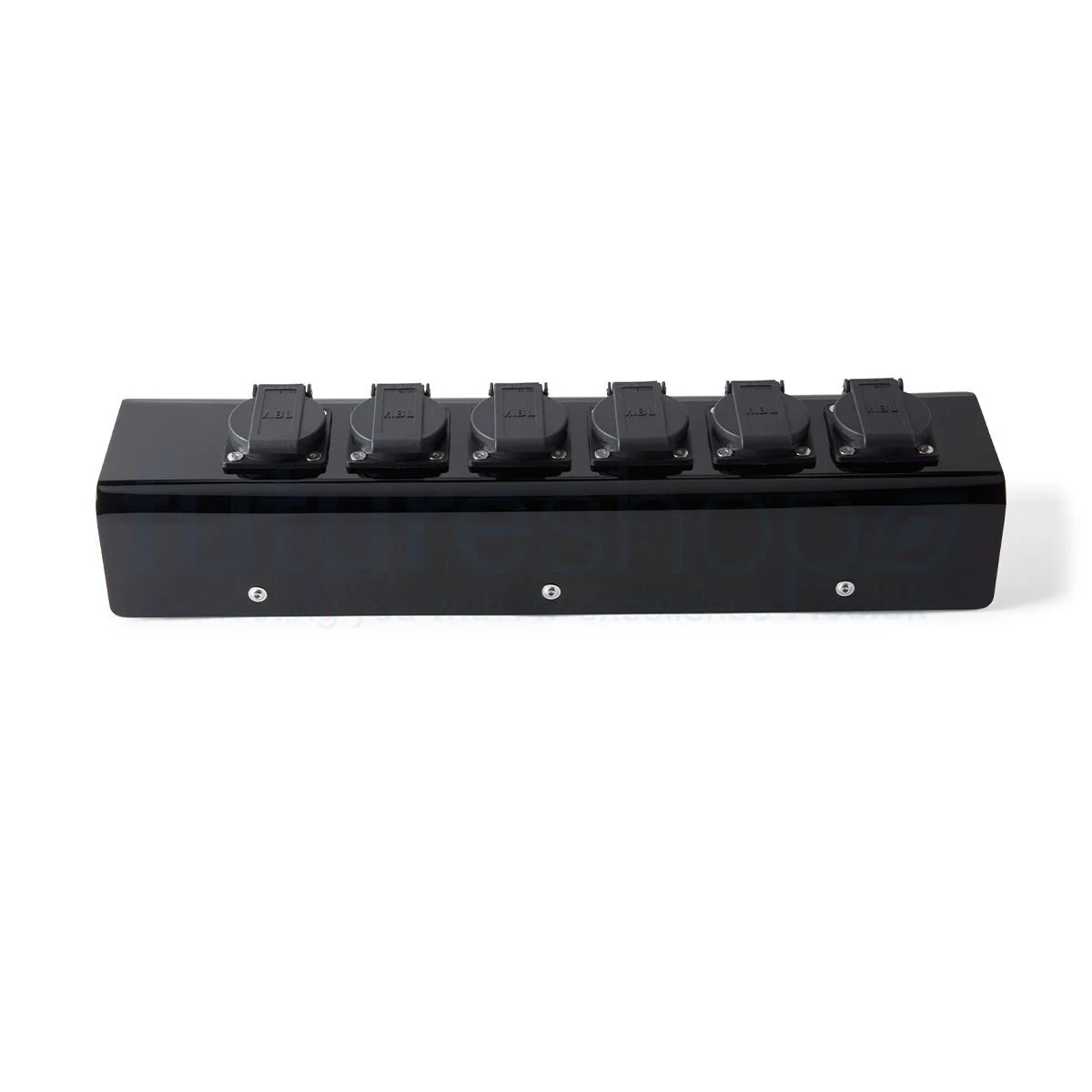
Connected Fidelity Six Star Distribution Block with RFI Filter
How one powers their audio system is essential, and there are many ways to do so besides just plugging components into a wall socket. Issues such as nonuniform voltage, electromagnetic interference (EMI), radio-frequency interference (RFI), and ground loops often require attention because they introduce noise. To address such issues, no single solution fits all; depending on where you live (out in the countryside or in a large metropolis), regional differences in how power is brought into your home can be significant. Different solutions may work better than others. Most audiophiles with high-end systems use a power conditioner of some kind, power strips, power regenerators, or a mix of several. The benefits include reducing the noise floor so that the background in the musical presentation is quieter, yielding clear sound; better separation of instruments in the perceived 3-D soundstage; and tighter bass.
Over 15 years ago, when I first began expanding my audio system, I used a PS Audio power strip called the “Dectet Power Center” (no longer manufactured); it had 10 outlets, two of which were for high-current devices (such as amplifiers). It was well built, never broke down, and did a nice job for my needs at the time. I still use it now, but not for my audio system: Its duties have been reduced to more mundane ones, such as charging or powering computers, mobile phones, electric razors, and supporting the many electric devices my children use. Over time, I moved up to an early version of a PS Audio power regenerator—the PerfectWave Power Plant 3—and then to the (even more expensive) Power Plant P12. (Such regenerators pull in the AC from the wall, convert it into DC, and then convert it back into “clean” AC.) But after another six years, as my system became much more elaborate and complex, I decided, in the Spring of 2025, that I needed to revisit these issues. I decided to start over from scratch and explore more carefully what would work. I focused, for starters, on high-end AC power distribution blocks built specifically for audio; in general, they are lightweight, small, and less expensive than alternatives.
This brings us to the focus of this review: Connected Fidelity Six Star Distribution Block with RFI Filter. (USD 1000). Hand-built in the UK, the sole US distributor is Sierra Sound in Sacramento, California, founded in 2020 by Michael and Sylvia Fajen. A friend of mine introduced me to Michael (President of Sierra Sound), and after several discussions with him, I decided to buy one of the Six Star Distribution Blocks. Connected Fidelity make two versions differing only in their input jack, involving “high versus low current”: One for high-current components like amplifiers (USD 1000 US); it comes with a heavy-duty 20-amp C19 IEC jack, and one for lower-current components like preamps, music servers, and DACs (USD 950); it comes with a 13-amp standard C14 IEC jack (all your standard high-end cables will work here) I initially bought a high-current one, but suffice to say, two months later, so satisfied was I that I bought a second one (low current)! Many thanks to Michael Fajen for his wise advice and all his help in acquiring these units.
How do they look, and what do they bring to the table?
With a glossy black finish, they look appealing and visually even match my glossy black speakers (Alta Audio Aphrodite). There is no need to hide them; they even look a dash glamorous. The “Star” refers to the (crucial) star topology/wiring they are endowed with, and the “Six” refers to their having 6 outlets. A star topology internally connects each outlet directly (with its own separate wiring) to the main input (the “star point”), rather than in series. In particular, all components connect to that same ground point; thus, they share the same ground potential, eliminating ground loops. Moreover, all components (connected to the outlets) receive identical impedance. (Most high-end distribution blocks now use some variation of this; Nordost does so, for example.)
A diagram of such a topology looks like a star. This engineering method is easier said than done; it is not trivial to carry out for serious high-end use, and requires expensive parts and delicate engineering; check out:
The Connected Fidelity “White Paper”, for details and a nice “Star” diagram:
Another feature that attracted me is the option of including the RFI passive filter, included on mine by choice, a necessity in my location (Manhattan, NYC). The units require a power cable of your choice, so the prices given are for if you supply your own; but Connected Fidelity makes its own high-end, hand-made “Unity Two Cables” that use the same internal wiring as the distribution block; I bought those as well. (USD 1100 for 1.5m for the C19, USD 1050 for 1.5m for the standard C14 with the distribution block purchase; a bit more costly if bought separately.)
In general, you plug a Six Star directly into the wall, but Connected Fidelity also offers for sale (expensive) an AC-2K balanced power unit that plugs into the wall with the Six Star plugged into it. (I did not explore that option; perhaps I will do so at a later date. Intriguing.)
Six Star distribution block features in more detail:
Live, neutral, and earth are hard (no solder) 'Star wired' to 6 output sockets, therefore components connected to any of the sockets are offered identical power capability and impedance - no loss of dynamics.
Point-to-point wiring used throughout is the same wire as used in the Unity Two power cables and the AC-2K balanced power unit. A specially formulated mains power wire for audio and AV.
All power components and wires are cryogenically treated for the highest power flow quality from the input socket to the output sockets.
High-quality Furutech gold-plated input socket as standard, with C14 (13A) and C19 (20A) options.
Six German-made high-quality output sockets, with sprung protective dust caps, UK and Schuko options available.
An external isolated earthing point connected directly to the star earth.
Low-resonance case construction using plastics and a non-magnetic stainless steel sub-chassis for reduced vibration intrusion.
Special design silicon rubber isolation feet.
Star wired wide band RFI filter option for use with ‘direct from the wall’ power supply.
Special price packages, including cable(s) or an AC-2K balanced power unit (or both), are available.
Dimensions: 330mm Long x 96mm Wide x 84mm High (inc. isolation feet).
Summary
This is the beginning of what I suspect will be an ongoing journey. But without reservation, I will say that I am, for the time being, just enjoying listening to music without thinking about anything else; the musicality presented by my system is high; the background is remarkably quiet. The Connected Fidelity Six Star Distribution Block with RFI Filter has been an exceptional starting point. Highly recommended.
Further information: Connected Fidelity
![Decca Pure Analogue— Sibelius: Symphonies 5 & 7; Tapiola/Colin Davis conducting the Boston Symphony Orchestra [2026/2 LPs/33 rpm]](https://images.squarespace-cdn.com/content/v1/55787f0ae4b02f0501debbeb/1769726727925-91VBFUZ9276PVWZBNO5Y/IMG_0505.jpeg)