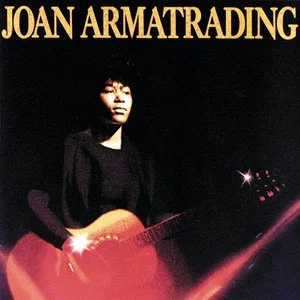
Joan Armatrading – Joan Armatrading (1976) A Reappraisal Through Three Pressings
Introduction
Downsizing a record collection has a way of forcing uncomfortable decisions. It’s one thing to admire a record in the abstract; it’s another to ask whether it truly earns its place on the shelf. While surveying my collection and identifying titles where I owned multiple pressings, I arrived at Joan Armatrading. I had long assumed the decision would be straightforward — until the thought of letting any one copy go became far more difficult than expected. Before making that decision, it became clear that I needed to hear the Intervention Records reissue to fully understand what this album was capable of sonically.
⸻
Context & Production
Released in 1976 and produced by Glyn Johns, Joan Armatrading represents a fully realized artistic statement. By this point, Armatrading’s voice, songwriting, and emotional authority had aligned into a singular style blending folk, rock, and soul-inflected introspection.
Johns’ production favors space, balance, and realism. Armatrading’s voice is placed prominently — often centered or slightly off-center — with reverb used judiciously to create depth without softening impact. The album rewards careful listening, particularly in its handling of dynamics and silence.
⸻
Core Musicians
The core band for Joan Armatrading (1976) brings a focused, highly musical foundation to the album:
• Joan Armatrading – acoustic guitar, vocals
• Dave Markee – bass
• Jerry Donahue – electric guitar
• Peter Wood – piano, organ
• Kenny Jones – drums
• Dave Mattacks – drums
A few additional musicians contributed on select tracks, adding subtle textures and embellishments, but the album’s emotional and sonic cohesion rests on this core group. Their interplay supports Armatrading’s voice and compositions with precision and nuance, allowing the performances to breathe naturally while maintaining musical authority.
⸻
Musical Highlights
“Down to Zero”
“Down to Zero” opens the album with quiet confidence. Piano, acoustic guitar, and bass form a gently swinging, propulsive foundation, subtly expanded by BJ Cole’s pedal steel guitar. Armatrading’s vocal floats above the arrangement, moving effortlessly from urgency to intimacy. The warmth and dimensionality of her voice immediately establish the album’s emotional gravity.
“Help Yourself”
“Help Yourself” unfolds patiently, holding back for two verses before expanding into a more energetic passage that reveals striking vocal range. Strings arranged by Brian Rogers lift the closing section, completing a carefully shaped emotional arc.
“Love and Affection”
“Love and Affection”, Armatrading’s UK Top 10 single, opens with arresting simplicity — voice and acoustic guitar alone. As drum and bass enter, the song broadens without losing intimacy. Strings, background vocals, and a vibrant saxophone solo by Jimmy Jewell add color, resulting in an unconventional hit whose melody lingers long after it ends.
“Save Me”
The emotional core of the album arrives with “Save Me”, which closes side one. The vocal moves delicately between registers as the chord changes quietly intensify the song’s impact. When the strings enter, they deepen the sense of vulnerability. In the brief coda, Armatrading descends from her upper register to her lowest on the final “save me” — a devastating moment of emotional exposure.
⸻
Side Two Perspective
The first side of Joan Armatrading feels remarkably complete — emotionally resolved and self-contained. Side two, by contrast, feels purposefully different.
“Join the Boys”, “People”, and the closing track, “Tall in the Saddle”, explore heavier, more rock-oriented territory, with dense arrangements and confident musicianship. The performances and sound quality remain strong, but the emotional cohesion of Side One gives way to stylistic exploration.
This kind of front-loading is not unusual. Artists and producers often craft side one as a unified statement, leaving side two freer to experiment with sound and style. Heard in this light, side two broadens the portrait of Armatrading as an artist, even if it doesn’t carry the same emotional weight as the album’s first half.
⸻
Pressing Comparisons
Original A&M (US, 1976)
The original US A&M pressing (SP 4588) established the album’s audiophile reputation. It was mastered at The Mastering Lab in Los Angeles — identified in the run‑outs with the inscription “Hack It” on both sides — a detail that signals the care taken with this early cut.
Soundstage placement is natural, bass is authoritative, and the presentation feels organic and unforced. However, pressing noise intrudes during quieter passages, limiting its ultimate resolution.
There is also a noticeable inconsistency between sides. Side A sounds more open and compelling, while Side B is comparatively flatter and less engaging sonically. This unevenness underscores the limitations of the original pressing, even as its fundamental tonal qualities remain appealing.
⸻
Speakers Corner (1997 Reissue)
The Speakers Corner edition (180 g reissue from 1997) improves upon the original with a quieter surface, greater dynamic expression, and enhanced low-level detail. The presentation is slightly more laid back than the Intervention pressing but consistently refined. It remains an excellent and satisfying reissue.
⸻
Intervention Records (2020 Reissue)
The Intervention Records edition, mastered by Kevin Gray at Cohearent, and pressed on exceptionally quiet vinyl, stands clearly above the others. It delivers greater clarity, depth, and dynamic nuance without sacrificing warmth. Vocals possess striking dimensionality, and soft-to-loud transitions feel lifelike and immediate.
The physical presentation is equally impressive. The record comes in a high-gloss tip-on gatefold, with the lyrics elegantly spread across the interior rather than printed on a separate inner sleeve. It is, without question, the best-looking presentation this album has ever had.
Crucially, the mastering brings Side Two fully up to the sonic standard of Side One, eliminating the inconsistency heard on the original A&M pressing. The album now allows the stylistic contrast between the two sides to be appreciated without sonic compromise. Emotionally, it is the most engaging and immersive of the three.
⸻
Conclusion
Revisiting Joan Armatrading confirmed its essential place in my collection, and it also reminded me why it’s difficult to limit oneself to a single pressing. Each edition offers something worthwhile, and a quiet original A&M or the Speakers Corner could easily satisfy many listeners.
Ultimately, however, the Intervention Records release delivers the most complete experience. From its impeccable pressing quality to Kevin Gray’s sensitive mastering, it reveals the album’s full emotional and sonic potential while preserving its organic character.
As for my own attempt at editorial discipline, the outcome was mixed but decisive. I kept two pressings — the Speakers Corner and the Intervention — and the original A&M didn’t even make it back to the shelf. It went straight into the giveaway pile. If restraint is measured in small victories, I’ll happily take this one.