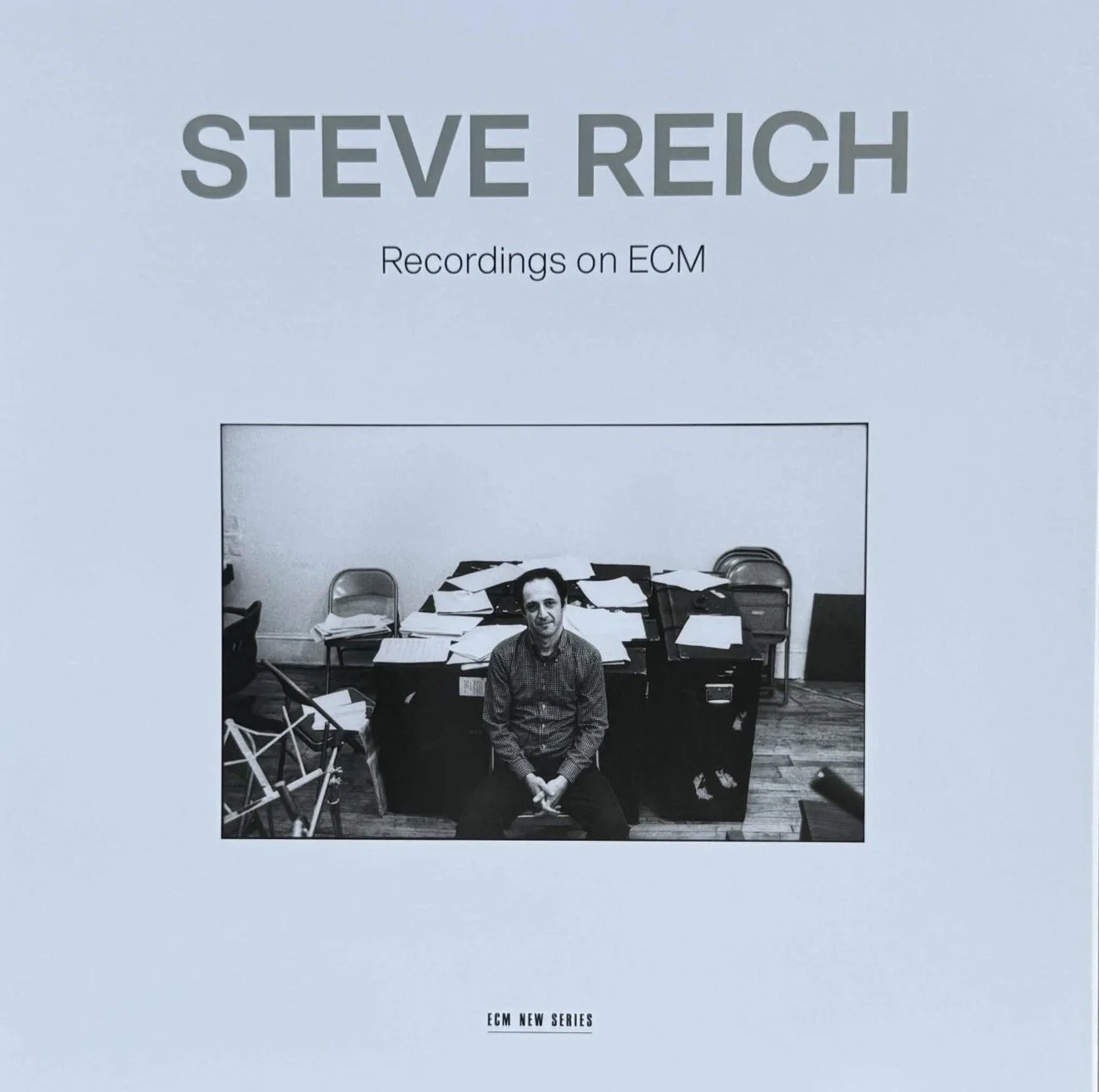
Steve Reich at 90: The ECM Recordings Revisited
I first discovered Steve Reich through my exploration of Philip Glass and other composers working outside the musical mainstream. Music for 18 Musicians was my introduction to Reich on record, and I was immediately captivated by its unusual instrumentation, interlocking rhythmic patterns, and the gradual transformations taking place throughout the work. Sometime around 1980, I attended a performance by the Steve Reich Ensemble in Boston, bringing along a friend whom I was trying to introduce to music beyond the rock and roll we usually listened to. I remember worrying that the experience might test his patience. Instead, he emerged from the concert dazzled, even mesmerized. Watching the musicians create this extraordinary tapestry of sound was a revelation for both of us.
Nearly half a century later, Reich’s music remains very much a part of my musical life. Just last month, I attended a performance of his Double Sextet at Miami’s New World Center, and later this month I’ll return to hear Three Movements for Orchestra. Both are later works, reminders of how his musical language continued to evolve beyond those early recordings that first captured my imagination. These performances are part of the celebrations marking Reich’s 90th birthday, an occasion ECM is also honoring with a newly remastered vinyl box set of its three landmark albums.
The ECM Recordings
In retrospect, it seems remarkable that Music for 18 Musicians struggled to find a home on record. Deutsche Grammophon recorded the work in Paris in 1976, but its parent company, Polydor, held the tapes for nearly two years, apparently uncertain what to do with music that resisted conventional categories. Manfred Eicher recognized its potential, and ECM released the recording in April 1978. The response was immediate. According to Paul Griffiths, whose illuminating essay accompanies this new collection, the album sold more than 100,000 copies in its first year. Not bad for music that the recording industry had difficulty categorizing.
These recordings are especially significant because they document Reich’s compositions in the hands of musicians who knew them intimately. Reich himself participated, and many of the same performers appear throughout the sessions. As Griffiths points out, Reich did not authorize performances and recordings of his music by other ensembles until 1990. The second ECM album, released in 1980, brought together Music for a Large Ensemble, Octet, and the earlier Violin Phase. Particularly noteworthy is the recording of Octet, which preserves the composition in its original form before Reich expanded the instrumentation and renamed it Eight Lines. The third album, Tehillim, followed in 1982, marking a significant change in direction with its settings of Hebrew psalm texts.
Although these three albums appeared within just four years, they document a period of considerable musical development. The intricate, interlocking patterns of Music for 18 Musicians lead to increasingly elaborate instrumental writing, culminating in the vocal and melodic language of Tehillim. ECM has brought them together in an elegant, minimalist white box containing facsimiles of the original album sleeves and an illustrated booklet with Griffiths’s historical essay. It’s a thoughtful presentation of recordings that remain central to Reich’s recorded legacy.
Music for 18 Musicians
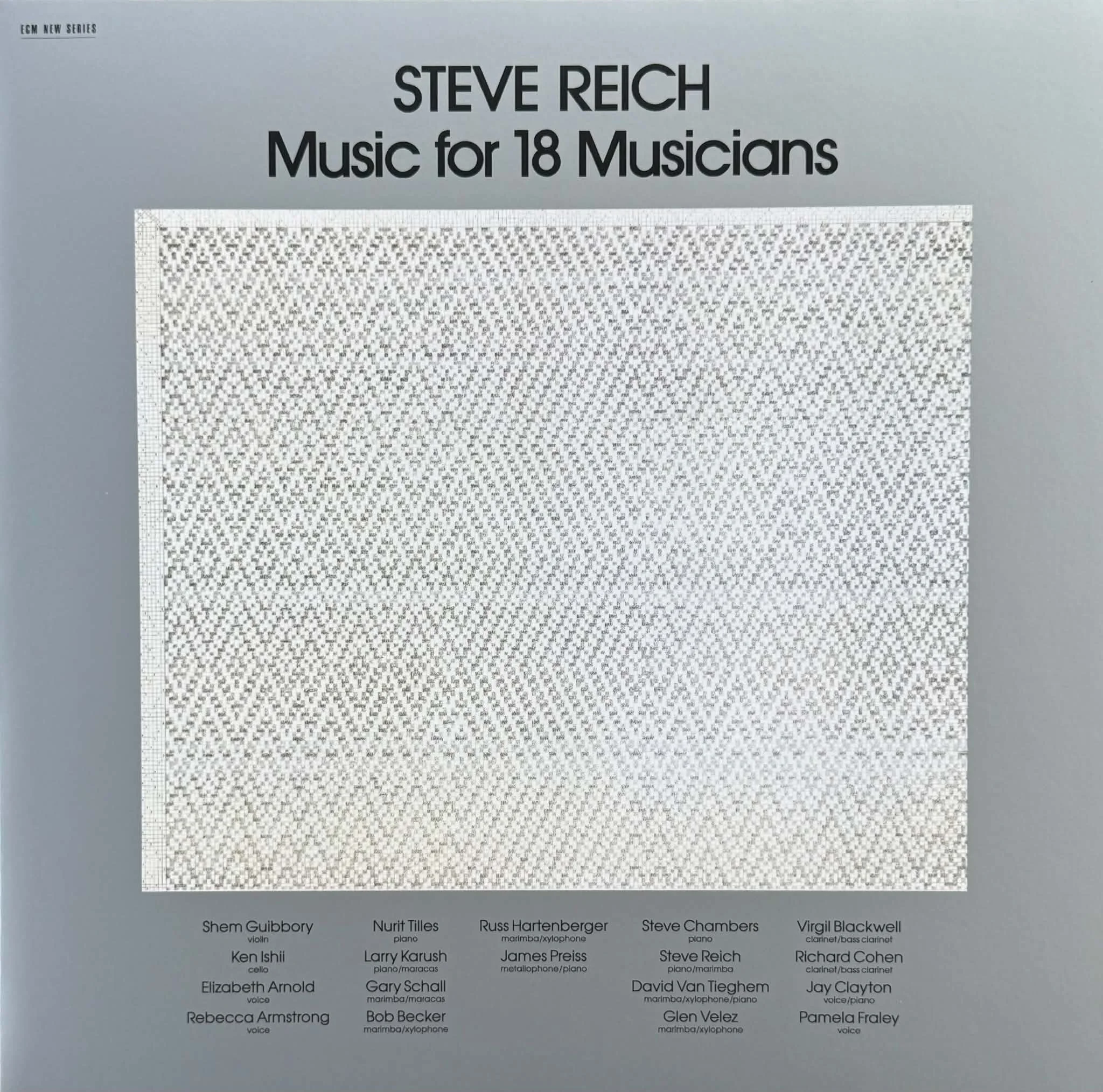
Music for 18 Musicians unfolds like an intricate musical tapestry, with instrumental lines weaving in and out, rhythmic patterns emerging and gradually transforming into something new. Reich employs an unusual combination of marimbas, xylophones, pianos, clarinets, strings, and voices, creating an extraordinarily rich palette of sound. Pulses establish themselves, then recede as other instruments take their place. The wordless voices blend so naturally into the instrumental textures that, at times, they could easily be mistaken for another instrument in the ensemble. The music moves between passages of considerable density and moments of relative quiet, allowing each new section to emerge naturally. Even the bell-like sounds of the metallophone serve a practical purpose, signaling changes to the performers without interrupting the musical flow. The original cover artwork seems to reflect the music itself. Its spare, nearly monochromatic design, with lines weaving through one another, offers a visual suggestion of the shifting patterns within. There’s an elegance to its simplicity that perfectly complements the music.
My original American ECM pressing has a wonderfully natural, slightly soft character, with excellent clarity and instrumental definition. Individual lines emerge effortlessly from the ensemble, while the cellos provide a satisfying foundation in the lower frequencies. Freshly cleaned, my nearly fifty-year-old copy plays with virtually no surface noise, setting a formidable standard for this reissue. Happily, the new iteration preserves those qualities while offering subtle yet consistent improvements across the board. There’s greater clarity in the textures of the violins, cellos, marimbas, and pianos, along with a more convincing sense of space and dimensionality. The pressing is so exceptionally quiet that the medium itself seems to disappear, leaving the music floating freely in the air. It’s a meaningful improvement on an original pressing that was already remarkably good.
Octet / Music for a Large Ensemble / Violin Phase
The second ECM album presents three compositions that reveal different aspects of Reich’s musical thinking. Music for a Large Ensemble feels more expansive than Music for 18 Musicians. Where the earlier work creates a tightly woven musical fabric, this one operates on a broader canvas, with longer melodic arcs, more open spaces, and dramatic changes in character. Sustained instrumental tones emerge above the busy rhythmic patterns, gradually swelling and receding into the ensemble. The occasional audible signal from the vibraphone marks a transition, allowing the musicians to move into the next section without a conductor.
Violin Phase, composed in 1967, returns us to one of Reich’s earliest techniques. Violinist Shem Guibbory performs all four parts through multitracking, creating a constantly shifting relationship among the overlapping figures. The apparent simplicity of the musical material conceals moments of almost bewildering complexity and passages of extraordinary clarity. At times, the effect seems almost organic, as though the patterns were occurring naturally. At others, it’s like watching a multifaceted jewel slowly turn, each movement revealing another aspect of the same musical material.
In Octet, the intricate piano writing provides much of the foundation, while strings and woodwinds continually alter the musical colors. The lighter tones of the flute and piccolo emerge above the ensemble, followed by the richer textures of the clarinets and bass clarinets. Each instrument seems to come briefly to the fore before returning to the larger musical fabric. As with Music for 18 Musicians, the new edition offers subtle but consistent improvements over my excellent original American pressing. There’s greater clarity, depth, and instrumental definition, revealing musical details that were less apparent before. Yet the presentation remains wonderfully natural. It’s another beautifully judged remastering.
Tehillim
Of the three ECM albums, Tehillim is the one I was least familiar with. When I bought it in 1982, I was still thoroughly captivated by the phasing, repetition, and interlocking rhythmic patterns of Reich’s first two ECM albums. Tehillim was something quite different, and I suspect I played it only once or twice. Returning to it more than four decades later has given me a fresh appreciation for just how much Reich’s musical language was evolving during this period.
Here, Reich sets Hebrew psalm texts for four female voices and an ensemble of strings, woodwinds, percussion, and electric organs. The words become central to the composition, shaping its extended melodies and changing rhythms. The work opens with a lone voice accompanied by percussion. As the music develops, the voices overlap, melodic lines become more elaborate, and instrumental colors continually change. The rhythmic precision of the percussion is especially impressive, while passages of considerable energy alternate with moments of surprising openness.
The recording itself is extraordinary, perhaps the most spacious and dimensional of the three. The voices occupy distinct positions within an expansive soundstage, and the percussion has a wonderful sense of presence and precision. The electric organs add another layer of color, occasionally filling out the ensemble before receding to reveal more intimate combinations of voices and instruments. I still find Tehillim demanding music, something I’m inclined to experience in smaller doses. Returning to it has nevertheless deepened my appreciation for its originality and the exceptional performances captured by ECM. It represents a fascinating new direction in Reich’s development and an important part of the story these three recordings tell.
Final Thoughts
Revisiting my original American ECM pressings only increased my admiration for what the label has accomplished here. Those records remain beautifully made, exceptionally quiet, and musically convincing, and I have no intention of parting with them. The new all-analogue masterings bring subtle but meaningful improvements in clarity, instrumental texture, and dimensionality while preserving the natural, unforced character of the originals. The pressings are exceptionally quiet, the satin-finished jackets are exquisite, and the accompanying booklet adds welcome historical perspective. At approximately $33 per record, the collection represents impressive value.
More importantly, this collection celebrates an extraordinary period in Steve Reich’s creative life, one in which his musical language expanded from the intricate instrumental patterns of Music for 18 Musicians to the very different vocal world of Tehillim. ECM recognized the significance of this music when others were uncertain where it belonged, and nearly half a century later, the label has returned to these recordings with the same good judgment. ECM has approached this collection with fidelity, restraint, and care. The result has exceeded my expectations, and it’s difficult to imagine a more fitting celebration of these landmark recordings and Reich’s 90th birthday.