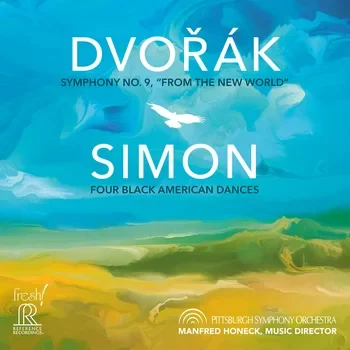
Dvořák: Symphony No. 9 “From the New World” / Carlos Simon: Four Black American DancesPittsburgh Symphony Orchestra / Manfred HoneckReference Recordings FR-769SACD
I am an unapologetic fan of Pittsburgh.
I grew up there. I studied music—and later law—there. Decades ago, when I was still playing trumpet and studying conducting, some of my teachers were members of the Pittsburgh Symphony Orchestra. And like so many Pittsburghers interested in classical music, I grew up with the orchestra as a fixture of the city’s identity.
I first knew the PSO under Lorin Maazel, then Mariss Jansons, and later Manfred Honeck. Along the way, I came to know the great recordings from earlier Pittsburgh eras under William Steinberg and André Previn.
There has always been something slightly improbable—and rather wonderful—about a relatively small Rust Belt city possessing an orchestra of unquestioned international stature. Pittsburghers are accustomed to punching above their weight, and the Symphony has long been one of the finest examples.
But life intervenes. I moved to Europe nearly seven years ago, and by this summer I had not heard the Pittsburgh Symphony live in more than a decade.
Then Dr. Jan Leysen—a reader of Audiophilia who has since become a close friend—invited me to tag along to a live concert in Essen, Germany.
The PSO was in Europe for its 2026 international tour, a 13-concert journey through six countries under Honeck. On September 8, it appeared at the Philharmonie Essen with pianist Alexandre Kantorow in a program of John Adams’ Short Ride in a Fast Machine, Rachmaninoff’s Rhapsody on a Theme of Paganini, and Dvořák’s Symphony No. 9, From the New World.
Jan and I also had the opportunity around the concert to speak with several members of the orchestra for what we hope will become a forthcoming Audiophilia piece about audiophile musicians—performers who care not only about making music but also about how it is reproduced at home. Among those we spoke with were the orchestra’s new Principal English Horn, Tim Daniels; Assistant Concertmaster Dylan Naroff; Principal Bass Trombone Jeff Dee; & Principal French Horn William Caballero. That is another story, but spending time with these musicians before hearing them perform perhaps made me especially attentive to something I had not expected.
This was not quite the Pittsburgh Symphony I remembered.
The basic DNA was unmistakable. The power was still there. Pittsburgh horns still sounded like Pittsburgh horns. But the orchestra seemed more flexible, more refined and, perhaps most surprisingly, more beautiful.
Part of that impression may have come from the orchestra’s changing personnel. Pittsburgh still has veteran musicians whose sound has defined the ensemble for decades, but they are now joined by a younger generation occupying important chairs. David McCarroll has assumed the role of Concertmaster, with Dylan Naroff serving as Assistant Concertmaster, while players such as Daniels and Dee contribute their own voices to a section-by-section renewal that never seems to disturb the orchestra’s underlying identity.
Adams’ Short Ride in a Fast Machine was exactly that: tight, manic and thrilling, with focused brass playing and an exhilarating sense of forward momentum. In the Rachmaninoff, Kantorow and Honeck found not only the virtuosity but the wit and torment beneath it.
And then came the Dvořák.
The strings seemed richer and sweeter than I remembered them, with a suppleness that complemented rather than diminished their traditional muscularity. The winds retained their individuality while blending almost effortlessly. The brass possessed tremendous weight but did not bludgeon. And the dynamic range was extraordinary. The Largo, in particular, seemed capable of shrinking the enormous hall around us as the orchestra descended into pianissimos that compelled rather than merely invited the audience to listen.
The overall impression was of an ensemble that had acquired another layer of sophistication during my absence.
Power and grace.
I went to Essen expecting to enjoy hearing my hometown orchestra again.
I left wanting to understand Dvořák’s Ninth better.
Going Back to the New World
That experience sent me back to the record shelves.
Dvořák’s New World is hardly neglected on record. The catalogue is crowded with formidable interpretations, and over the following weeks I revisited many of them. There was István Kertész and the London Symphony Orchestra on Decca, among the enduring reference accounts of the work; Karajan and the Berlin Philharmonic; Kubelík; Reiner; Szell; Ančerl; and others.
This is one of the pleasures—and dangers—of rediscovering a standard work. The more you listen, the more difficult it becomes to imagine that anyone can say something genuinely new about it.
And yet I kept thinking about Essen.
I kept thinking about the softness of the Pittsburgh strings, the flexibility of Honeck’s phrasing, the warmth of the winds, the terrifyingly good brass playing, and the extraordinary way the orchestra seemed simultaneously disciplined and spontaneous.
Then I turned to the PSO’s own newly released recording.
Reference Recordings’ FR-769SACD, recorded live at Heinz Hall in February 2025 and released July 3, 2026, couples Dvořák’s Ninth with the first commercial recording of Carlos Simon’s Four Black American Dances.
And somewhere during the process of listening to it repeatedly, comparing it with those great performances and returning again to the Pittsburgh recording, something unexpected happened.
This became my favorite New World.
Two Views of America
But first, the coupling.
Pairing Dvořák’s New World with Carlos Simon’s Four Black American Dances is, in one respect, rather obvious—and intelligently so. Both works concern America and its musical culture, but they approach the subject from vastly different perspectives.
Dvořák encountered America as an outsider, absorbing and responding to musical traditions he heard around him. Simon writes from within Black American culture itself. Taken together, the two works offer two different ideas about what an American orchestral language can be.
Simon’s suite is also tremendous fun.
His music sounds profoundly American. At various points I hear Copland and Gershwin—and I mean that entirely as a compliment. This may be new music, but it does not sound like “new music” in the pejorative sense. It communicates immediately: tonal, rhythmic, colourful, accessible and beautifully orchestrated.
The opening Ring Shout is lively and uplifting, although an intriguing sense of mystery gradually appears beneath the surface. Simon clearly understands what an orchestra can do, and Pittsburgh responds with playing full of colour and character.
Nothing sounds sterile.
More importantly, you can tell the musicians are enjoying themselves.
The Waltz is entirely different. The Pittsburgh strings are gorgeous, the balance exceptional, and the music unfolds with the lushness of a Golden Age film score. It evokes not Vienna so much as the elegance of Black American high society seen through the vocabulary of the waltz. Honeck’s Viennese roots inevitably reveal themselves nonetheless. There is elegance and sweep to the phrasing, but without any attempt to turn Simon into Johann Strauss.
Then comes Tap!, less than two minutes long and enormous fun: Broadway meets Harlem. Think old-school hoofing translated into orchestral language. Pittsburgh plays it with precisely the rhythmic snap and swagger it requires.
The final Holy Dance begins suspensefully and then erupts with something resembling the energy of a Black church service on Sunday morning. The brass blaze, the percussion drives, and the pulse practically begs for handclaps—on beats two and four, please.
The Pittsburgh percussion and brass sections finally get permission to show off, and they seize it gleefully. One can easily imagine why a player such as Principal Bass Trombone Jeff Dee would relish music like this: it gives the low brass real dramatic weight without reducing them to mere volume.
More than anything, Four Black American Dances demonstrates the flexibility of this orchestra. Within roughly fifteen minutes the players move from ritual to Viennese-inflected elegance, Broadway theatricality, Harlem hoofing and church-inspired exuberance without ever sounding stylistically uncomfortable.
Some say that a car is most fun to drive when it is being pushed toward its limits, and something similar happens here. You can hear the PSO players being pushed—technically and musically—and that sense of challenge gives the performance an extra charge.
It also makes the whole experience more fun to hear.
A New New World
Then comes Dvořák.
Immediately, the strings are beautifully balanced, rich and full-bodied without becoming heavy. Almost at once, I recognized the qualities that had surprised me in Essen.
The Pittsburgh strings I remembered from earlier eras could be muscular, athletic and tremendously powerful—perhaps in part a product of years spent filling one of America’s larger concert halls with sound. Under Honeck, they seem to have acquired another dimension. There is now a sweetness and suppleness to the sound—discreet portamento, exquisitely controlled pianissimos and considerable warmth—without surrendering any of the traditional Pittsburgh strength.
The newer string leadership seems entirely comfortable within that tradition. Under Concertmaster David McCarroll, with Dylan Naroff among the leadership of the first violins as Assistant Concertmaster, the section combines tremendous weight with polish and flexibility. The old Pittsburgh muscle has not disappeared; it has simply acquired finesse.
Again: power and finesse.
I particularly enjoy Honeck’s little expressive details. There are portamento flourishes in the strings that add personality and an almost old-world expressiveness. There are also tiny ritenuti—brief slowdowns that give phrases room to breathe before the music resumes its course.
These gestures rarely feel imposed upon the score. They sound instead like evidence of Honeck thinking deeply about how each phrase should speak.
The brass are punchy but never harsh. That distinction matters. The brilliance is there, but it is integrated into the orchestral fabric rather than simply sitting on top of it.
And then there are the horns.
The famed Pittsburgh horn section, led by the legendary Principal Horn William Caballero, remains one of the orchestra’s defining assets. Caballero has occupied that chair since 1989, meaning his tenure spans the Maazel, Jansons and Honeck eras.
French horns occupy a fascinating place in any orchestra because they straddle the worlds of brass and winds. Pittsburgh’s section makes that role especially apparent. At one moment the horns reinforce the formidable brass section; at another they seem to dissolve into the woodwinds.
Under Caballero, they become the bridge between the two.
The result is one of the things I most admire about this performance: brass and winds do not sound like competing orchestral choirs. They form a remarkably unified sonority—power and colour balanced against refinement and lyricism.
The Largo
For all that power, however, the second movement became the emotional center of this recording for me.
As a former trumpet player, I will readily admit that I tend to like the loud parts.
So perhaps the greatest compliment I can give this performance is that the passages I find myself returning to most are among its quietest.
The dolcissimo of the Largo is extraordinary.
The softness draws you inward. Rather than merely hearing the orchestra play quietly, I found myself physically leaning toward my beloved Spendors. And I wanted the sound to continue indefinitely.
It is beautifully controlled, expressive pianissimo—quietness not as the absence of energy but as concentrated energy.
The famous English horn solo is beautifully shaped, with a wonderful sense of line and restraint. The recording predates Tim Daniels’ arrival as the orchestra’s new Principal English Horn, so I would not attribute the solo here to him. But hearing Daniels with the orchestra in Essen only reinforced my sense that Pittsburgh’s woodwind tradition is in very capable hands.
Later, a violin duet is lush and deeply emotional, the two voices seeming to breathe together rather than simply move in parallel.
This is where Honeck’s approach seems most revealing.
Any first-rate orchestra can create an impressive fortissimo climax. Sustaining emotional intensity at pianissimo is vastly more difficult.
Pittsburgh does both.
The Scherzo
The third movement reminds us just how quickly this orchestra can change character.
It opens with tremendously detailed, articulated strings pulsing beneath beautifully etched winds, creating an immediate sense of underlying suspense. Then the mood changes and a playful, almost waltz-like episode emerges, beautifully shaded and shaped by Honeck.
What follows feels like a tour through the artistry of the orchestra itself: rich, deep cellos; sweet-toned clarinets; violins capable of sounding playful without ever becoming lightweight; and, inevitably, the brass.
Then come the horns.
Their great climax is so viscerally satisfying—so profoundly dopamine-producing—that for a moment it seems impossible for the movement to become any more exciting.
Then it does.
And, boy, does it sound good.
The keenest listeners may even catch something else buried within all this excitement. Is that the rumble of a Tube train beneath Kingsway Hall?
No.
Unless my ears deceive me, it appears to be Maestro Honeck himself, so jubilantly engaged that he can be heard grunting along with his beloved bass section.
I approve.
The Sound of Heinz Hall
The recording itself deserves nearly as much praise as the performance.
These performances were captured live at Heinz Hall by the Soundmirror team for Reference Recordings. The album is part of the long-running Pittsburgh Live! collaboration that has documented Honeck and the orchestra in Beethoven, Brahms, Bruckner, Shostakovich, Strauss, Tchaikovsky and other repertoire.
Audiophilia readers already know how successful this partnership can be. Anthony Kershaw has previously praised the Honeck/PSO Bruckner recordings, and the qualities that have made this series so successful are again apparent here.
The New World does not sound excessively spot-miked, yet everything is remarkably present and immediate. Heinz Hall contributes a warm reverberance around the orchestra without smearing articulation or sacrificing detail.
That is a difficult balance to achieve.
There is air around the instruments, yet plenty of focus. One can follow individual lines while retaining the sensation of an orchestra playing together in a real acoustic space.
It sounds like a concert rather than an assemblage of microphones.
And that matters particularly in the fourth movement.
The cellos sing beautifully under Pittsburgh’s beloved Principal Cellist Anne Martindale Williams, bringing warmth and humanity to music that could easily be dominated by sheer orchestral force.
The sustained high clarinet playing is wonderfully controlled—unwavering, expressive and remarkably pure in tone.
The timpani toward the conclusion are thrilling: weighty, emphatic and never crude. Honeck is known for examining even familiar scores from first principles, and in this recording he makes specific alterations to Dvořák’s timpani writing, including a particularly noticeable adjustment in the first movement that he explains in the accompanying notes. Whatever one’s position on such interventions, they are characteristic of a conductor who refuses to treat a warhorse as museum furniture.
Then a beautiful French horn solo emerges, lyrical and warm amid all the accumulated power.
Finally, Honeck begins building the great concluding pages.
And building.
And building.
Even on my seventh listen, I found myself conducting along in the kitchen.
Everything seems destined for the sort of enormous orchestral punctuation that might shake the foundations of Heinz Hall. Honeck allows the tension to accumulate until the music seems incapable of containing much more.
And then Dvořák does something much more interesting.
After all that energy, the symphony resolves into its extraordinary sustained final wind chord.
It does not end with a shout.
It exhales.
Honeck allows that final gesture to speak with enormous emotional force.
An Orchestra I Thought I Knew
Perhaps that is why this recording affected me so strongly.
I thought I knew this orchestra.
I grew up with it. I studied with its musicians. Its sound was part of the musical landscape of my childhood and young adulthood.
And yet after more than a decade away, the orchestra I encountered in Essen—and then again on this recording—seemed simultaneously familiar and transformed.
Part of what makes the transformation so interesting is the mixture of generations now on stage.
There are musicians such as William Caballero and Anne Martindale Williams, artists whose playing has helped define the orchestra over decades. Alongside them are newer voices such as Concertmaster David McCarroll, Assistant Concertmaster Dylan Naroff, Principal English Horn Tim Daniels and Principal Bass Trombone Jeff Dee. The result does not sound like an old orchestra being gradually replaced by a new one. It sounds like an established musical culture continually absorbing fresh personalities without losing its identity.
That, perhaps, is Honeck’s most impressive achievement.
This is not an orchestra resting comfortably on its distinguished past.
It sounds like an extraordinary combination of veteran musicians and newer players being continually pushed—technically, musically and stylistically—by a conductor who plainly still has something to say.
Honeck’s Viennese background remains audible in the phrasing, rubato, warmth and attention to orchestral colour. But this is no longer simply an Austrian conductor bringing Central European manners to an American orchestra.
After nearly two decades together, this has become Pittsburgh’s own language.
And the institution clearly believes there is more to come. Honeck, Music Director since 2008, recently extended his contract through the 2032–33 season. If completed, that extension will take his Pittsburgh tenure to 25 years.
At the same time, his international profile continues to grow. In September 2026, London’s Philharmonia Orchestra announced that Honeck will become its next Principal Conductor beginning in September 2028.
That combination is significant.
At a time when many important orchestras move through changing conductors, institutional transitions and periodically reinvented “artistic visions,” Pittsburgh has something increasingly unusual:
Continuity.
Honeck and these musicians seem to know exactly what sort of orchestra they want to be.
More importantly, they still sound hungry enough to keep pursuing it.
This album does not sound like a victory lap.
It sounds like a declaration.
When I returned home from Essen, I wanted to know Dvořák’s New World better. So I listened to Kertész. I listened to Karajan. I revisited other performances that have occupied places of honour in the catalogue for decades.
They remain great recordings.
But ultimately, I kept returning to Pittsburgh.
Perhaps some hometown bias is unavoidable. I warned you at the beginning that I am an unapologetic fan.
But fandom alone cannot manufacture what is on this recording: warmth, precision, expressive freedom, orchestral colour, extraordinary dynamic control and a palpable sense of musicians fully committed to what they are doing.
Somewhere along the way, without my intending it to happen, this became my favorite recording of Dvořák’s New World Symphony.
I have listened to the Pittsburgh Symphony for most of my life, through different conductors, different personnel and different eras.
I do not think I have ever heard Pittsburgh sound better.