Famous Blue Raincoat: The Art Behind an Audiophile Classic
Jennifer Warnes’ Famous Blue Raincoat has been an audiophile touchstone for nearly four decades, but its place in that world has never depended on sound alone.
Released in 1986, the album soon attracted the attention of serious listeners, helped in part by Harry Pearson and The Absolute Sound. Since then, a succession of major reissues has returned listeners not only to the recording, but to the album itself.
That distinction matters. Famous Blue Raincoat was Jennifer Warnes’ album in the fullest sense, a project she had wanted to make for years, built around the songs of Leonard Cohen. Its character comes from the choices she made as an interpreter, from the arrangements she helped shape, and from the care brought to the recording as a whole.
I have lived with this album through several of those editions. Returning to four of them now, I found myself interested not only in how the sound changes from one pressing to another, but in why this particular album continues to matter as music while remaining such a durable audiophile reference.
The answer is inseparable from Warnes herself: from Cohen’s remarkable songs and the quality of the recording, certainly, but also from the unusual degree of control, taste and care she brought to every part of the project.
Finding Her Own Voice
By the time Warnes began work on Famous Blue Raincoat, she had already spent nearly two decades in the music business. She was known to a wider audience through “Right Time of the Night,” while her duet with Joe Cocker, “Up Where We Belong,” had become a major international hit. Yet commercial success had not given her the freedom to define herself as an album artist. Seven years had passed since Shot Through the Heart, and Warnes later described the period leading to Famous Blue Raincoat as a long struggle to gain greater control over her own work. The newly formed Cypress Records finally gave her the opportunity to make the kind of record she had wanted to make: personal, carefully produced, and built around the songs of Leonard Cohen, whom she had known and worked with for years.
Warnes’ connection to Cohen was already well established by the time Famous Blue Raincoat took shape. She had worked as a backing singer on his recordings and toured with him, gaining an unusually close understanding of his music. That history helps explain why the album never feels like a conventional tribute. Warnes was not approaching these songs from a distance or attempting to imitate Cohen’s performances. She recast them through a distinctly different vocal sensibility, bringing purity and expressive range to melodies and lyrics associated with Cohen’s darker, more austere voice.
Cohen himself became part of the album, most notably joining Warnes on “Joan of Arc.” Their correspondence, reproduced in the anniversary editions, makes the depth of their friendship clear. Cohen writes warmly of Warnes’ sensibility and intelligence, and of the importance of her friendship and encouragement. His comments make clear that he saw Famous Blue Raincoat not simply as an album of his songs, but as something unmistakably Warnes’ own.

The Songs
The songs themselves are essential to the spell Famous Blue Raincoat casts. Leonard Cohen’s writing rarely proceeds in a straight line. Love, betrayal, longing, faith, sexuality and spiritual yearning drift through songs filled with images that can seem at once intensely personal and deliberately elusive. They invite interpretation without necessarily yielding to it. Even Cohen acknowledged that the title song retained an ambiguity he could never entirely resolve. Warnes respects that ambiguity. Rather than trying to explain these songs, she lets their mysteries remain, using the flexibility of her voice to trace their emotional contours without forcing them toward a single meaning.
Warnes was also doing more than assembling a collection of familiar Cohen songs. Several were already in his established songbook, but “First We Take Manhattan” and “Ain’t No Cure for Love” received their first released recordings here, before Cohen issued his own versions. “Song of Bernadette,” meanwhile, grew directly from the collaboration, with lyrics by Warnes and Cohen and music by Warnes and Bill Elliott. The subject was deeply personal to Warnes. As a child, she wrote a school paper about Saint Bernadette of Lourdes, which she preserved and later reproduced in the anniversary booklet.
The Making of Famous Blue Raincoat
That sense of ownership extended into the making of the album itself. Warnes produced Famous Blue Raincoat with bassist and longtime collaborator C. Roscoe Beck, assembling a remarkable group of musicians around them. Vinnie Colaiuta supplied much of the album’s powerful drumming, while Robben Ford appears prominently on guitar, joined by Stevie Ray Vaughan on “First We Take Manhattan.” David Lindley contributes steel guitar to “Coming Back to You,” while Bill Ginn’s keyboards, piano and arrangements recur throughout the record. Paul Ostermayer supplies the memorable tenor saxophone on the title track, and Van Dyke Parks contributes the vocal arrangement of “A Singer Must Die,” created with Ginn. Yet the album never feels like a parade of accomplished session players. Each arrangement seems constructed around the atmosphere of the song.
The recording itself occupies an interesting place in the transition between analog and digital production. Much of Famous Blue Raincoat was recorded on Sony’s PCM-3324 digital multitrack system, with Bill Youdelman serving as chief recording engineer, before being mixed to 30 IPS analog stereo tape. Mixing responsibilities were divided among several engineers, including Frank Wolf, Larry Brown and George Massenburg. Massenburg mixed both “Bird on a Wire” and the title track, two recordings whose depth and spatial organization have made them particularly revealing listening tests for me.
What is striking, nearly forty years later, is how little the recording sounds like a technological period piece. There are certainly traces of its era, but its most impressive qualities are fundamentally musical: wide dynamic range, deep and powerful bass, carefully layered voices and instruments, and the ability to move from vast scale to complete intimacy. Sound quality was clearly taken seriously, but it was placed in the service of the arrangements and performances. That distinction would prove crucial to the album’s long life as an audiophile reference.
From Cypress to the Audiophile Canon
When Famous Blue Raincoat appeared on Cypress Records in 1986, no one could have known how long its life on vinyl would prove to be. The original U.S. Cypress LP established the album’s sonic identity and, with the attention it received from Harry Pearson in The Absolute Sound, helped turn it into an audiophile reference.
The album’s audiophile reputation was not confined to vinyl; its CD editions also became part of that same community of serious listeners.
Long before the internet made recommendations instantly searchable, Pearson’s celebrated SuperDisc List became a kind of roadmap for serious listeners. I remember that influence very well. I copied his recommendations by hand into a small booklet that I carried with me to record stores. As I worked my way through the bins, I would consult it, looking for titles I had read about in The Absolute Sound. You couldn’t pull out a phone to check a pressing, read twenty opinions, or order a copy from somewhere else. You had the list, what you had learned along the way, and the possibility that somewhere in those bins was one of the records Pearson had told you was worth hearing.
Famous Blue Raincoat became part of that audiophile culture, but its reputation did not remain attached to the original Cypress LP. Two decades later, Cisco revisited the album with its three-LP 45rpm 20th Anniversary Edition, and Impex would eventually return to it at both 33⅓ and 45rpm. Successive editions would reveal just how much more could be drawn from the recording.
For the comparisons that follow, I concentrated primarily on the first side of the album: “First We Take Manhattan,” “Bird on a Wire,” the title track and “Joan of Arc.” I listened beyond those four tracks, but returning to the same sequence gave me a consistent way to hear the differences among the pressings without turning the article into a track-by-track survey of the entire album.
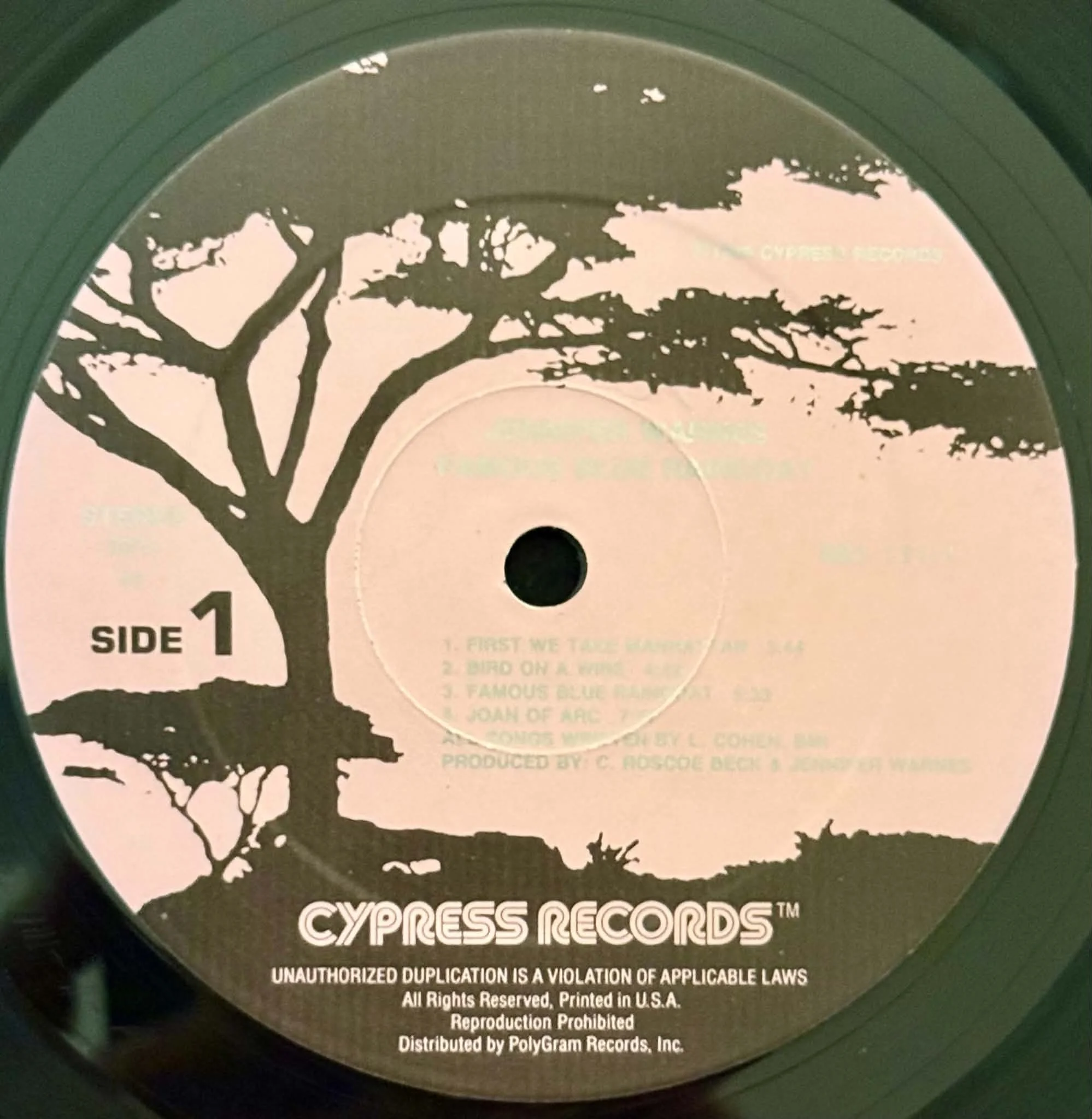
The Original Cypress
My U.S. copy, pressed by Specialty Records Corporation, is an excellent pressing in its own right. From the opening of “First We Take Manhattan,” the qualities that would make Famous Blue Raincoat an audiophile favorite are already unmistakable: clarity, a wide and open soundstage, powerful drums, and an ability to separate the many elements of the production without losing its sense of scale.
Returning to it after hearing the later editions, however, reveals another side of its character. There is a slightly cool, almost icy quality to the upper frequencies, particularly around Warnes’ voice, along with occasional hardness on cymbals and other high-frequency information. It isn’t unpleasant, and in isolation I might simply have described the Cypress as exceptionally clean and revealing. In comparison with what came later, though, it can sound somewhat analytical, a reminder of the sonic character associated with some early digital recordings. It is difficult to know how much of that comes from the recording itself and how much from the mastering.
The Cisco 45
Two decades after the original Cypress release, Cisco Music revisited Famous Blue Raincoat with a three-LP 45rpm 20th Anniversary Edition, remastered by Bernie Grundman from Jennifer Warnes’ analog mixdown tapes. The expanded edition also included additional performances and an extensive booklet, treating the release as an archival reconsideration of the album.
The difference from the original Cypress LP becomes apparent on “First We Take Manhattan.” The track begins with a distant, radio-like voice before the music seems to take over the listening space, with larger images, greater dimensionality and a more immersive soundstage. The slightly icy quality I hear on the original has largely disappeared, replaced by a rounder, more inviting top end. There is no shortage of detail or clarity, but considerably less edge.
“Bird on a Wire” extends that impression. The opening drums arrive with real force, while bass, percussion and Warnes’ voice occupy a deeply layered space. Those low, almost growling background voices emerge from behind and below the lead vocal, and the soundstage extends backward, creating the sensation of looking into the recording rather than simply hearing images arranged between the speakers.
The title track brings another change into focus. As Warnes sings more softly, she draws you into a greater sense of intimacy; as she opens into a stronger phrase, her voice seems to move toward you. The Cypress conveys those dynamic shifts, but the Cisco makes them considerably more apparent.
And then there is “Joan of Arc.”
Here the increased scale becomes inseparable from the music itself. The arrangement builds around bells, guitar and shimmering keyboards, as bass, drums and increasingly elaborate vocal layers gather around Warnes. When Leonard Cohen enters as Fire, his dark, weathered voice seems to arrive from another world. The contrast with Warnes’ purity is startling, and as the vocal layers multiply and the arrangement grows increasingly grand, the recording somehow retains the intimacy at its center. As the track draws to a close, the entire presentation gradually recedes until the final sounds fade into nothing. I’m always struck by how completely the performance has drawn me into its world.

The Impex 33
Impex Records, founded after the closure of Cisco Music, later revisited Famous Blue Raincoat, this time returning to the album’s original single-LP format. Bernie Grundman again handled the mastering from Jennifer Warnes’ analog mixdown tapes, with Warnes personally supervising the project.
The obvious question was whether returning to 33⅓rpm would come at a sonic cost. Remarkably, it gives up very little to the Cisco. The same sense of scale and dimensionality remains, but the Impex shifts the balance slightly toward a fuller, rounder and more relaxed presentation. Bass is deep and richly weighted, while the upper frequencies retain plenty of life without the harder edge of the Cypress.
What distinguishes the Impex most is how naturally all of these qualities come together. Drums have greater body and presence, piano and strings carry more warmth and weight, and the mournful saxophone on the title track hangs naturally within the acoustic space. On “Joan of Arc,” the music seems to advance and withdraw almost like waves, surging into the room and then pulling back toward the speakers. It is a wonderfully natural expression of the recording’s dynamics.

The One-Step
Impex returned to the album once more with its three-LP 45rpm One-Step Edition, mastered by Bernie Grundman and pressed at RTI on Neotech VR900 vinyl. Its one-step process eliminates the conventional father-and-mother stages between lacquer and stamper. Each stamper was used to press no more than 500 copies, and the 7,500-copy edition ultimately required Grundman to cut more than 100 lacquers.
The physical presentation is equally ambitious, beginning with an elegant embossed slipcase and continuing with a substantial multi-panel Stoughton package, revised artwork and a newly designed booklet that gathers archival material, photographs and reflections on the album’s history. Executive producer Abey Fonn and Impex have approached the One-Step as a keepsake edition, intended to represent the music as completely as possible in both sound and presentation. That philosophy is especially apparent here. Even the hype sticker describes this as the final vinyl edition to be made before Warnes’ tapes are retired to the vault, reinforcing the sense that the set was conceived not simply as a premium pressing, but as an archival statement.
The source remains Warnes’ first-generation analog mixdown master. In that sense, the One-Step and the Impex 33 are cut from the same cloth, and that is very much how they sound. The One-Step does not make the Impex 33 obsolete. The differences are subtler than that.
Compared with the 33, the bass is slightly tighter, Warnes’ voice more precisely focused, and individual elements within the soundstage easier to place. The quiet Neotech vinyl helps reveal low-level detail, but the effect is not artificially highlighted information. It is more like bringing an already excellent lens into finer focus. The One-Step offers greater precision without making the recording sound analytical. More importantly, it does not impose precision where the recording itself contains ambiguity.

An Album Becomes an Archive
The One-Step returns to the expanded program first presented on the Cisco Anniversary Edition, showing how the album had continued to grow beyond its original form. Its bonus material includes “Night Comes On,” “The Ballad of the Runaway Horse,” “If It Be Your Will,” an 8-track analog demo of “A Singer Must Die,” and a live performance of “Joan of Arc,” recorded in Antwerp in 1992. These aren’t simply five more tracks from the original sessions; they come from different moments and circumstances, broadening the picture of Warnes’ relationship with Cohen’s music.
“Night Comes On” is a gentle, stripped-down ballad, centered on a crystal-clear vocal and acoustic guitar with only the subtlest accompaniment behind them. “The Ballad of the Runaway Horse” remains centered on Warnes’ voice and an acoustic bass, while guitar, pedal steel guitar, percussion and strings add an unusual, almost dreamlike atmosphere.
“If It Be Your Will” is built from a sparse arrangement of Warnes’ voice, guitars and keyboards, yet the presentation sounds enormous. Small guitar details and delicate gestures emerge around her without disturbing the stillness of the performance. It is absolutely gorgeous.
The 8-track analog demo of “A Singer Must Die” is even more stripped down, built almost entirely around Warnes and electric piano. What is striking is how completely she carries the song with so little accompaniment. Despite its demo origins, the recording still sounds large, immersive and remarkably lush. It is precisely the sort of archival material that earns its place in an expanded edition, not simply as an alternate take, but as another window into the making of the record.
The final side closes with “Joan of Arc” live.
Joan of Arc, One More Time
The studio version of “Joan of Arc” is almost impossible to fault as a production. Its scale and complexity build steadily, Warnes’ layered voices become increasingly elaborate, the drums add growing dramatic weight, and Cohen’s arrival as Fire gives the song its theatrical center.
The 1992 Antwerp performance is different in character. The dreamy opening is shorter and less elaborate, while piano, bass and drums carry more of the arrangement. Strings assume some of the role played by the layered background voices on the studio recording, giving the song a different character altogether.
Warnes also sings with greater freedom. Her phrasing shifts, certain words receive different emphasis, and the performance feels less controlled in the best sense of the word. She sings both sides of the dialogue herself, only occasionally altering the color of her voice to distinguish them. By the final passage assigned to Fire, she lowers and darkens her tone just enough to suggest the change without turning it into an imitation.
The audience responds audibly to the first wordless chorus, and as the performance continues, Warnes seems increasingly willing to let the song breathe. Then, before one of the final choruses, she lets out a cry that sends a jolt through the performance. It is one of those moments that could never have been planned in quite the same way in the studio.
By the end, she has pulled me completely into the performance. It is a stunning capstone to the expanded edition.
Conclusion
Nearly forty years after its release, continues to reward this kind of close listening. Each edition reveals something different, but none changes the essential character of the album. Successive masterings can bring changes in scale, warmth, focus and resolution. They can let us hear more deeply into the choices Warnes and her collaborators made. What they cannot do is supply the artistry those choices were meant to serve.
After living with these four versions, I find myself less interested in declaring one of them the winner than in what their differences reveal. The best of these editions do not reinvent Famous Blue Raincoat. They bring the performances, arrangements and recording into slightly different focus, allowing us to hear more clearly what was there from the beginning.
That, ultimately, is why the album has remained relevant through so many changes in audiophile fashion. Its sound keeps giving listeners reasons to return, but what they find when they get there is still Jennifer Warnes’ remarkable record.
Thanks to Abey Fonn of Impex Records for supplying the One-Step edition used in this evaluation.