Vivaldi’s The Four Seasons on Decca Pure Analogue [Vinyl 2026]
Until now, Decca Pure Analogue has drawn from the Decca and Philips catalogues, with much of the early series devoted to recordings from the later analogue years and the transition to digital. Some of the Philips titles have given the engineers a chance to go back to the original four-track quadraphonic tapes. What caught my eye about Vivaldi’s The Four Seasons was the Argo name. It’s the first Argo title in the series, and to my ears this 1969 recording with Alan Loveday, Neville Marriner, and the Academy of St Martin in the Fields belongs squarely in Argo’s classic analogue era.
I once asked Dominic Fyfe, Decca Classics’ A&R director, why the series hadn’t gone further back into the Decca catalogue. As he explained it, they’re up against their own legacy. Decca made some of the most admired classical recordings on LP, and many of those originals were beautifully mastered. The idea is to choose recordings where a new cut can bring something to the listening experience. In the titles I’ve heard so far, sometimes I’ve preferred what the new mastering brings out. Other times, I’ve heard a different balance and could happily live with either.
I put the best of the original Argos in much the same company as the great Deccas. There’s a beauty to the sound of the original UK oval-label Argo pressing of The Four Seasons, and I was curious what Rainer Maillard and Sidney C. Meyer would bring out of the tapes today. Would I hear more of Loveday’s playing, or more of the church around the strings? And would those differences change how I responded to the performance?
The recording
Argo had been part of Decca since 1957, and its catalogue had a character of its own. It made room for spoken word, Elizabethan music, and the kind of chamber repertoire that helped establish Marriner and the Academy on records. The Four Seasons may be one of the most familiar works in classical music, but it’s also a good introduction to what Argo could do. I’m glad to see Decca open up that catalogue, and I’m curious about what else might come out of it.
The sound of the Loveday–Marriner recording owes something to a change of plans. The sessions were booked for Kingsway Hall, but when part of the ceiling collapsed, producer Michael Bremner and balance engineer Stanley Goodall moved the recording to St John’s, Smith Square. Argo had never recorded there. As the Academy tells it, the two men tested the church’s acoustics with claps, whistles, and a little Vivaldi hummed on the spot. The sessions took place from September 8 to 10, 1969, with Tryggvi Tryggvason also credited as a recording engineer. The LP appeared a year later, in September 1970, as Argo ZRG 654.
I Musici helped establish The Four Seasons on LP in the 1950s. I reviewed the Esoteric reissue of their 1959 Philips stereo recording with Felix Ayo for Audiophilia, and what stayed with me was the grace and lyricism of Ayo’s playing. A decade later, Loveday and Marriner made a recording that became a benchmark in its own right. Edward Greenfield, writing in Gramophone, singled out the liveliness of the playing and the colour and atmosphere Goodall captured at St John’s.
The music
The Four Seasons are the first four of twelve violin concertos Vivaldi published as his Op. 8 in 1725. The original Argo still has its insert with all four sonnets in Italian and English, with the movement markings alongside the verses. In “Spring”, birds greet the returning season with song. In “Autumn”, villagers sing and dance to celebrate a good harvest. As Stanley Sadie points out in the original liner notes, the dedicatee, Count Morzin, had already heard the concertos before he read the poems. I like to keep the sheet beside me as I listen so I can follow the scenes as they unfold in the music.
Vivaldi scored these concertos for solo violin, strings, and continuo. As Tully Potter notes in the reissue, Marriner’s Academy played modern instruments. The performance has the intimacy I associate with chamber music. Loveday leads from within the ensemble, and there’s as much pleasure for me in hearing what goes on around the solo violin as in following his line. Simon Preston gives the music its pulse and weight on a Mander organ and a Robert Goble & Son harpsichord.
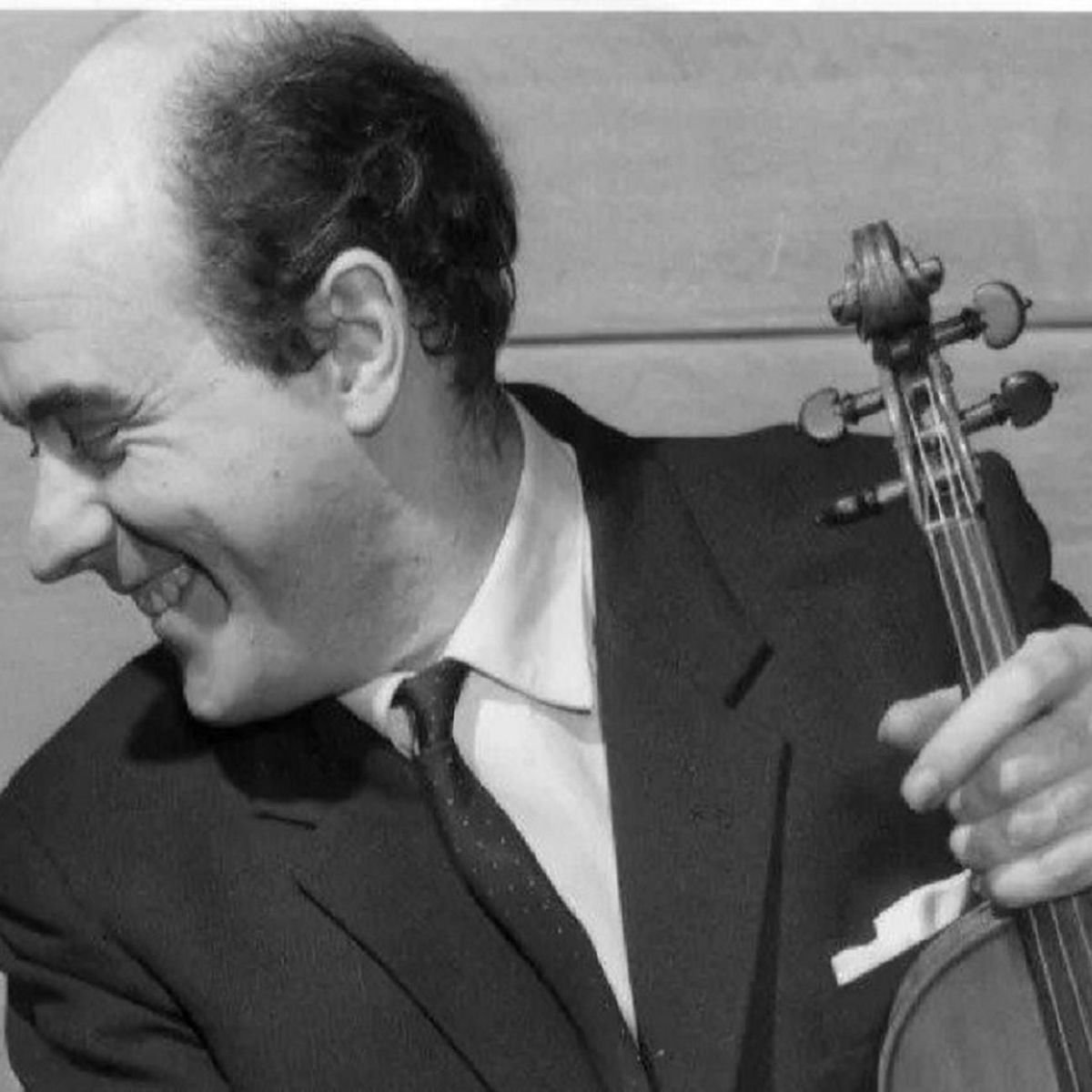
Alan Loveday, solo violin
The three pressings
The original UK first pressing used in this comparison came from the Weisfeld Collection. I evaluate and catalogue records from the collection for Harry Weisfeld, co-founder of VPI Industries. The copy he sent is a beautiful oval-label pressing with 1G in the dead wax on both sides. The G identifies Ted Burkett, a Decca mastering engineer whose work I’ve long admired.
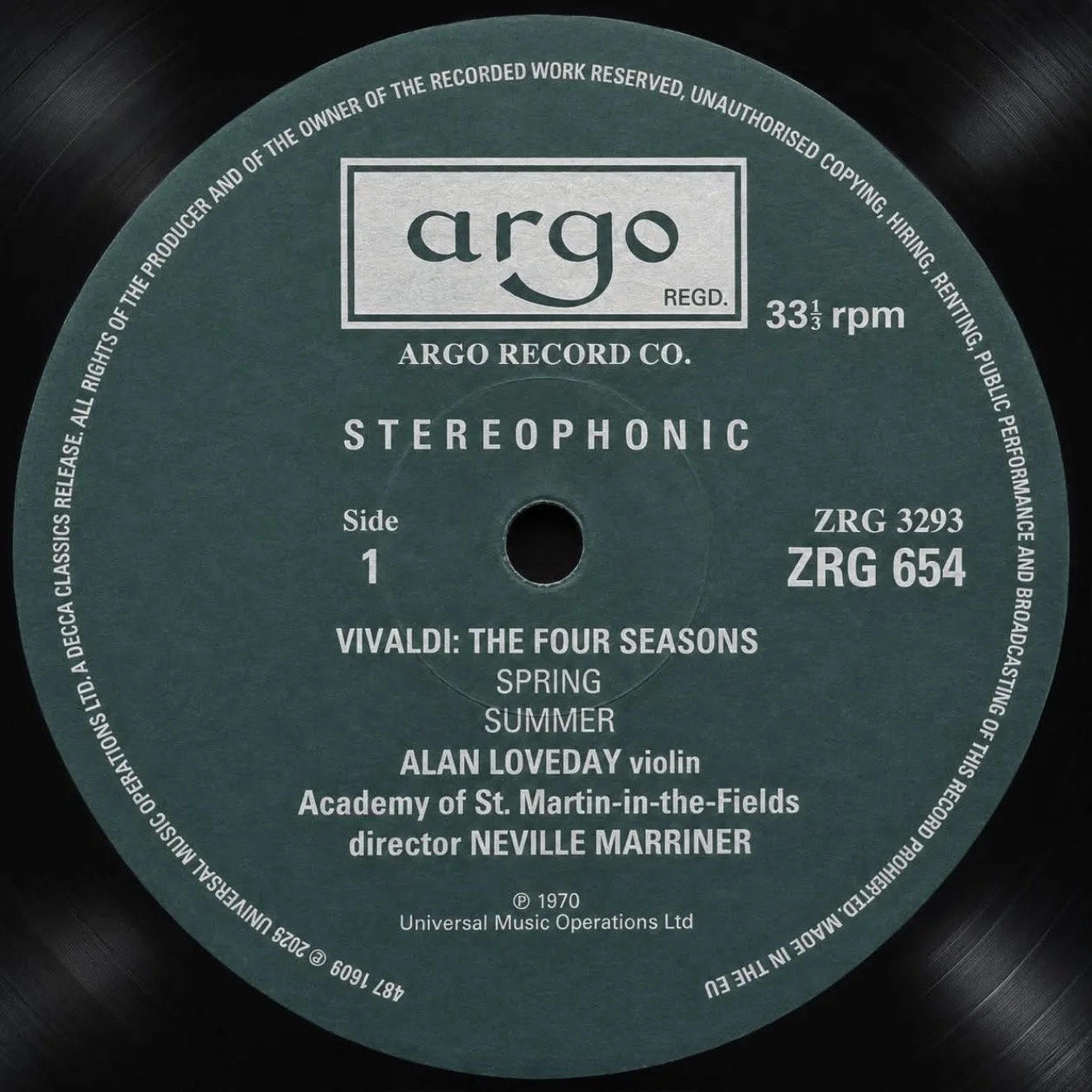
The later Dutch box-label pressing came from Anthony Giaramita, my Audiophilia colleague and from the Everything Classical Music livestream. Decca Classics supplied the Pure Analogue review copy. For that edition, Rainer Maillard mastered the original quarter-inch, two-track stereo tapes, and Sidney C. Meyer cut the lacquer at Emil Berliner Studios. The reissue reproduces the side-one master-tape label for Spring and Summer, which lists a C37 tape machine and a speed of 15 inches per second. I was pleased to see matrix number 3293 on the tape label and again in the dead wax of both the UK and Dutch Argos.
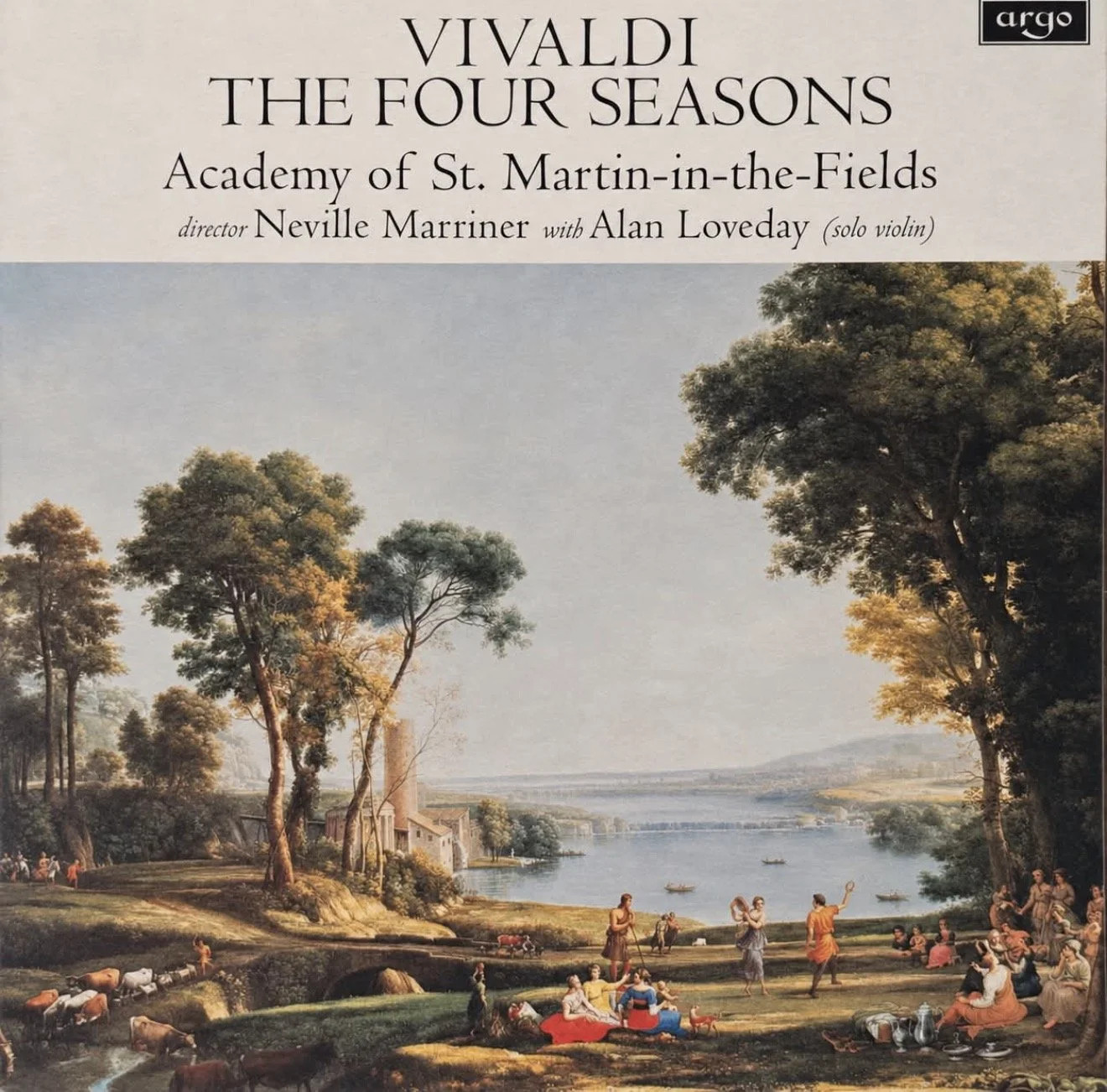
The jackets are interesting to compare side by side. On the original oval-label Argo, Vivaldi’s name sits off to the left, and the painting is reproduced in deep, saturated colours that bring out the richness of the oil. On the later jackets, the type has been rearranged, and the same painting has an almost watercolour quality.
With the same performance on all three, I wanted to hear how each presented Loveday’s violin, the Academy’s strings, and the acoustic of St John’s.
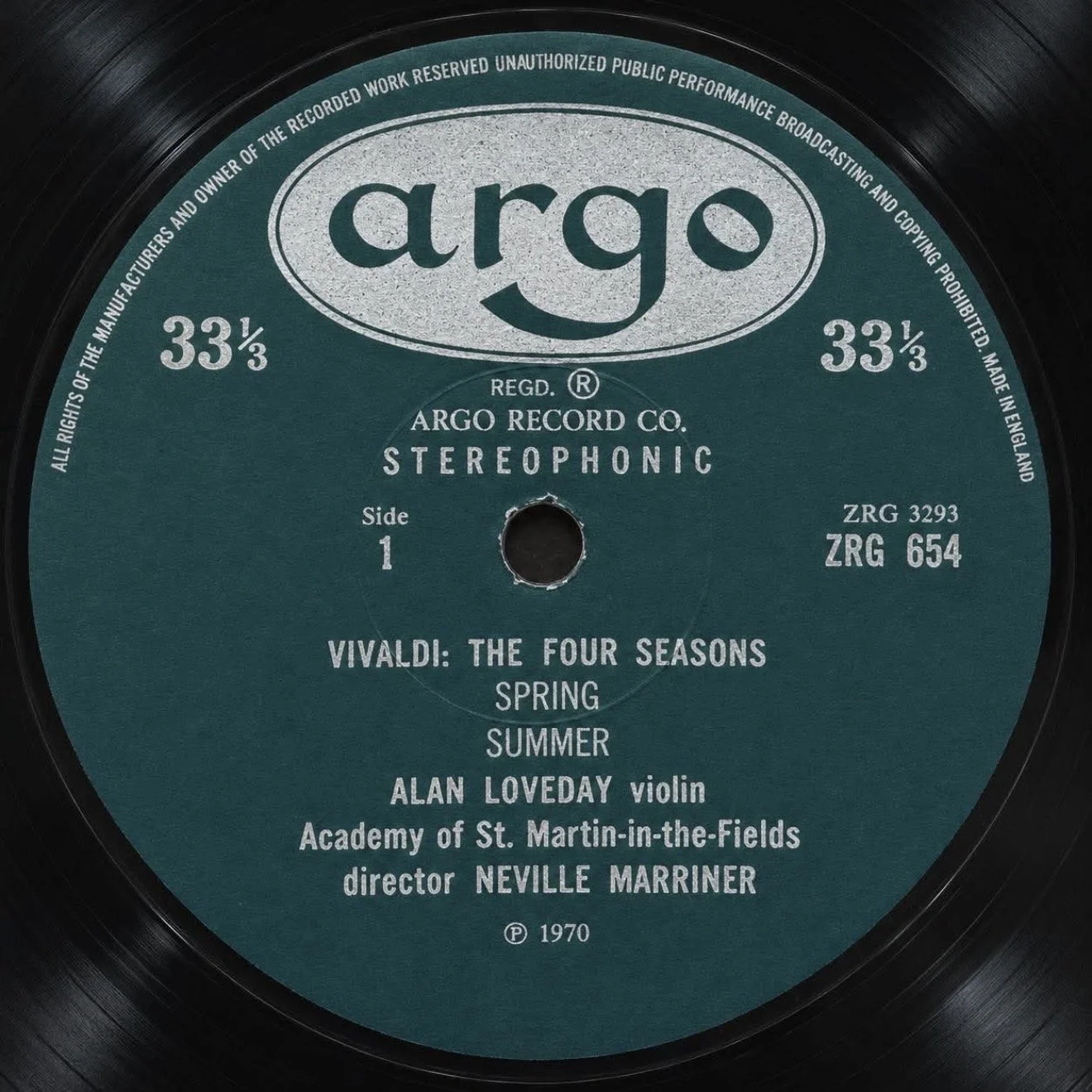
The original UK Argo pressing
What strikes me first about the original oval-label Argo is its restrained elegance. The dynamics swell and recede, and even when the playing grows more forceful, it never feels overbearing. The quieter passages are especially beautiful. Loveday’s violin is finely rendered, with a delicacy and air around it, and the church acoustic gives the strings a soft glow. The harpsichord has a light touch, and its detail comes through clearly.
Looking at the floor plan of St John’s, I thought of Blue Heaven Studios, a recording studio and concert venue housed in a former church in Salina, Kansas. I’d been there for the Vinyl Summit and remember how intimate it felt, with two banks of pews and a single aisle down the middle. The floor dimensions are remarkably close. Blue Heaven’s sanctuary measures 77 by 52 feet, and the main floor at St John’s is about 57 feet across and extends some 77 feet back from the front of the stage. Having been in a room of that scale gave me a better appreciation of what Stanley Goodall captured on the Argo.
I think we sometimes put too much emphasis on pinpoint imaging in hi-fi. It’s exciting to hear a system place instruments that precisely, but I rarely hear that degree of separation in a concert hall. In a hall I can tell where the players are, and what reaches me is a continuous fabric of sound shaped by the room. That’s the perspective the Decca engineers captured here, and it’s one of the things I love about the original Argo.
There’s also a lovely balance of weight and top-end extension. I hear a deep foundation from the organ and what sounds to me like the lower strings, which adds to the sense of being there. The copy I heard is surprisingly quiet, too, something I’ve often found with well-preserved Decca pressings from this era.
The later Dutch Argo pressing
The Dutch box-label Argo is pressed on noticeably thinner vinyl than the UK original. Decca was already having LPs pressed in the Netherlands by 1979. Philips’ plant in Baarn took on much of that work in 1980, when PolyGram acquired Decca’s record business and Decca closed its own pressing plant at New Malden.
I was delighted to find the sonnets printed on a full-size, 12-by-12-inch sheet with the Dutch reissue. The original oval-label Argo came with a half-size sheet.
The Dutch pressing sounds a little leaner and cleaner to me. It retains much of the original oval-label pressing’s elegance, and I still get a natural sense of the ensemble in the room. If you’re looking for the sound of the original, the Dutch pressing gets you surprisingly close at a substantially lower price.
The Decca Pure Analogue reissue
Some of the earlier Pure Analogue releases brought details forward so vividly that the effect could be startling. This one takes a more restrained approach. Maillard and Meyer stay remarkably close to the character of the original Argo. I noticed the extra clarity first in Preston’s harpsichord. I can follow his playing more easily, and it still feels like part of the same fabric. Loveday’s violin tone is beautiful throughout, and the cohesion of the ensemble remains one of the recording’s strengths.
The new cut handles small shifts in dynamics beautifully, and it’s a little easier to hear the sound trail off into the church. In the storm at the end of “Summer”, the ensemble comes forward with a little more force and bite on the Pure Analogue, and there’s plenty of detail even at the height of the storm. It’s a thrilling listen. On the original UK Argo, the string textures in that same passage sound a shade more refined.
The quiet Pallas pressing lets the soft passages come through beautifully. The jacket is elegant, and the cover artwork has never looked better to me.
I thought again about what Dominic Fyfe told me. Decca is up against its own legacy, and the original Argo is a good example of why that’s such a high bar. I think Maillard and Meyer made the right choices here. This is one of the better Pure Analogue releases I’ve heard. The care they took with the balance of the ensemble is what won me over.
Original copies are still fairly easy to find if you’re curious to hear both. The Pure Analogue is a beautiful way to get to know this performance on LP, and for those of us who already know the Argo, it offers a compelling reason to listen again.