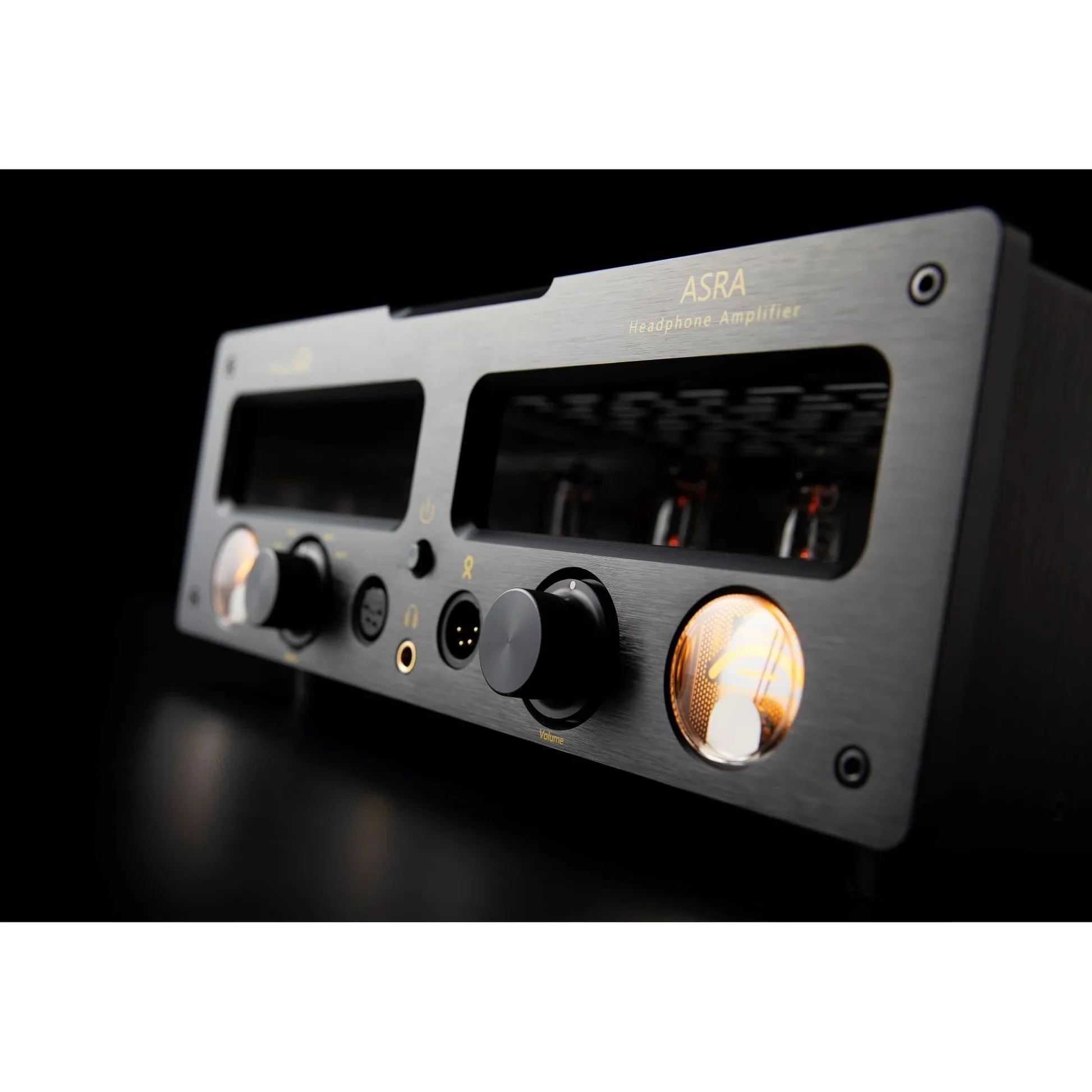
Allnic Audio ASRA RHPA-7500 Headphone Amplifier
After enjoying the convenience and efficiency of Class D amplification in my reference system for a while, I had a powerful craving for some tubes in my life. I reached out to John Ketcham of Kevalin Audio, the US importer for Allnic Audio of Korea. Allnic has been a favourite brand among Audiophilia writers, but I’ve never tried their electronics myself. My general inquiry about amplification uncovered the news that Allnic has a brand new ‘headphone amplifier’ about to launch. More than just a headphone amplifier, this new product has speaker taps and special output specifically for driving ribbon headphones.
Intrigued, I learned more background from Ketcham and one of his major US dealers, Danny McKinney of Requisite Audio. After having launched RAAL 1995 ribbon headphones in the United States, McKinney eventually collaborated with Allnic on incorporating dedicated circuits into Allnic amplifiers capable of driving RAAL true ribbon headphones. This requires a bit of engineering because RAAL ribbons have an impedance of less than 1 ohm! Allnic is not the first brand to include ribbon outputs on their amps, but they are one of a select few. Committed RAAL ribbon headphone users often use expensive transformers between their “normal” headphone amplifiers and headphones or even resort to using speaker amplifiers.
For its new line, Allnic has chosen the name ASRA (pronounced as-rah), which means something faint, distant and profoundly deep in Korean. One of the more captivating product names I’ve encountered in audio. The RHPA-7500 is the first of several ASRA products coming out in 2026 - a DAC and phono stage are in the pipeline. Allnic designed the ASRA line to bring its unique philosophy and style of tube electronics to a slightly more affordable segment of the high-end market. The goal is to offer a suite of tube electronics that are distinctly Allnic with retail prices under $10,000 USD.
Even though I’m accustomed to reviewing equipment I can't afford to purchase myself, I still cringe when I call high-end audio affordable. Allnic is focused on the most extreme expression of engineering and musical ideals of founder Kang Su Park, and the most extreme expression of anything doesn’t come cheap. Before the ASRA debut, Allnic’s HPA-300B was the only combination headphone and integrated amplifier in the portfolio at USD 13,200. With a base price of USD 6000, the RHPA-7500 lowers the entry point by more than half. My review sample is an upgraded unit with a retail price of USD 7500, which includes a Constant Impedance Attenuator volume control instead of the standard precision potentiometer.
Features & Specifications
Nominal emphasis on headphone amplification notwithstanding, the RHPA-7500 looks like a straightforward integrated amplifier in terms of general functionality. A closer look at the key features uncovers some distinctions. Primarily, the inclusion of a ribbon headphone output appeals strongly to the devoted base of RAAL headphone users.
The Constant Impedance Attenuator volume control is a unique Allnic technology that is featured on their highest-end amplifiers. Like the nickel permalloy transformers, this is a point of engineering pride for the company.
The tube complement is also unique. The preamp section uses the common 12AU7 and somewhat familiar ECF80, while the power section uses 7558 power tubes. Although new old stock 7558 tubes appear to be widely available (and seriously cheap!) I could not find a single home audio product, new or vintage, that uses them. Apparently, 7558 tubes were popular for CB radio applications. Allnic may be introducing this tube to high-end audio for the first time - let’s see how long the NOS tubes stay cheap.
Power output from the single set of speaker taps is 10 watts in triode mode and 20 watts in pentode mode. This mode can be changed (while the amp is off) by convenient toggle switches in the tube compartment.
Power available to the various headphone taps is not as clear, although I heard from Kevalin that the ribbon output offers 4 watts. Based on my listening, the single-ended and balanced outputs offer a hilarious amount of power, and I can’t imagine there is a headphone that the RHPA-7500 could not drive.
The RHPA-7500 does not include a remote, but considering Allnic’s purist philosophy, emphasis on headphone listening I think this is fair.
Below is a complete list of specifications as provided by Allnic:
Vacuum Tubes
ECF80 × 2 / 12AU7 (6211) × 2 / 7558 × 4
Output Power
20W (Pentode) / 10W (Triode)
Output Impedance
10Ω – 300Ω
Voltage Gain
+28dB
Headphone Outputs
1/4″ (6.35mm) × 1
4-pin XLR × 1
RAAL Ribbon Dedicated 4-pin XLR
Speaker Output
1 Pair Binding Posts
Analog Inputs
RCA × 3 / XLR × 1
Volume Control
Precision Potentiometer
(Option: 41-Step Constant Impedance Attenuator)
Frequency Response
20Hz – 20kHz (±0dB)
Dimensions (W × D × H)
35.5 × 44.5 × 14.0 cm
Weight
12 kg
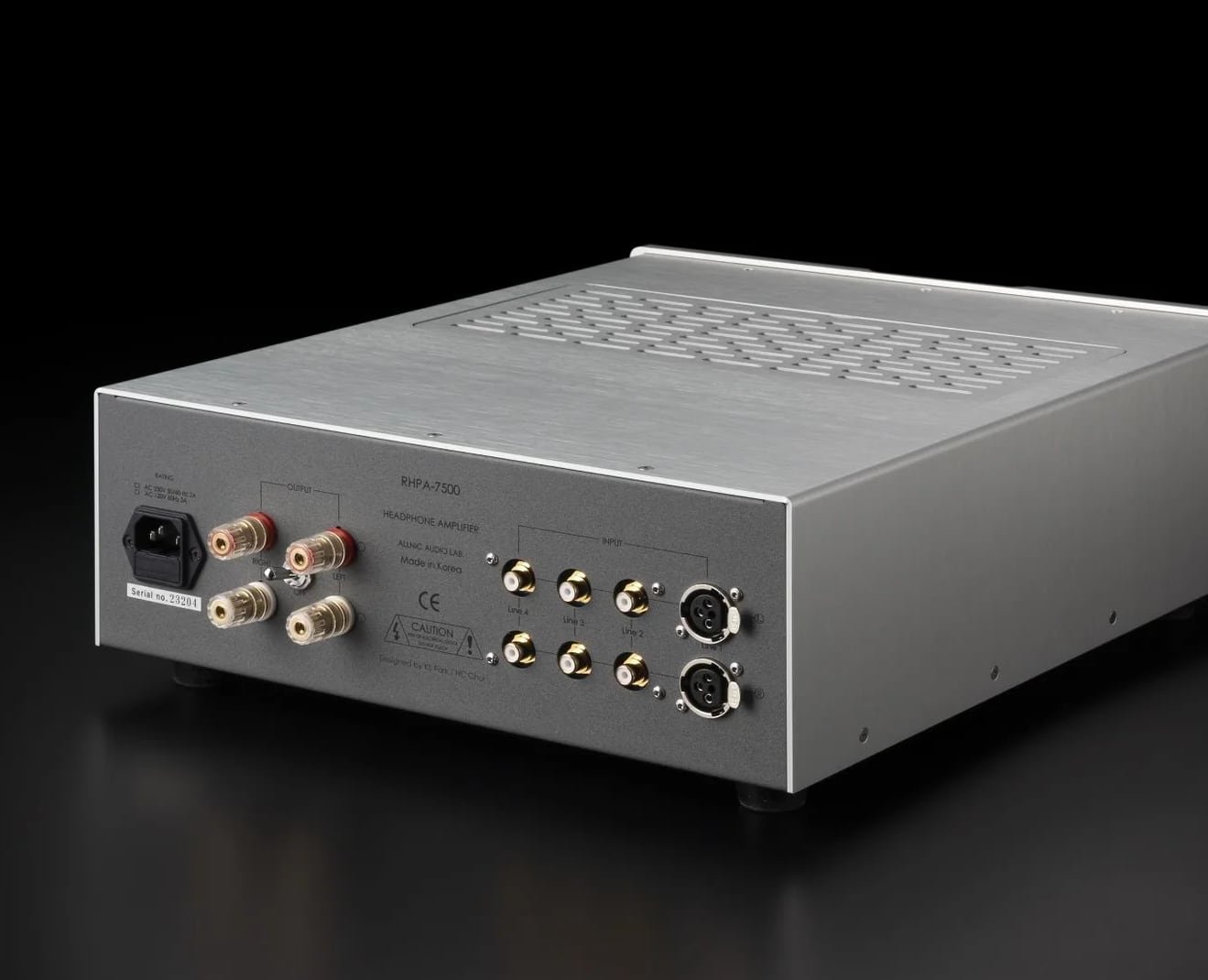
Design & Build
The RHPA-7500 arrived on my doorstep in immaculate condition thanks to its simple but extremely robust packaging. Pulling it out and inspecting it, I enjoyed seeing Allnic’s signature industrial design, including the amber meters for tube bias current, thick aluminum faceplate and open “windows” into the tube compartment. Allnic’s hand-wound transformers are housed inside the chassis rather than protruding above the deck, resulting in a footprint that is deeper than it is wide. For a high-end tube amplifier, it’s a manageable form factor.
From handling the unit, I would not guess it was any less expensive than other Allnic products I have read about. Fit and finish are precise, with flawless black anodizing, crisp golden-yellow labelling, and beautiful chamfering in key areas of the faceplate.
Interacting with the RHPA-7500 is analog bliss. The solid clicks of the volume knob made me say to myself they don’t make ‘em like they used to. I don’t actually know how they used to make ‘em, but I doubt it was this satisfying.
Regarding audible artifacts, in my time with the RHPA-7500, I never noticed any tube microphonics, current rush through the speakers, or pops of any kind. Kneeling in front of the unit, I could detect the softest, reassuring transformer hum, just enough to remind me that, no, this is not a Class D design.
Review System
My review period was relatively brief, so I kept my review system simple, focusing on digital listening for consistency of reference recordings. I used my Wiim Mini to send high-resolution streams to my reference Ferrum ERCO DAC / Headphone amplifier and fed analog signals via single-ended RCA to the RHPA-7500.
For speakers, I primarily used the 8 ohm / 87 dB Audio Physic Step monitors, and for a 4 ohm torture test, I tried the Care Orchestra Celestial Deep Breath Evo. My reference headphones are the planar magnetic Sendy Peacock (50 ohm / 103 dB) and classic budget reference Sennheiser HD6XX (300 ohm / 103 dB).
Listening
After plenty of low-volume background break-in, I dove into a handful of diverse reference recordings that illustrated to me the breadth of the RHPA-7500’s capabilities as both a speaker and headphone amplifier.
I love Jon Batiste’s Anatomy of Angels (Verve, 2018) because it captures the magic of a great jazz performance at New York’s Village Vanguard in modern digital sound. On the standard “The Very Thought of You,” Batiste introduces singer Rachael Price to the stage, and just a few seconds in, hearing the cheers and clicking of glasses is an immersive experience. When listening to the Sennheiser HD6XX, the famously intimate midrange is blown open while still retaining the magical body in the midrange, especially with Price’s vocals. While pairing $200 headphones with a $7500 amplifier seems silly, the HD6XX are my reference for a reason - they reveal differences in amplifiers more than any other headphones I've used, regardless of price.
I’ve had a few friendly jabs back and forth with our publisher, Anthony, about speaker-first versus amplifier-first system building philosophy. I lean toward amp-first, especially for entry-level speaker-based systems. Here, the RHPA-7500 makes a bold case for amplifier-first system building for headphone listening. It was absolutely laughable to me how much more space, detail and control I got from both the HD6XX and my planars with the RHPA-7500.
To test out an amplifier's authority, I often rely on doom metal legends Electric Wizard, often affectionately called the heaviest band in the universe. They carry on Black Sabbath’s legacy to the extreme with the thickest, most bloated, down-tuned guitar riffs and satanic themes. Electric Wizard can groove hard, but even my favourite recordings like the classic Come My Fanatics… (Rise Above, 1997) can come off like a wall of sound on a subpar system. Whether I was listening on my planar headphones or through speakers, with the Allnic, the low sludgy guitar riffs were distinct from bass and drums, with crisp imaging and vocals present in the mix. Through the 4 ohm Care Orchestra speakers, I was shocked at the low-end authority coming from the RHPA-7500 in both triode and pentode mode, producing almost a full body listening experience.
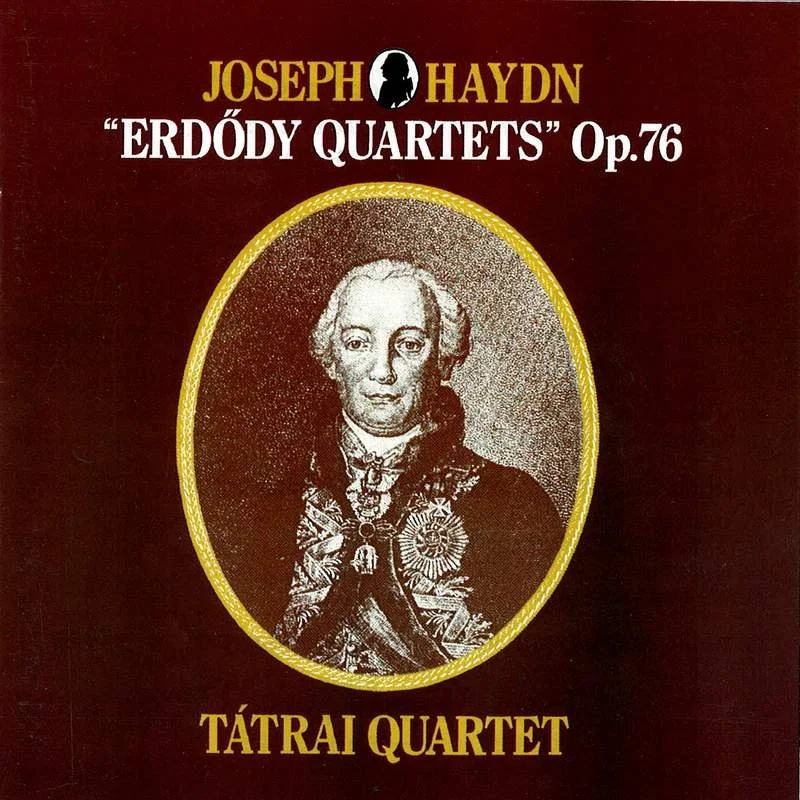
Returning to civility, I spent some time streaming the Tatrai Quartet’s legendary Haydn cycle on Hungaroton. I focused on “The Lark” from the 1986 set Six String Quartets, Op. 64 (Hungaroton, 1986), which I also have on CD. String quartets can be a litmus test for a hi-fi system. Four string players in a room, simple recording with nowhere to hide. These Tatrai recordings sound fine with the PS Audio Stellar Strata Mk2, but came to life with the Allnic. While soundstage depth was similarly wide, depth expanded dramatically with the Allnic. The real magic was in the timbre. Closing my eyes, the realism was beyond what I’ve experienced with solid-state amplification.
Many of my listening impressions of the RHPA-7500 were consistent for both headphone and speaker listening. One example I particularly appreciated was that turning up the volume resulted in the musical presentation becoming larger rather than just feeling louder. Not only is this phenomenon enjoyable in itself, but it is an illustration of how the Allnic is just as easy to listen to at higher levels as it is at moderate levels. And considering I was not using efficient speakers, it indicated to me modest power rating of 10-20 watts goes a long way.
I generally split my serious listening about 50-50 between headphones and speakers. Although I’ve had many wonderful integrated amplifiers with serious headphone amplifiers, none of those products were designed with equal consideration for headphone and speaker listening. The RHPA-7500 is the first amplifier I’ve used that achieves this balance. While it is certainly packed with audiophile features, I believe it is this balance that will enable the RHPA-7500 to stand out in the market over the long term.
Of course, the ASRA will have immediate appeal to RAAL headphone devoted owners. Although I have not had the chance to use it with RAAL headphones, I hope to try this in the future and share my impressions with Audiophilia readers. On features and value alone (no transformer required!) it may be wise for RAAL users to seek out a demo. My impressions and recommendations are otherwise based on speaker and dynamic/planar headphone listening.
Conclusion
My mind was blown by the ASRA RHPA-7500, plain and simple. It offers a rare have your cake and eat it too proposition. Speakers and headphones are both driven with authority and beauty. And that’s on top of all the various audiophile goodies that offer excellent pride of ownership commensurate with the 6000-7500 USD retail price. Audiphiles looking for a simple system for both headphone and speaker listening should seek out the Allnic ASRA RHPA-7500. A truly heirloom product.
Further information: Allnic Audio


![DG The Original Source Series vinyl reissue—Stravinsky: Petrushka/LSO/Abbado [2026]](https://images.squarespace-cdn.com/content/v1/55787f0ae4b02f0501debbeb/1772300749736-M7J0KQWH4VE79LE3MA7P/IMG_0698.jpeg)