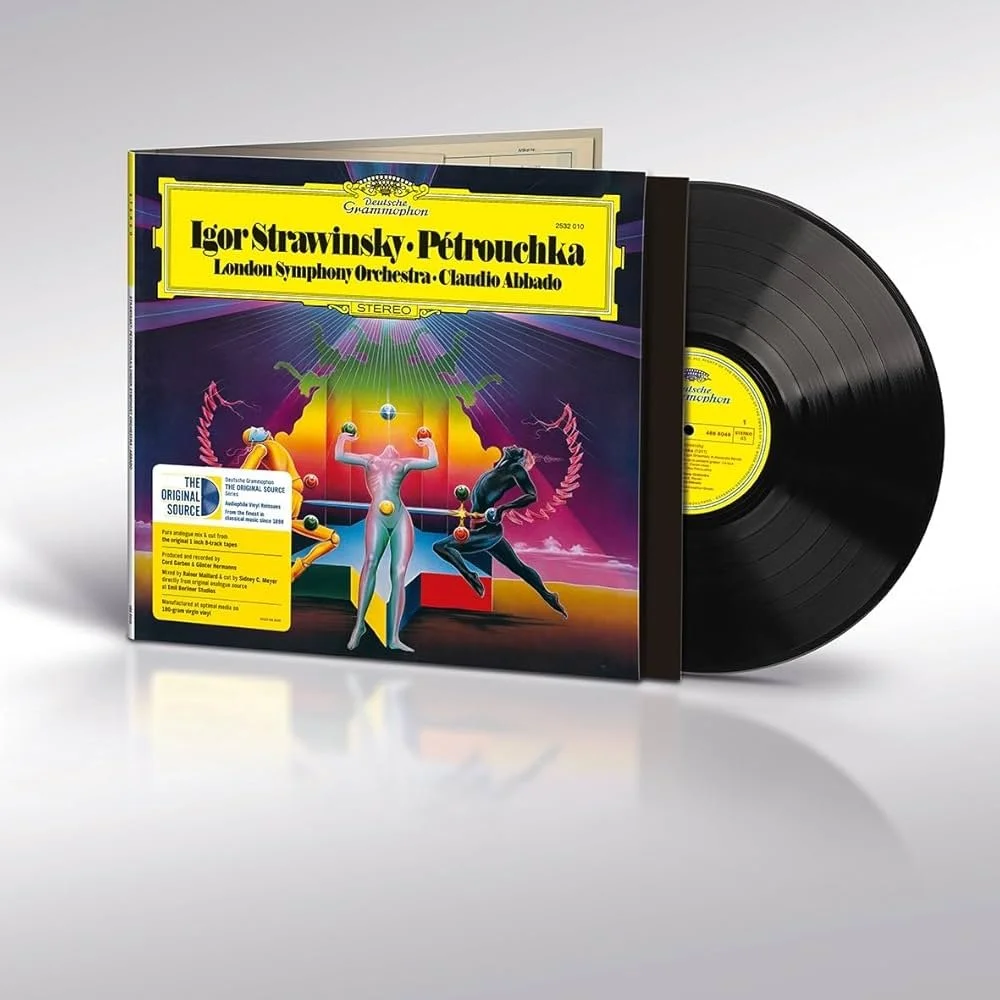
![DG The Original Source Series vinyl reissue—Stravinsky: Petrushka/LSO/Abbado [2026]](https://images.squarespace-cdn.com/content/v1/55787f0ae4b02f0501debbeb/1772300749736-M7J0KQWH4VE79LE3MA7P/IMG_0698.jpeg)
DG The Original Source Series vinyl reissue—Stravinsky: Petrushka/LSO/Abbado [2026]
My favourite Stravinsky work, in fact one of my favourite classical works period, was recorded at probably the most inopportune time for classical recording purists and analoguephiles…the cusp where the major record labels were switching from recording in analogue to digital. 1979-81
As the early digital recordings could be pretty rough, companies with enough clout and financial support, such as Decca, EMI and Deutsche Grammophon, recorded their early digital sessions in both digital and backup analogue tape. In DG’s recordings, such as this 1980 Petrushka, in 8 track analogue. It is this 8-track master that Emil Berliner used to master the new DG The Original Source release [2026]. For the original 1980 release, the digital two-track was used. The original sound engineer was Klaus Heimann.
I was at Trinity in London (late ‘70s, early ‘80s) when Abbado and his LSO heroes (no heroines back then) were playing their Stravinsky programs at the Royal Festival Hall before making the recordings. The concerts were unforgettable. I did not miss one. Probably the best Stravinsky orchestra in the world (they can do The Rite from memory!) and one of the composer’s greatest conductors.
Interestingly, the qualities of the magnificent live shows did not transfer to the recording location (and typical of London booking nonsense, every work was recorded in a different location!). Luckily, Petrushka got Walthamstow.
But the 1980 release was serviceable, not much more, much like the equally uninspiring Le Sacre du Printemps (originally released in 1975). Happily, Emil Berliner transformed that humdrum record into a humdinger; probably my favourite Rite. The swashbuckling live LSO returns in the most dynamic way. A knockout Rite courtesy of the ears and good taste of Herr. Maillard. Did he do the same for my beloved Petrushka?
Stravinsky composed Petrushka as his second ballet for Diaghilev’s Ballet Russe. This came after the spectacular success of Stravinsky’s The Firebird. Petrushka premiered in Paris on 13 June 1911.
Typically, because of Russian copyright, Stravinsky later created different versions of his works for Boosey & Hawkes and Western copyright. Abbado uses the 1947 Boosey version.
Petrushka is a colourful story surrounding the Russian Shrovetide Fair, with three puppets brought to life by a magician, and the subsequent story of sad, hapless Petrushka, a pretty ballerina, and a Moor cast as a bully.
The ballet bursts into life as the fair is in full swing. It’s one of the great openings in classical music—colour, drama and brilliance. The orchestra really gets to strut its stuff.
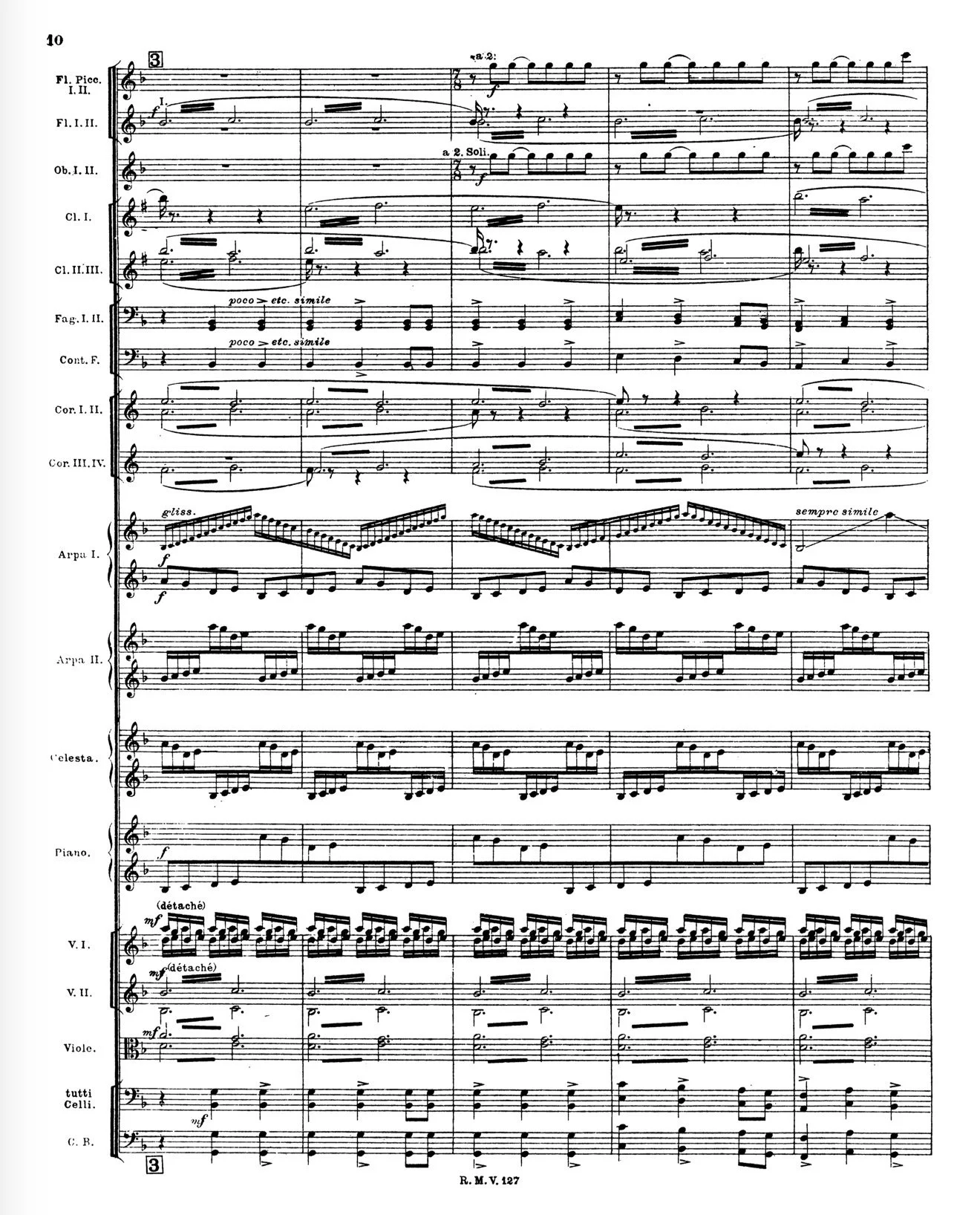
Bustling energy (1911 version shown)
And Emil Berliner has allowed, through their remastering prowess, the LSO to strut. The precision of the orchestra is mesmerizing, especially at Abbado’s fast tempos. No matter the technical hurdles, the LSO virtuosos vault them with ease. Listen to the scary, on every audition, trumpet solo introducing the ballerina. My heart always skips a beat waiting for the inevitable fluff. Maurice Murphy plays the damn thing like it’s on page 1 of the Arban method book. Peter Lloyd’s many flute solos are typically gracious, and Frank Nolan’s piccolo playing is spectacular with the added thrills of the 1947 version, with the picc parts an octave up (listen for his sparking high Cs in the opening).
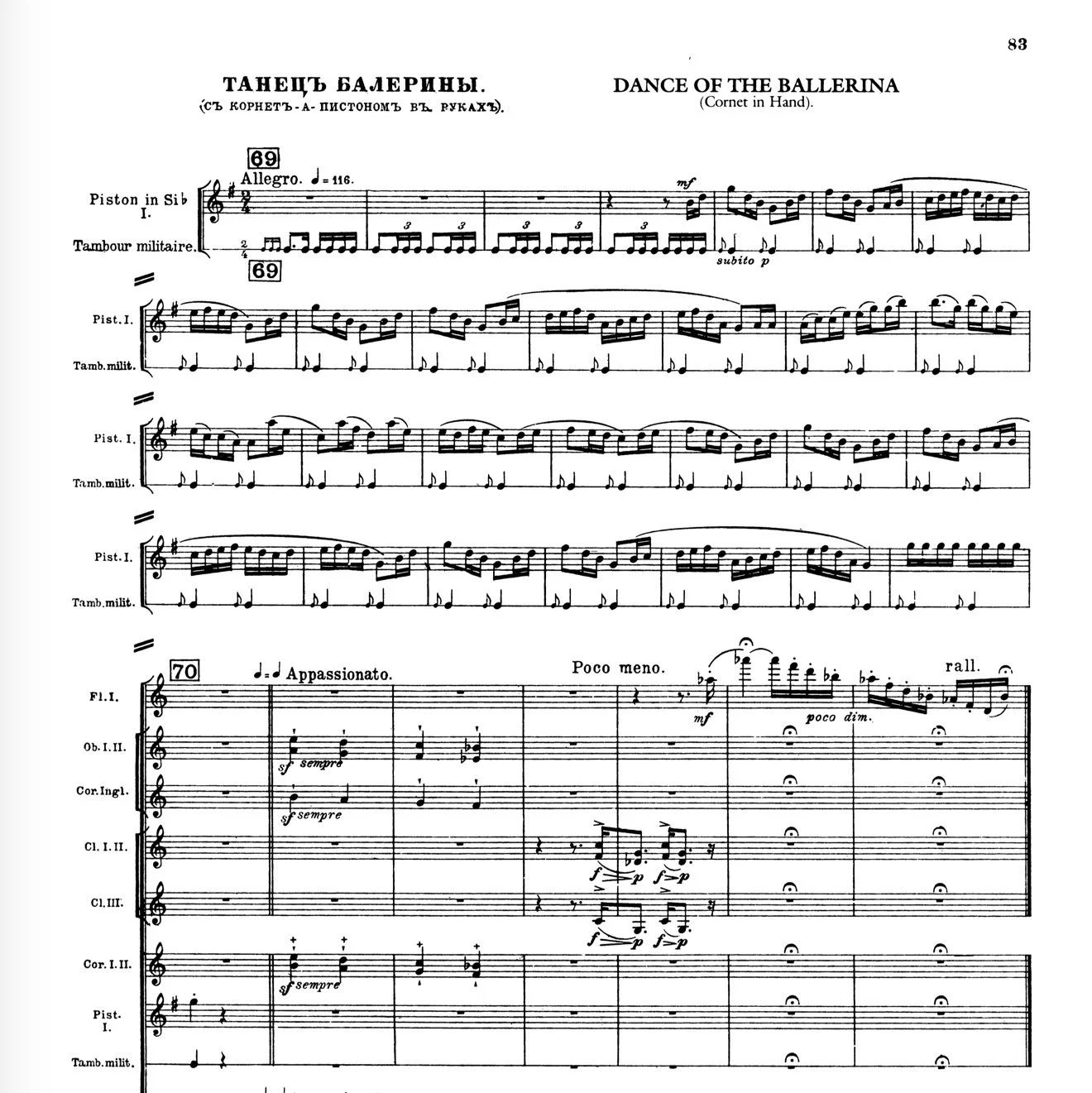
The infamously difficult trmpet solo.
I must highlight the wonderful pianism of Leslie Howard in the very important concertante piano part and the late, great John Fletcher on his amazing tuba representing a very powerful bear.
Abbado brings out the characters’ personalities very well—Petrushka is as pathetic as he’s ever sounded—a manic depressive bounding from depression to mania, the ballerina is, as always, pretty and flirty, and the Moor a giant boor. And as Petrushka goes up against the Moor in a jealous fit, his ass-whooping is masterfully and heartbreakingly told by Abbado.
There are many good Petrushkas. Ansermet, Decca LP—masterfully interpreted and recorded—is best among them, also the RPO/Danon on Chesky is superb—and some awful ones, chief among them a Nimbus dog of a CD with old lazybones Gennady Rozhdestvensky conducting a woefully underprepared LSO.
But if you’re looking for a top-notch version in very good sound, this very exciting, superbly played version will do. If you have Ansermet on an ED1, a Blueback or the exceptional Speakers Corner LP, I think you may be done.
Is the remastering/cutting as good as Emil Berliner’s masterful Le Sacre? No. But close. And to hear the LSO with such clarity and luminosity in such a masterpiece is no small thing. Very highly recommended.
Audiophilia purchased this record. It arrived flat and silent (45 RPM pressing is from Optimal, deluxe gatefold and pressed on 180gram vinyl). It’s limited to 3500 copies.
![American Tapestry—Calidore String Quartet—Signum Classics CD [2026]](https://images.squarespace-cdn.com/content/v1/55787f0ae4b02f0501debbeb/1772736921902-S6CGP5D2MHL89VM7RM55/IMG_0714.jpeg)