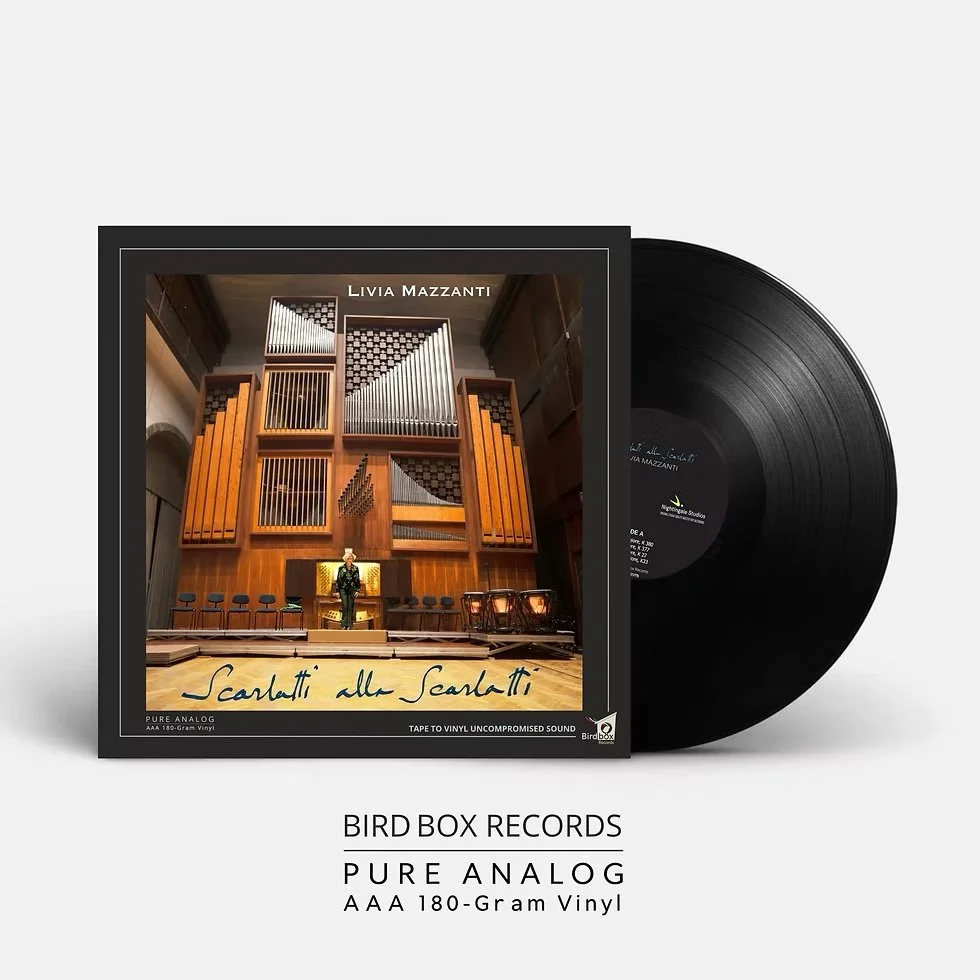
Scarlatti Alla Scarlatti—Livia Mazzanti (Birdbox Audio Archive Series – Reference Test Pressing)
While many listeners associate Birdbox Records primarily with jazz, the Italian boutique audiophile label has been quietly expanding its scope under the direction of founder Lorenzo Vella, who also serves as the label’s recording and mastering engineer. His first classical LP is among the most ambitious projects Birdbox has undertaken to date—not an orchestral recording, but an organ recording approached with uncommon care and intent.
The artist is Livia Mazzanti, and the program consists of eight sonatas by Domenico Scarlatti, originally written for harpsichord and here adapted for organ by Mazzanti herself. The resulting album, Scarlatti Alla Scarlatti, is represented here by a special reference test pressing—the first opportunity to experience what has been achieved. The LP is scheduled for release in March 2026, with a reel-to-reel tape edition to follow.
Mazzanti studied extensively with Jean Guillou in Paris and, in addition to her international performing and recording career, teaches at the Naples Conservatory. She was also deeply involved in the restoration of the great organ housed in Scarlatti Hall, an instrument constructed by Tamburini in 1983 under a project directed by Jean Guillou, and later restored by Zanin in the 2000s. With nearly 4,000 pipes across 49 stops, the instrument is capable of both immense power and exceptional subtlety—qualities that prove essential to the success of this recording. Photographs of the hall and organ provide a useful visual reference, though they only hint at the experience ultimately captured on tape.
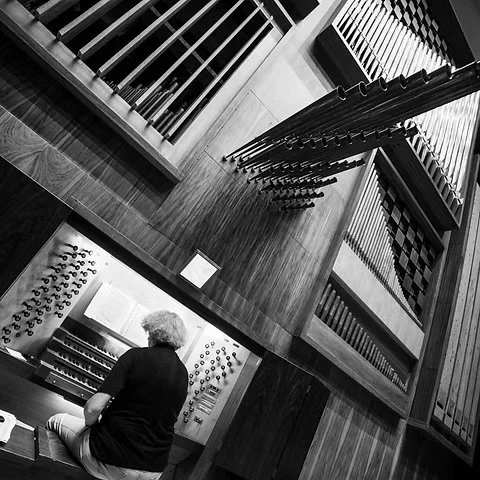
Livia Mazzanti
Vella’s primary challenge was to master the demanding acoustics of Scarlatti Hall while preserving the full dynamic contrast between the organ’s most delicate pianissimos and its thunderous fortissimos. His goal was not merely accuracy, but immersion: “to envelop the listener and recreate the vivid sensation of being present at the exact moment of the performance.”
That intention is realized almost immediately. Rather than presenting the organ as a distant spectacle or an oversized sonic event, the instrument emerges as a physical presence within a coherent acoustic space. The relationship between direct sound and reverberant field is rendered with uncommon stability, allowing both the scale of the instrument and the dimensions of Scarlatti Hall to emerge naturally, without exaggeration or artifice.
The balance achieved here is exquisite. Dynamic range is wide and effortlessly rendered, with bass fundamentals that are appropriately massive, yet never overwhelming. Just as impressive is the clarity in quieter passages: delicate lines remain crystalline and intelligible, even as the instrument breathes within the surrounding air of the hall. Unlike many organ recordings, there is no blurring in the bass registers, and no loss of articulation when the music grows complex. The precision and expressive nuance of Mazzanti’s performance are revealed in full, aided by Vela’s remarkable command of image and tonal balance.
Musical Perspective
Mazzanti’s interpretations highlight the rhythmic vitality, lyrical beauty, and nuanced character of Scarlatti’s writing, rendered on the organ with striking naturalness. Her sense of articulation and pacing allows the music to retain its dance-like character while fully exploiting the instrument’s color and resonance. Ornamentation is handled with elegance, and changes in registration feel organic rather than demonstrative. Throughout the program, musical momentum is sustained with such poise that each piece seems to end too soon. Immersion gives way to surprise when the stylus reaches the run-out groove—an indication of just how completely the listener has been drawn into the performance.
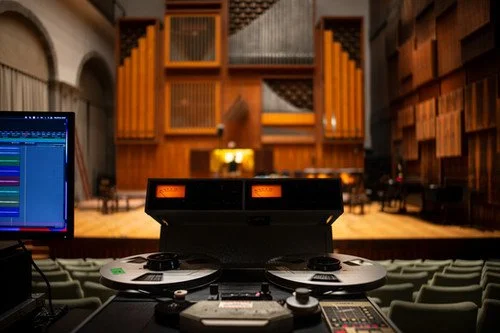
Microphones & Recording Approach
The sense of presence achieved on this recording is the result of a carefully considered microphone strategy, both sophisticated and restrained. A total of seven microphones were employed. Ambient information and spatial realism were captured using a Neumann KU-100 binaural microphone, providing a strikingly three-dimensional representation of the hall that closely mirrors human perception. This was complemented by a Decca Tree of specially selected condenser microphones, forming the foundation of the stereo image and anchoring the organ naturally within the space.
Direct tonal capture was handled by a pair of Neumann U47 microphones placed closer to the pipes, preserving weight, harmonic richness, and tonal color without sacrificing clarity. A final spot microphone was used judiciously to maintain definition during the most complex passages and ensure that musical lines remain intelligible, even at peak dynamic levels.
Every element—from microphone choice through cutting—was selected with a singular objective: to reproduce exactly what was heard in Scarlatti Hall on that day. Judging by this reference test pressing, that objective has been fully realized.
It is also worth noting that this reference test pressing is housed in an unusually elaborate presentation and was produced in a run of just twenty copies worldwide. This was never intended as a commercial edition, but rather as an internal reference and archival document. While most readers will never encounter this version firsthand, it offers a clear indication of the level of care applied throughout the project. With that attention evident in every aspect of this pressing, I have no doubt that the forthcoming commercial disc and tape editions will possess the same magic.
A listening experience of this clarity, scale, and musical insight is rare, and Scarlatti Alla Scarlatti delivers it with quiet authority.
Further information: Birdbox Records
![Christy Baron—I Thought About You—Chesky One Step Pressing On 180G Vinyl [ 2025]](https://images.squarespace-cdn.com/content/v1/55787f0ae4b02f0501debbeb/1770851690129-V3Y8FIMRHZNDKY9JO3YP/IMG_0604.jpeg)