The Volumio Primo Plus DAC and Streamer
I have friends who constantly ask me about what’s the newest product they can buy so they can ‘listen to Spotify or Tidal’ on their phone, digital audio player, or home setup. The first thing I ask is: how much do you want to spend, and the second is, do you want practicality or sound? They all want the lowest cost and best product. Well, in audio, this has a level of complexity. I always tell them, you don’t need a small fortune to get some good integrated audio components. In my experience, the new audiophile audience is mostly interested in streamers and DACs, though sooner or later the analog bug will get them, trust me. A new audio product generates an audience first based on their looks, their ease of use, versatility, their technology, and the ‘flow’ they have with their audio system. If this intrigues you, then this is the review for you: the brand new DAC and Streamer Primo Plus, from the Florence-based company Volumio (USD 1399).
Specifications
Network: PCM 384kHz/32bit
USB-C (Device): PCM 768kHz/32bit, DSD512
USB-A (Host): Input - USB Flash Drive and HDD/SDD. Output - PCM 1536kHz/32bit, DSD1024
Coax: PCM 192kHz/24bit
Optical: PCM: 192kHz/24bit
Bluetooth: 5.0
Power: 5V DC / 3A
Power connector: Barrel jack 5.5/2.1mm (outer/inner diameter)
Power polarity: positive
CPU: Quad-core Cortex-A72 (ARM v8) 64-bit SoC @ 1.5GHz
RAM: 2GB LPDDR4
Internal storage: 16 GB EMMC
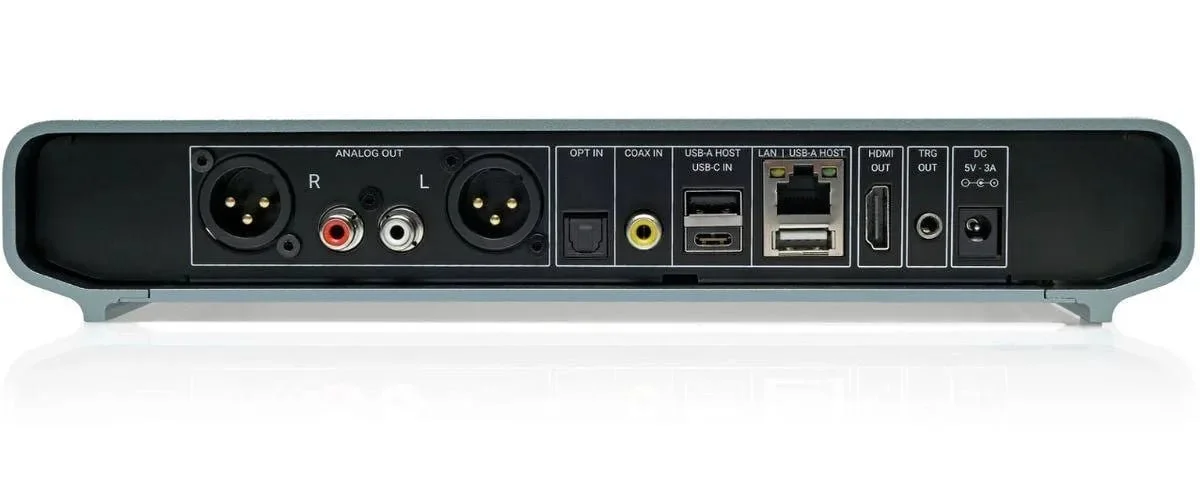
USB: 1x USB Type-C connector (device). 2x USB Type-A connectors (host)
S/PDIF: 1x Coaxial input (RCA connector) 1x Optical input (Toslink connector)
Stereo Outputs: 2x unbalanced RCA connectors. 2x balanced XLR connectors
High-speed network: Wi-Fi 802.11a/b/g/n/ac (2.4G and 5G). Gigabit LAN10/100/1000M
Trigger out: 12V 3.5mm jack (positive on tip)
Display: 1.3” OLED display
Knobs: 2 rotary encoder knobs with push-button
HDMI video output: Volumio OS app mirroring up to 4K/60fps
Remote: IR Remote receiver (aluminum IR remote included)
Getting to know the Primo Plus
Some companies find a way to appeal to audiophiles, to music lovers, and even to the engineer we all have inside, and for this, we must be appreciative. Perhaps the spec you will be more interested in is that this Primo Plus has a Dual Mono DAC chip, the well-known ESS ES9039Q2M. Volumio has improved the power supply and added a new clock design to provide jitter-free playback. Hand-built in Florence, the newest version of the Primo has more digital inputs than the previous first-generation Primo running on the latest version of VolumioOS.
In the past, I’ve reviewed the Volumio Preciso DAC ($799) and the Rivo Plus Transport
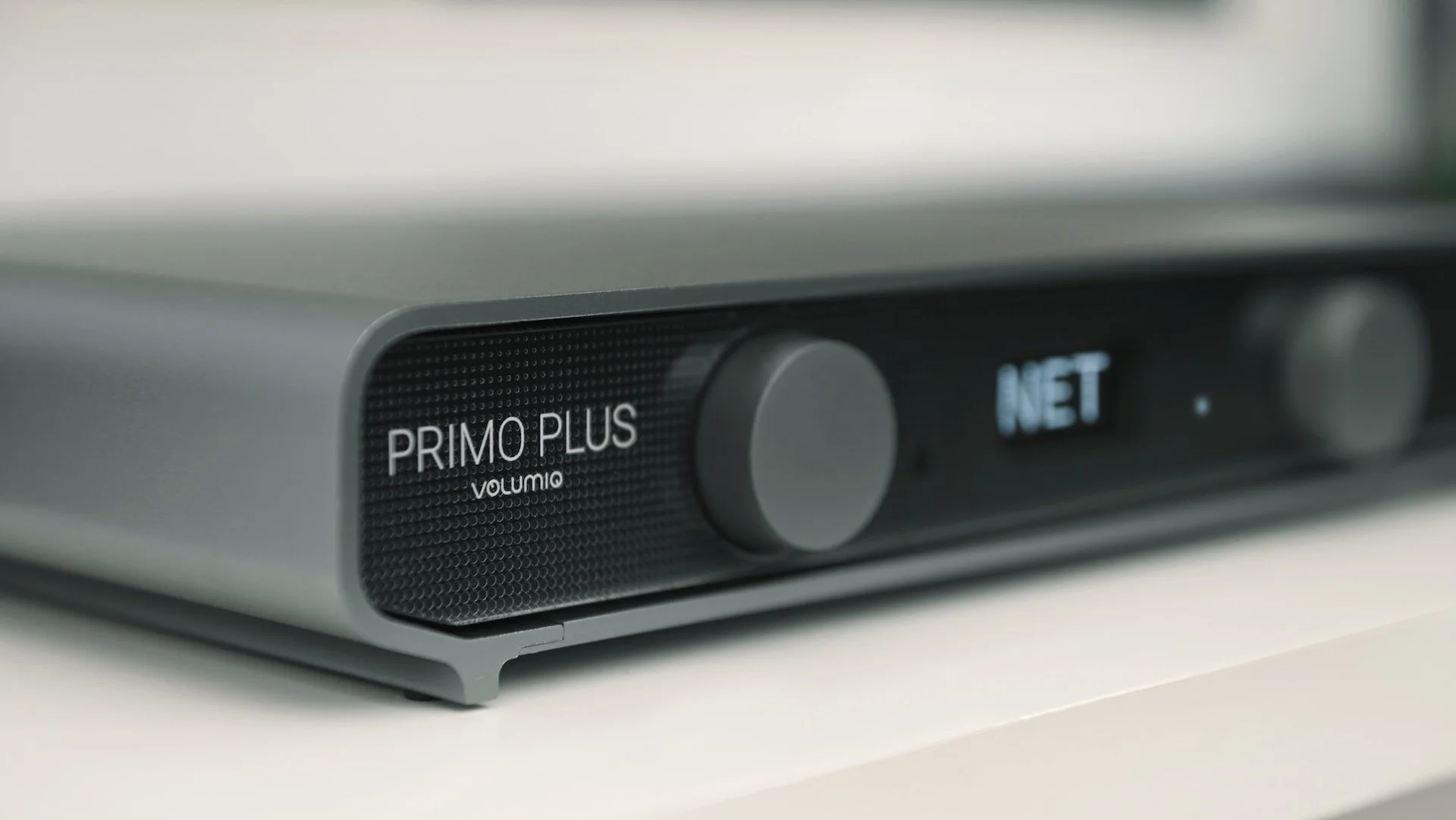
As always, the minimalist design of the product is a looker; it fits anywhere, my wife loves the clean and flat colour, and the old style with the new minimalist design. The Primo Plus works with two knobs on the right (mute-unmute, DAC filter, volume) and left (power ON/OFF, ready state, Enter stand-by mode, stand-by Enter ready mode, input source) and a small front LED display in the middle (Red-power off, Green-loading, Blue-ready, Orange-stand-by), a very old-school feel to the knobs and display. This small horizontal and flat-book feel fits as a stack with other Volumio products. It comes with a remote control, a 5V 3A power supply, and an NFC/QR code information card.
Sound
I’ll start by mentioning that the Primo Plus has eight DAC filters. I would be lying if I said that I noticed any defining difference in all of them, perhaps just in one or two settings, where I hear a slight clouding of sound; I mostly listened to the default Minimum-phase filter. I liked the ease of the small remote control that worked fine, and its design goes well with the overall product. Connection was even easier with the Primo Plus than with my previous Volumio products, and I did try it with their application (it’s getting much better to use than before), but Roon was my primary source of music. With the Roon Nucleus One music server (Ethernet connection), I was set to try out this streamer/DAC. My listening experience was through the RCA and Coax connectors (though balanced connectivity is available).
I generally try to couple the audio component with a peer, that is, a similarly priced component. In this case, I assembled the Primo Plus with the PS Audio Stellar-Strata Integrated amplifier (used as a preamp, $2999 USD) and the Galion TS A75 power amplifier ($1,495 USD). An added aspect of this component is that if you have a power amp, the Primo Plus has a built-in preamp volume control, so right there, functionality is in your favour. I found this setup has a warm feel, and I liked it. I also used two pairs of speakers: the tonality-balanced PS Audio Aspen FR5 loudspeaker ($3,999 USD with stands, review forthcoming) and the beautiful and sought-after Galion TS Voyager Transmission Line (TL) Speaker (1,195 USD), just for comparison and for fun.
I was excited to try out this component and compare it with the Rivo Plus and the Preciso DAC. I have always been more of a fan of separates in the audio chain; for me, they can offer sound dynamics that you can mix and match and play around with.
First Impressions
My first impressions were that having the Rivo Plus streamer and the Preciso DAC in my setup was a specific way of learning about the DAC, that is, since the Rivo Plus I find very neutral, the Preciso was easy to listen to and understand its character: fluid, a bit of treble sparkle in the high-treble register, and a solid but not engulfing bass, mid-range was nothing out of the ordinary, but for the price the Preciso DAC was a great choice for the beginner audio enthusiast.
However, something changed in my experience when I disconnected the separates and put in the Primo Plus: a more defined mid-range and a less crisp upper treble. Bass (specifically mid-bass) sounds much better; its definition fits in one box, which is what is salient here.
The Verdict
I’ll give you an example of the sound character. In the album Trio Tapestry, the superb ensemble formed by Joe Lovano, Marilyn Crispell, and Carmen Castaldi (2019), the song “Gong Episode” fluctuates between an atmosphere of solitude that can lead to an isolated experience in the sound. Well, this doesn’t happen with the Primo Plus. The clarity in the Primo Plus is surprising; the separation of sound layered instruments is perceived in a particular open soundstage.
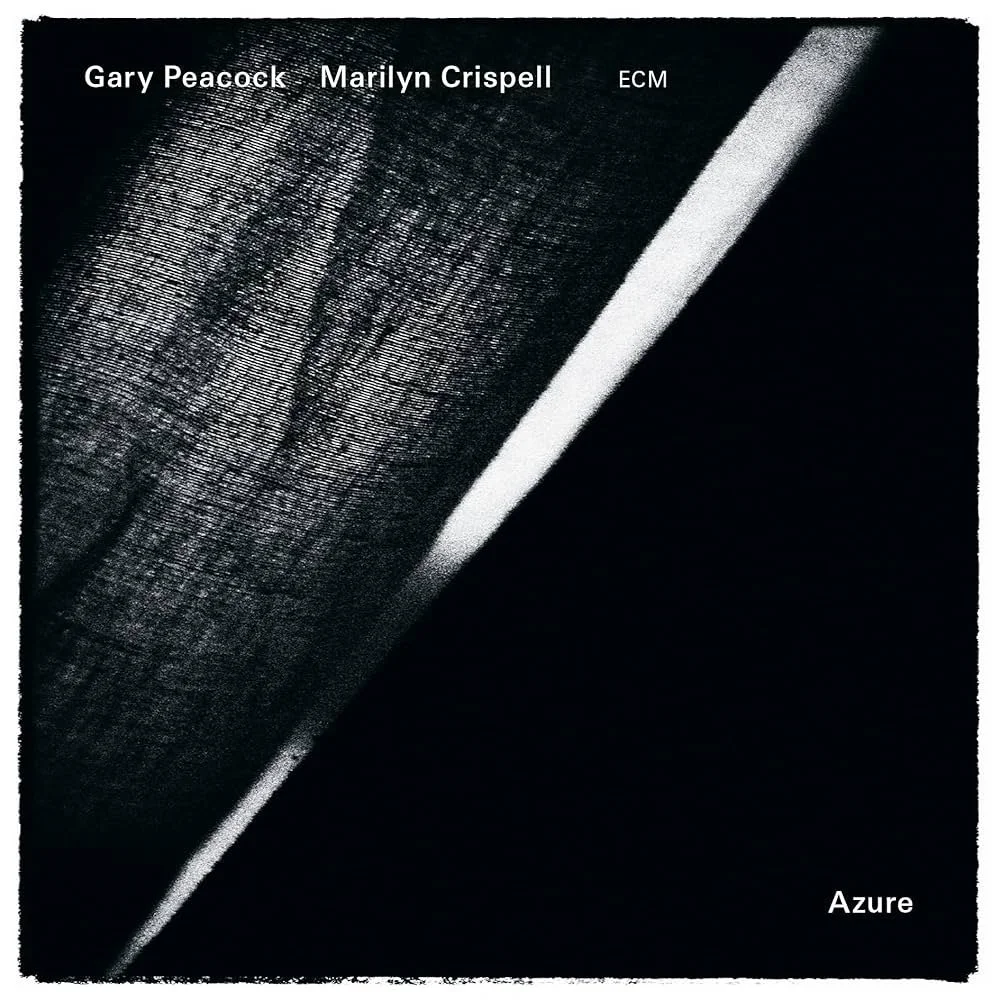
Another example, in the song “Bass Solo” on the album Azure, Gary Peacock (double bass) and Marilyn Crispell’s (2013) piano sound so complementary that there needs to be a neutrality and non-colouring interpretation of the sound so that one instrument doesn’t override the other; the Primo Plus does it without losing a stride.
In the recently unveiled live Mahler Fourth by Christoph Eschenbach and the Verbier Festival Orchestra (2026), the Primo Plus is challenged by a sonorous wave of strings and winds that constantly drift toward Eschenbach. I was thoroughly impressed again by the instrument separation, but mostly by the dynamics from the new Volumio component. The first movement is an edge-of-your-seat interpretation with a faster tempo than one expects from the Fourth, but it works; with attention to the wind section, one gets lost in the flow, only to be delighted by the contrast of the strings that hold back the danger every Mahler director can get in trouble with: pace.
I decided to trust the Primo Plus with the most fragile frequency (treble) in a more volume-heavy jazz-metal sphere. By now, you must’ve realized I worry about treble a lot. There’s a specific range that my hearing really dislikes: too much treble. The album Who Are We by Al-Qasar (2022), with their song “Awal,” is a tour de force. The concert-like interpretation of the Primo Plus was overwhelming, bass and mids filled the room, and the echo of Lee Ranaldo’s guitar was haunting.
Finally, Wax Tailor’s song “Ungodly Fruit” from the album Tales of Forgotten Memories (2005) and its electronica/hip-hop was a fun moment to enjoy, having these two components in one, a neutral streamer and a clean and non-chip sounding (sometimes heard as cold/lifeless) DAC, the Primo Plus will be an integrated component front runner.
Conclusions
Audio moves fast; in one year, you have a component that can be almost obsolete the following year. That’s why it’s important to do some homework, not just about the product, but about the setup and sound you are looking for. If I were beginning the audiophile journey, I would start with integrated components. When the sound of your chain is recognized by your ears, then would I go into separates. I can say that the Primo Plus will be a significant product for your chain if you want a practical and fun way to listen to your favourite music. I had no issues with Volumio or their application, but I preferred it with Roon. I would get this component for the person interested in clear and neutral audiophile and the minimalist design fan.