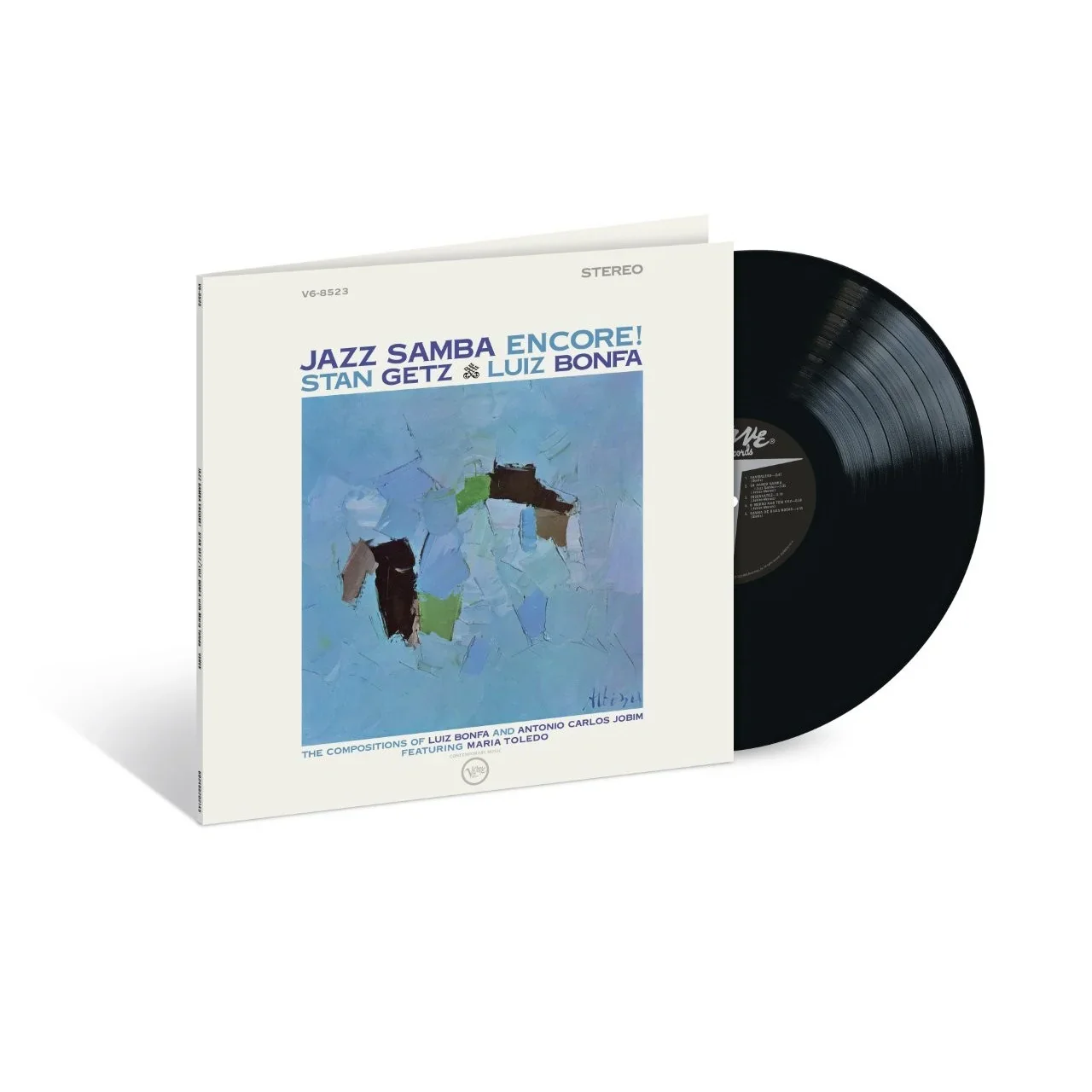
Stan Getz & Luiz Bonfá — Jazz Samba Encore! (Acoustic Sounds Series)
Stan Getz and Luiz Bonfá’s Jazz Samba Encore! marks the saxophonist’s first recorded collaboration with Bonfá, following the commercial success of Jazz Samba with guitarist Charlie Byrd. While it occupies a quieter place in the catalog, this 1963 session offers a distinct and often more intimate perspective on the Brazilian idiom—one that feels less driven by novelty and more by musical ease. This latest release in the Acoustic Sounds Verve Jazz Series brings renewed attention to a recording that reveals itself gradually.
At the center of the session is Luiz Bonfá, whose guitar work and compositions shape the character of the album. His playing is understated yet expressive, providing a natural framework for Stan Getz, whose tone here feels relaxed and unforced. Vocalist Maria Toledo is used sparingly but effectively, often adding color and texture rather than serving as a constant focal point. When she does step forward, her performances reflect the Brazilian vocal tradition—unhurried, lightly phrased, and integrated naturally into the surrounding texture.
Produced by Creed Taylor, Jazz Samba Encore! was recorded in New York City across sessions on February 8, 9, and 27, 1963. The engineering reflects the depth of talent associated with Verve during this period, with Val Valentin overseeing the sessions and a team that included Bob Simpson, Roy Hall, and Phil Ramone. The result is a recording that bears the hallmarks of that experience.
It is also worth considering this recording in relation to Getz/Gilberto, which would follow the next year and introduce the now-iconic vocal style of Astrud Gilberto. Her performances on that album are beautifully understated—tentative in the best sense, with a light, intimate quality that became closely associated with the bossa nova sound. Maria Toledo’s approach here is subtly different. While equally grounded in that style, her voice feels more present and defined within the mix, at times taking on an ethereal quality, though without the same sense of fragility. The result is a vocal style that stands on its own, rather than inviting comparison to what would come later.
The stereo presentation reflects the character of early 1960s recording practices, with vocals often positioned distinctly to one side and at times occupying a somewhat separate acoustic space. The effect can occasionally feel disembodied, but it contributes to the album’s period character rather than detracting from it.
For comparison, a Japanese Polydor pressing (UMV 2100) presents the recording with notable clarity and detail, though with a slightly elevated top end that can introduce a degree of brightness, particularly in the upper registers of the saxophone and voice. The presentation reflects the precision often associated with these pressings, with very quiet surfaces and a highly detailed, if somewhat forward, overall balance.
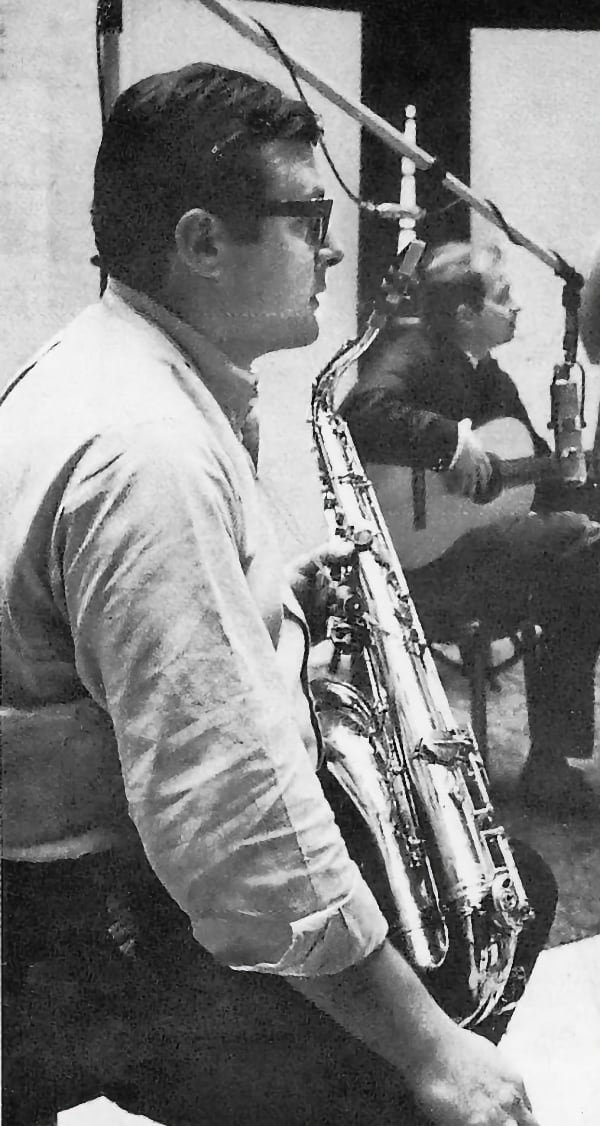
Stan Getz and Luis Bonfa
By contrast, the new Acoustic Sounds Verve Jazz Series reissue, mastered by Matthew Lutthans at The Mastering Lab using tube equipment, offers a markedly different presentation. The sound is richer and more relaxed, with the brightness of the earlier pressing replaced by a warmer, more natural tonal character. Bonfá’s guitar is especially well served here: its picking is clearer, yet without emphasizing detail for its own sake, and the instrument is rendered with greater body, warmth, and resonance. Cymbals, which can sound slightly metallic on the Japanese pressing, take on a more natural shimmer and decay, with a convincing sense of air and extension. The low end is also notably improved, with bass lines that are easier to follow and extend more fully, anchoring the music in a way that feels both more stable and more natural.
Getz’s saxophone benefits equally from this approach. The instrument retains its clarity but gains a greater sense of breath and air behind the tone, and even at its most dynamic peaks, it avoids the hint of glare that can emerge on brighter cuts. Importantly, these improvements do not come at the expense of detail. Rather, detail is integrated into a more cohesive whole, allowing the recording’s inherent character—including its occasionally diffuse vocal placement—to be heard with greater ease.
More broadly, the overall sound is more immersive. While the Japanese pressing offers impressive precision, the new mastering introduces a greater sense of space, with more air around the instruments and a more convincing acoustic perspective. That added openness brings a sense of intimacy that makes the music feel immediate and more involving. Where the earlier pressing can introduce a subtle sense of tension, this edition allows the listener to relax fully into the performance—nothing calls attention to itself; everything flows with a natural, unforced ease. It is, quite simply, a superb result.
It is also worth noting that while the Japanese pressing is characteristically quiet, the Acoustic Sounds Verve Jazz Series edition is equally impressive in this regard. Pressed at Quality Record Pressings, the low noise floor contributes meaningfully to the overall presentation, enhancing the overall clarity and letting finer details emerge more naturally.
From a presentation standpoint, the album is equally well served visually. The cover art, a striking composition in shades of blue and black by Olga Albizu, will be immediately recognizable to collectors familiar with her work on Jazz Samba and Getz/Gilberto. Albizu’s abstract style became closely associated with the visual identity of Verve’s bossa nova releases, and here it remains as visually compelling as ever. The Stoughton tip-on jacket of the Acoustic Sounds Series edition presents it with a tactile presence that complements the music within.
While Jazz Samba Encore! may not carry the same historical weight as Jazz Samba, it offers, in some respects, a more immediately engaging listen. There is a natural ease to the performance that invites repeated listening and reveals new pleasures over time, and in that respect, this reissue not only presents the recording at its best, but underscores the quiet strengths that have always been part of it.
![MonAcoustic SuperMon Mini [2026]](https://images.squarespace-cdn.com/content/v1/55787f0ae4b02f0501debbeb/1774997632563-7BEBCHYYIEXZDQ54NUH7/IMG_0817.webp)