![MonAcoustic SuperMon Mini [2026]](https://images.squarespace-cdn.com/content/v1/55787f0ae4b02f0501debbeb/1774997632563-7BEBCHYYIEXZDQ54NUH7/IMG_0817.webp)
MonAcoustic SuperMon Mini [2026]
Two-way monitor (or bookshelf) loudspeakers are one of the most crowded product categories in all of HiFi, and yet are among my favourite products to explore because of their vast possibilities for shaping the overall sound of real-world, high-end audio systems. There is so much variety to the expressions of the designers and manufacturers. MonAcoustic from Korea came on the scene with a tiny two-way monitor speaker that brings something unique to the scene. It’s surprisingly tough to find a direct competitor to their SuperMon Mini.
The original SuperMon Mini hit the market in 2022 to wide acclaim, and it has been substantially updated for 2026, just in time for Axpona. In place of a rev number or name change the updated speaker is aptly called SuperMon Mini 2026. The retail price is USD 2500 with a 200 upcharge for custom colours.
The SuperMon Mini is designed for near-field or semi-near-field listening. Although a major broadcasting company did not back its development, the intended application is quite similar to the classic BBC-designed LS3/5A speaker, and the frequency response range looks similar as well. Unlike the BBC monitor, construction, driver complement, and amplifier requirements are completely different, and ultimately, the sound signature of the SuperMon Mini is unique. It’s not a BBC monitor, it’s not a professional studio monitor either; it is an audiophile-oriented speaker. I have been genuinely curious about this speaker since its launch, and I am grateful for an early listen to the new version and for the opportunity to share my impressions with Audiophilia readers. Thanks to MonAcoustic for arranging the review loan.
Features & Specifications
The central technical feature of the SuperMon Mini is the isobaric configuration of the woofer. This means there is a second identical, hidden driver behind the woofer moving perfectly in unison. This ensures the volume and pressure in the cavity behind the main driver are consistent regardless of the position of the driver as a result of the musical signal. The term isobaric comes from the Greek: iso- means equal and baros means pressure or weight. The result is a consistency of performance across a wide frequency range and across a wide range of output levels. This is essential because the woofer is doing almost all the work here. The SuperMon Mini is a two-way, but its woofer is nearly full-range, covering up to 7,500 Hz. The AMT tweeter takes over from there, handling what is mostly harmonics and spatial information. Key updates for the 2026 version include a redesigned waveguide for the tweeter, cabinet modifications to improve diffraction, including a boltless front baffle and cosmetic updates to the finishing.
Complete specifications as published by MonAcoustic are below:
Type
Passive 2.5-way isobaric bookshelf loudspeaker
Drivers
Dual 4″ isobaric woofers, 1 × AMT tweeter
Frequency Response
65 Hz – 25,000 Hz (±3 dB)
Sensitivity
87 dB (2.83 V / 1 m)
Nominal Impedance
4 Ω
Recommended Amplifier Power
30 – 150 W
Crossover Frequency
7500 Hz
Cabinet Construction
CNC-milled aluminum enclosure with internal damping and resonance control
Enclosure Type
Isobaric bass-reflex design
Finish Options
Premium lacquer or custom anodized finishes
Dimensions (W×H×D)
Approx. 180 × 290 × 260 mm (7.1 × 11.4 × 10.2 in.)
Design & Build
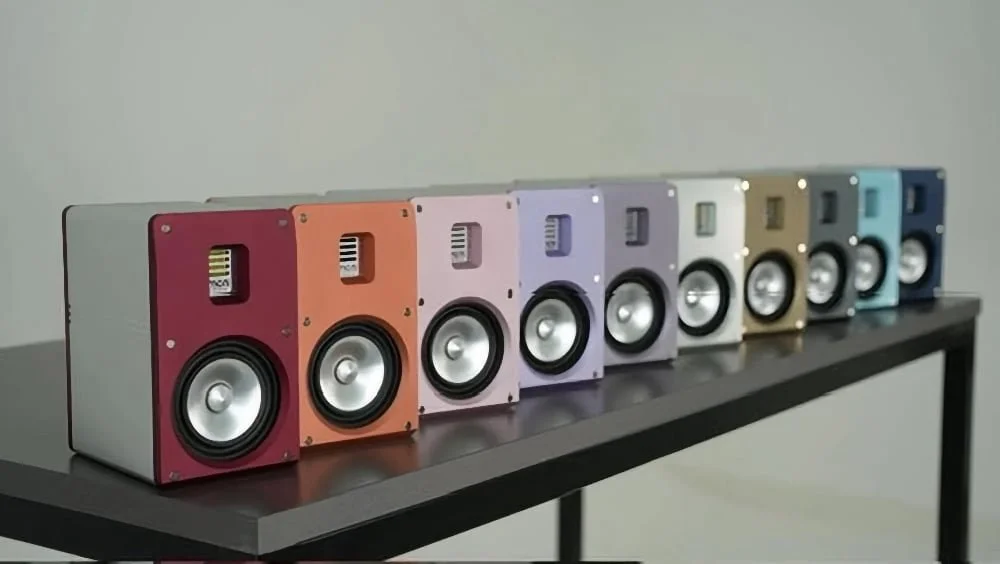
SuperMon Minis arrive on my doorstep in a box that would hold just one of the speakers I am used to handling. Still, there was ample closed-cell foam packaging to keep the speakers nice and snug. The CNC-machined aluminum cabinets give these speakers a heft that is hard to imagine until handling them. They are cute from afar, but their density and jet black anodized finish give them a menacing impression up close.
The SuperMon Mini offers a solid aluminum cabinet for a fraction of the price of the entry model from brands that typically offer this type of construction. Think YG Acoustics, Magico and Stenheim with prices well into five figures. MonAcoustic, for their part, do offer a larger MTM speaker called the PlatiMon Virtual Coaxial ONE MKII, starting at $9800, priced more in line but still competitive with the players mentioned.
Review System
I auditioned the SuperMon Minis without a subwoofer. While pairing with a sub is warranted, I made a point of experiencing the product on its own terms.
Positioning and listening setup are critical to the experience of the SuperMon Mini. I placed them on my 24-inch Pangea stands, secured with Loctite Blu-Tack and found the best results with the baffles toed in, pointing directly at my ears. I formed an equilateral triangle with 6 feet between both the speakers and me. In general, space from the rear wall improves soundstage depth and I settled on a distance of about two feet.
I fed high-resolution streams from my Wiim Mini into the optical input of the PS Audio Stellar Strata Mk2 or the Cambridge EVO 150, and when I played vinyl, it was on the Cambridge Alva TT V2 utilizing the phono stage in the Stellar. I briefly dabbled in tubes with the Allnic ASRA RHPA-7500 and high current Class AB with my near-vintage Parasound HCA-750A.
Listening
I am an imaging fanatic, and this was my first fixation with the SuperMon Mini. My experience was less of a 3D holographic performance in my room and more like staring deep into a window to observe a well-defined performance behind the speakers. This was different from what I am used to, but equally enjoyable and impressive to my brain, which gets stimulated by any kind of musical illusion. Recently, I took a nostalgic trip to the mid-2000s alternative rock of my college years, when big, lush, reverb-laden vocals were a trend. This effect was on display when streaming Z by My Morning Jacket (ATO Records, 2005). The trio prominently features Jim James’ vocals front and center with a dose of dreamy reverb and startling clarity. I was impressed that the SuperMon Minis lent the voice weight without sacrificing the body and impact of the drums and bass around it. Along with the transparency, I did not suffer through any extra heat from the AMT tweeter. In a compact listening setup, I experienced a complete and musically satisfying performance from the diminutive SuperMon Minis.
The SuperMon Minis impressed with detail and transparency on a slightly processed rock recording, but I needed more time to feel out how they handled timbre on audiophile acoustic recordings. Spinning the 2022 Blue Note Classic Series reissue of Joe Lovano’s 2003 live 2LP All for You was a perfect all-analog recording for the SuperMon Minis to reproduce a jazz quartet with no artifacts to hide behind. Joe Lovano’s romantic tone is on full display, and all that romance was coming through the speaker, not from the speaker. Large and clear, positioned left and a bit forward with no extra sizzle. Paul Motian’s drums were off to the right, further back than Lovano’s tenor, and an appropriate size relative to the saxophone (if not exactly life-size). Hank Jones’ piano was centred behind the speakers, with an even emphasis on the fundamental notes throughout the range, with any percussive aspect appearing only as Jones perked up for a solo. George Mraz’s bass, meanwhile, formed a diffuse background, perhaps a bit light in terms of impact and definition in the lowest octave, but forming an impressively large sonic canvas for the band to spread out on. With this recording, which is squarely within the SuperMon Mini’s dynamic and frequency capabilities, they rendered an intelligently scaled performance of Joe Lovano’s quartet and did justice to the mastery exhibited by all four players.
I was enamoured with the performance of the SuperMon Mini on recordings well within their obvious capabilities, but I naturally had to seek the boundary of their limitations, as I would with any speaker. A live rock concert recording is a solid bet for testing those boundaries. “Jimi Thing” from Dave Matthews Band Central Park Concert (Bama Rags Records, 2003) is an all-time favourite performance. Considering the recording was produced for CD at the height of the loudness wars, it’s only slightly compressed. At comfortable levels, the unique ensemble (guitar, violin, saxophone, drums and bass) sounds smooth, and the treble is balanced and not fatiguing. Spatially, things start to get congested during hard jamming passages at high listening levels. Some spicy treble and harshness start to come out only after the volume gets uncomfortable for near-field listening. So the SuperMon Minis have limits to their output, but given their size, those limits are extremely impressive. In the future, I hope to try a subwoofer to see how they perform when some load is taken off the overachieving woofer.
With minimal expectations, I tried the SuperMon Mini with the Allnic RHPA-7500. Although this amp drove other 4 ohm speakers well, it was not an ideal match. I got a taste of timbral beauty and holographic imaging, but it wasn't a complete performance given the lack of low-end heft. The SuperMon Minis need both current and power from a substantial Class AB or high-end Class D amplifier. The SuperMon Minis are a great example of Hoffman’s Iron Law, which states (I’m paraphrasing) that it is possible to achieve two of these three elements in a speaker design: Bass extension, small size, and efficiency. Their bass extension (and surprising impact) and tiny size mean the SuperMon Minis require serious juice.
Conclusion
The MonAcoustic SuperMon Mini 2026 is a compelling and unique contender in the crowded bookshelf speaker market. Its core design—the isobaric woofer configuration and the solid CNC-milled aluminum cabinet—sets it apart, bringing a level of build quality and technical innovation usually reserved for loudspeakers well into five figures. The result is a diminutive speaker that, in the right application, can provide thrilling musical engagement. An Audiophilia Star is well deserved for engineering and musical achievement.