
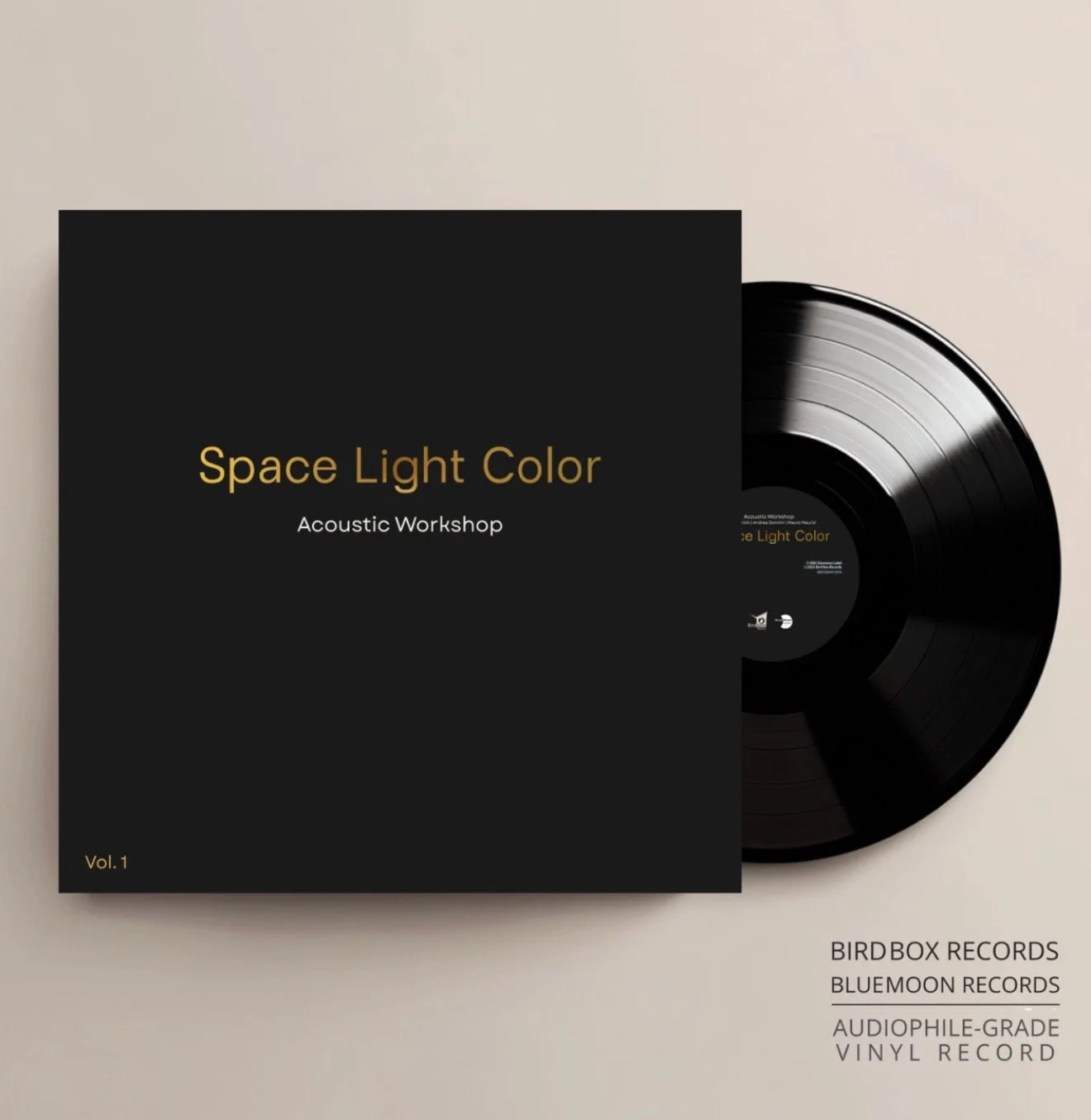
Space, Light, Color – Acoustic Workshop, Volume 1 (Birdbox Records)
Birdbox Records’ Space, Light, Color – Acoustic Workshop, Volume 1 is a compelling project from Lorenzo Vella, founder of the label and mastering engineer at Nightingale Studios.
It was created in collaboration with recording and mixing engineer Massimo Piantini.
At its core is a recording made in June 2002 at the Museo di Cassero in Monte San Savino, Italy, captured on digital audio tape. It was originally issued as a limited LP/CD set by Max Research, and surviving copies now appear to be exceedingly scarce.
While Vella is known for his commitment to analog recording and mastering, he is guided above all by a sensitivity to sound quality. In this case, he recognized something exceptional in the original digital recording and set out to bring those qualities forward through a different approach. The original DAT was transferred to half-inch analog master tape and passed through an analog mastering chain incorporating vintage equipment, resulting in a presentation that retains the precision of the source while introducing greater tonal richness and dimensionality.
The recording is built around a trio—Gae Tortorizio (guitar), Mauro Maurizi (double bass), and Andrea Donnini (trumpet)—captured live in the studio with no overdubbing. Careful attention was given to microphone selection, placement, and the acoustic environment itself. Recorded in a large stone-walled room within an old palace, the space plays a central role, contributing air, decay, and a natural sense of openness.
The program draws from familiar material—“Tequila,” “Killing Me Softly with His Song,” “From the Beginning,” “Georgie Porgy,” “Black Queen,” “On Broadway,” “My Funny Valentine,” and “Goodbye Pork Pie Hat.” Yet despite the familiarity of the titles, the album plays out less like a set of covers and more like an exploratory jazz session, one that also possesses the qualities of a demonstration recording.
Rather than presenting these tunes outright, the trio approaches them obliquely, allowing familiar material to emerge gradually. In many cases, the melodies recede beneath the interaction of the players, revealing themselves only over time and often in unexpected ways.
“Tequila,” for example, emphasizes interplay over statement, with bass and guitar taking the lead while the melody appears only in passing. A similar approach shapes “Killing Me Softly with His Song,” which becomes a study in double bass—initially abstract, but increasingly recognizable as the performance unfolds. The instrument is handled with a high degree of control and sensitivity, with sustained, subtly shaped notes that reinforce the gradual emergence of the melody.
This approach carries throughout the program, with familiar material often suggested rather than stated, the trio allowing structure and identity to emerge gradually from within the performance.
The closing “Goodbye Pork Pie Hat” brings the trio fully together. A haunting bass line is joined by a sensuous muted trumpet, and the interplay between the musicians comes into clear focus, providing a fitting conclusion.
The combination of a digital source with analog mastering techniques is described throughout the accompanying booklet as “alchemical.” In this context, the term refers to the transformation of a high-quality digital recording through an analog chain—tape transfer, vintage equipment, and careful mastering—into something that retains precision while gaining a greater sense of depth and ease.
The overriding impression of this presentation is one of space—an idea reflected directly in the title itself. With minimal instrumentation, careful microphone placement, and a thoughtfully chosen acoustic environment, the recording achieves an open, unforced character that allows the music to breathe naturally. Height, depth, and the reflective qualities of the room all contribute to a sense of dimensionality that reveals not only the tonal character of each instrument and the natural rise and fall of the performance, but also the expressive intent behind each moment.
Each instrument is presented with a clear sense of physical presence and immediacy. The guitar feels present and direct, with the articulation of the pick, the release of the string, and the natural decay of each note extending convincingly into the surrounding space. A wide range of tonal color emerges from the instrument, from delicate, lightly touched passages to more forceful attacks, all conveyed with clarity and nuance. The double bass is equally compelling—deep and resonant, yet rich in character, with subtle slides, bowed passages, and clearly defined plucked notes that anchor the recording with both weight and nuance. The muted trumpet is heard here with a breathy, textured quality, always controlled and rich in character. The sound of breath and the instrument’s distinctive timbre come through with real clarity.
Together, these elements create a powerful sense of realism—not in the sense of sudden impact, but in the recognition of music being created in real time. The fine dynamic shading and the natural flow of the performance give the impression of sitting in front of a live performance, where each gesture and inflection is both audible and fully realized. Perhaps most importantly, the recording steps aside, allowing the intention and emotional character of the performances to come through with clarity—an achievement that ultimately sets it apart.
The physical presentation reflects the same level of care. Pressed at Optimal Media, the vinyl surfaces are exceptionally quiet. The record is housed in an elegant satin matte-finish gatefold jacket—predominantly black with gold accents—that conveys understated luxury, and is accompanied by a 15-page booklet featuring photographs, technical details, and insight into the recording and mastering process. Cut at 45 RPM, the format contributes to a heightened sense of openness and resolution, allowing the full character of the recording to emerge. Limited to 300 copies, this is very much a connoisseur’s release, appealing to audiophiles for its sonic qualities while remaining equally rewarding as a musical experience.
What ultimately makes Space, Light, Color so compelling is the way these elements come together as a unified whole. This is not simply an exercise in sound quality, nor merely a collection of inventive interpretations, but a recording that fully realizes both at once. Lorenzo Vella’s instinct to revisit and reimagine this material proves to be well-founded, resulting in a release that is as engaging musically as it is rewarding sonically. It is, in the end, the kind of record that invites not just admiration, but return—each listen offering something newly revealed within its carefully shaped space.
![Ella Fitzgerald - Sings The Rodgers and Hart Song Book—Verve (Acoustic Sounds Series) vinyl reissue [2026]](https://images.squarespace-cdn.com/content/v1/55787f0ae4b02f0501debbeb/1774714651217-TB29YHD81EK60DZ2H5CJ/IMG_0813.jpeg)
![MonAcoustic SuperMon Mini [2026]](https://images.squarespace-cdn.com/content/v1/55787f0ae4b02f0501debbeb/1774997632563-7BEBCHYYIEXZDQ54NUH7/IMG_0817.webp)