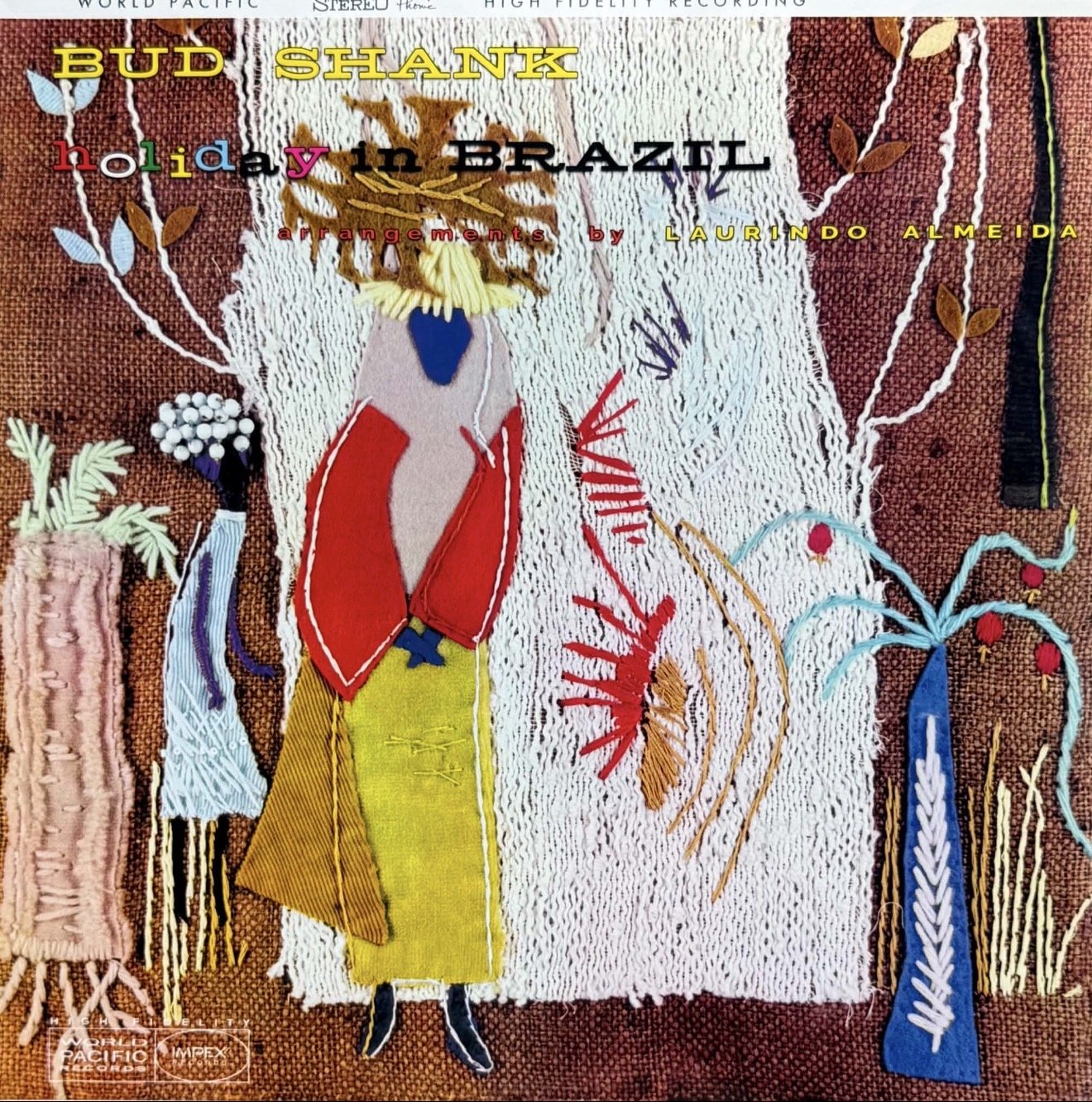
Holiday in Brazil – Bud Shank & Laurindo Almeida (Impex vinyl reissue 2026)
Holiday in Brazil arrives as a somewhat unexpected entry in the Impex Records catalog—a reissue drawn from the archives of World Pacific Records, a smaller and often overlooked label compared to contemporaries like Blue Note or Verve. Originally recorded in 1958 at Radio Recorders in Los Angeles and released in 1959, this early stereo session captures a moment that is firmly of its time, yet quietly points ahead to what’s to come.
What makes this release particularly intriguing is not just its pedigree, but its relative obscurity—it’s not an obvious title, nor one that arrives with built-in expectations.
The program consists of ten compositions, drawing primarily from original material by Laurindo Almeida. Bud Shank is represented with a composition of his own, and the two musicians are credited together on one piece. Stanley Wilson’s “Simpático” adds further variety, while material from the Rodgers and Hart catalog provides a familiar point of reference within an otherwise more exploratory set.
The session features Shank on alto saxophone and flute alongside Almeida, who also provides the arrangements and guitar work. The rhythm section includes Gary Peacock on bass and Chuck Flores on drums.
The recording was engineered by Bones Howe, here credited under his given name, Dayton Howe.
Before even lowering the stylus, there was a sense that this was a somewhat daring choice for Impex, given how rarely this title has been reissued.
In my own case, the Brazilian influence was enough to hold my interest. Almeida was a known quantity from other recordings, but Shank was less familiar territory. That combination—one artist I understood, another I had yet to fully explore—added a layer of curiosity going in, even if the title itself remained something of an unknown.
Still, if there’s one thing I’ve come to trust, it’s the curatorial instinct of Impex. Their choices are rarely arbitrary, and even when a title appears unexpected, there’s usually a clear sense of purpose behind it. That alone was enough to keep me fully engaged.
From the opening moments, the recording immediately places itself in the early stereo era. The separation is wide and clearly defined, with Almeida’s guitar anchored in the right channel and Shank’s alto saxophone positioned to the left. There is some center fill, but it lacks the cohesion and dimensional specificity that would come later as stereo techniques evolved.
What stands out right away is the grounding of the presentation. There is a notable depth to the bass—articulate, controlled, and unexpectedly weighty for a recording of this period. It provides a firm foundation for the music, holding everything together and giving the overall sound a sense of stability that feels both natural and engaging. The album opens with “Simpático,” composed by Stanley Wilson, and it serves as an effective introduction to the album’s sonic character.
The opening guitar immediately draws you in—clear, articulate, and resonant, with a natural tonal quality that feels unforced and present. Shank’s alto saxophone matches that same natural quality, complementing the guitar rather than competing with it. The two instruments feel well-matched, each occupying its own space while remaining part of a cohesive whole.
The bass remains easy to follow as it moves up and down the scale, providing clarity and direction.
What emerges musically is a gentle sense of movement and exchange. Each instrument is given room to shine before yielding to the next, creating a conversational flow that feels relaxed and unhurried. The overall feel is light.
The Brazilian character of the album is not always presented in an overt way. At times, the structure and phrasing draw more from a familiar jazz framework. And yet, the Brazilian influence remains present—operating just beneath the surface, informing the rhythm, phrasing, and overall feel in subtle but meaningful ways.
There is, at least initially, a sense that the recording is firmly rooted in its time. At the same moment, Shank’s playing carries a quality that feels slightly more reminiscent of an earlier era. And yet, that subtle contrast never becomes a distraction. If anything, it adds character.
The pairing of alto saxophone and guitar proves consistently engaging, with the two voices blending with an ease that feels natural and unforced. The overall effect is one of lightness—a breezy, unhurried quality that fully lives up to the album’s title.
As the album progresses, another aspect of the recording becomes more apparent. There isn’t a great deal of depth to the image, which feels relatively contained, suggesting a smaller, more intimate recording environment rather than a large, expansive space.
That sense of intimacy feels just right. Expanding the scale too much would likely diminish the subtle interplay and relaxed conversational quality that define the session.
This presentation does not lean toward hyper-detail or brightness. Instead, it settles into a warmer, more relaxed balance, with a slightly softened top end that feels entirely appropriate for the material. There is clarity and separation throughout, but without the kind of extended high-frequency emphasis that can sometimes draw attention away from the music. The edges of both guitar and saxophone are well-defined, yet free from any sense of glare or hardness.
Subtle percussion plays an important supporting role throughout, adding a gentle sense of movement and reinforcing the album’s understated Latin character.
In the latter half of the record, Shank’s flute becomes more prominent, introducing a softer, more airy tonal color. This comes into particularly sharp focus on “Mood Antiqua,” where the flute is firmly positioned in the left channel, breathy and expressive. Almeida’s guitar follows from the right, while the percussion occupies a space just right of center. The rhythmic foundation gradually becomes more assertive, leading into a brief solo passage on hand-struck drums that adds a sense of momentum.
It’s one of the more immediately engaging moments on the album, offering a touch of sonic excitement while still remaining true to the overall aesthetic. While it lacks the precision of later stereo recordings, what it offers instead is something equally compelling: a vivid, evocative snapshot of its time.
Another standout moment comes with “Nocturnal,” an Almeida original. Here, the album settles into a particularly languid pace, allowing the phrasing to unfold with a sense of ease and patience. The balance between the two soloists is especially effective, with a slightly moody undercurrent that remains contemplative and quietly expressive. It’s a moment that captures the essence of the album—understated, unhurried, and deeply musical.
One final point is worth emphasizing. On first listen, Holiday in Brazil made only a modest impression. Nothing immediately demanded attention, and it would be easy to move on without fully absorbing what it has to offer.
But with repeated listening, something begins to shift.
Over time, the character of the album reveals itself more fully. What initially feels understated becomes its greatest strength. This is not a record that yields everything at once. It asks for patience, and in return, offers a deeper, more rewarding experience.
Above all, what stays with me most is the natural musical character of this album. It is not showy, nor is it “audiophile” in the way that term is often used today. It is quiet, intimate, beautifully performed, and gently evocative of Brazil.
This is exactly the kind of release that highlights what makes Impex so compelling as a label. In a reissue landscape often dominated by familiar titles, this offers something increasingly rare: an unfamiliar work, thoughtfully produced and beautifully executed, that reveals its value over time.
While this title may not initially appear essential for many listeners, it has, for me, become an essential part of my collection—one I expect to return to often, and with increasing appreciation over time.
⸻
Production Details
Cut at 33⅓ RPM from the original analog master tapes by Chris Bellman at Bernie Grundman Mastering
Pressed on 180-gram vinyl at Record Technology Inc.
Stoughton single-pocket jacket with glossy front