Staccato Audio Black Unique BU-01 Amplifier
In early December this year (2025), my doorman notified me of a large 75-pound box that had arrived addressed to me. Not recalling ordering anything of that nature, I was stumped as to what it could be; I did not recognize the sender's name or address. Suffice it to say, it required two men to help me get it into my apartment. It turned out to be the star of this review, a Staccato Audio Black Unique BU-01 Amplifier ($15,990 US). To make a long story short: Benjamin Zwickel, Owner/Founder of Mojo Audio, had discovered what he felt was a very unique and special-sounding amplifier that he thought I would want to hear. He had access to the only one in the USA; it was manufactured by a company, Staccato Audio, not yet well known. I had pushed him off several times without committing to having it sent to me, and I was too busy to pay close attention to the various product details he had alluded to, even including its weight and size. Zwickel was persistent, so one day I succumbed and said, "Sure, just send it sometime, I’ll check it out.” He followed up.
So what exactly was this amp? It was a pure class A dual mono integrated stereo amplifier (amp plus line-stage preamp, with 6 inputs, no phono stage), meticulously handcrafted by Designer/Founder Jakub Honkisz in Poland, using carefully matched transistors and other carefully selected components. It uses only RCA connections (single-ended), no XLRs, and weighs 66lbs with dimensions of 17.7" W x 7.1" H x 16.3" D. (See the full set of specifications further below.)
Pure class A refers to the output transistors remaining continuously on (no switching on and off), conducting electricity at full blast; hence, they are notoriously inefficient, wasting 80% or so of their energy in heat. But when designed in the right hands, such an amplifier can yield a remarkably smooth and detailed sound with no distortion.
The following is from the Staccato Audio website:
The name Black Unique is far from arbitrary — it refers to the “black background” in music, the subtle silence in which the room’s acoustics become perceptible. The designer’s intention was to reveal and define this black background. From a technological standpoint, the amplifier employs a proprietary triple electromagnetic shielding system for the transformer. This is crucial in Class A operation, where the high idle current generates significant electromagnetic radiation that can negatively affect internal coupling and signal purity. Furthermore, a high design priority was the elimination of internal wiring as a potential source of signal loss and unwanted antenna effects. By carefully routing a distributed ground network with hum-isolating resistors, the designer achieved an ultra-low self-noise floor.
Because of the heat issue, such an amp needs to be in an open space, and in my case, the only spot in my system cabinet that would accommodate it was quite a distance from some of my other components. Moreover, I mainly use balanced XLR connectors as my modus operandi; I did not have the RCA cables required to set it up fully. Admittedly, at first, I was less than enthusiastic to deal with all this. Moreover, I assumed I would have to use my standalone preamp (which was far away on another shelf). But then I realized that the Black Unique already had a line-stage preamp built in. Even better, the only part of my audio system that uses an RCA pair (besides the turntable-to-phono stage) is the analog output on my DAC, which was conveniently sitting right next to the Black Unique! Within 10 minutes, I heard music. Within 1 week, I was addicted to this unique amp. (I am grateful to Zwickel for introducing me to this remarkable unit.)
How does the Black Unique look?
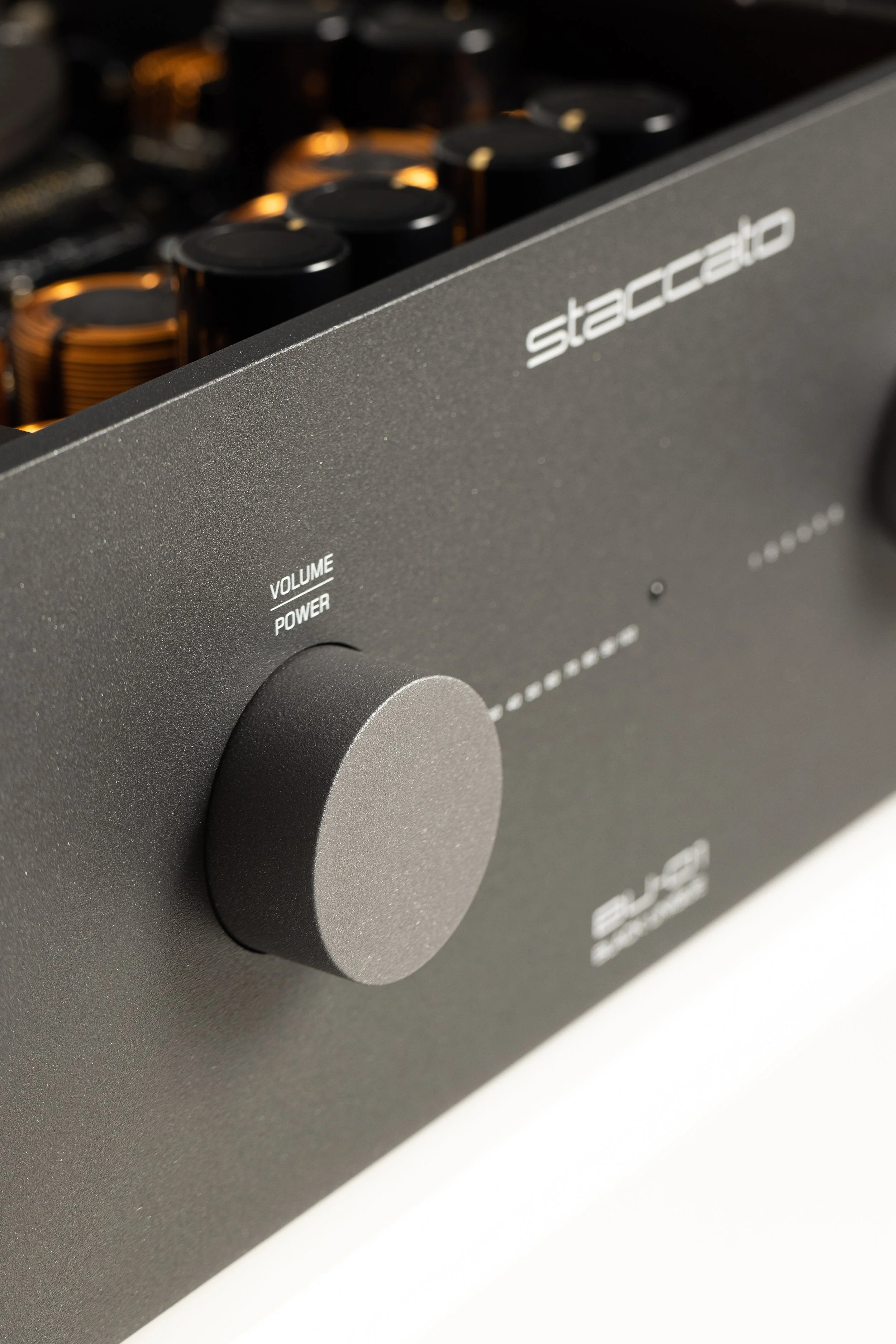
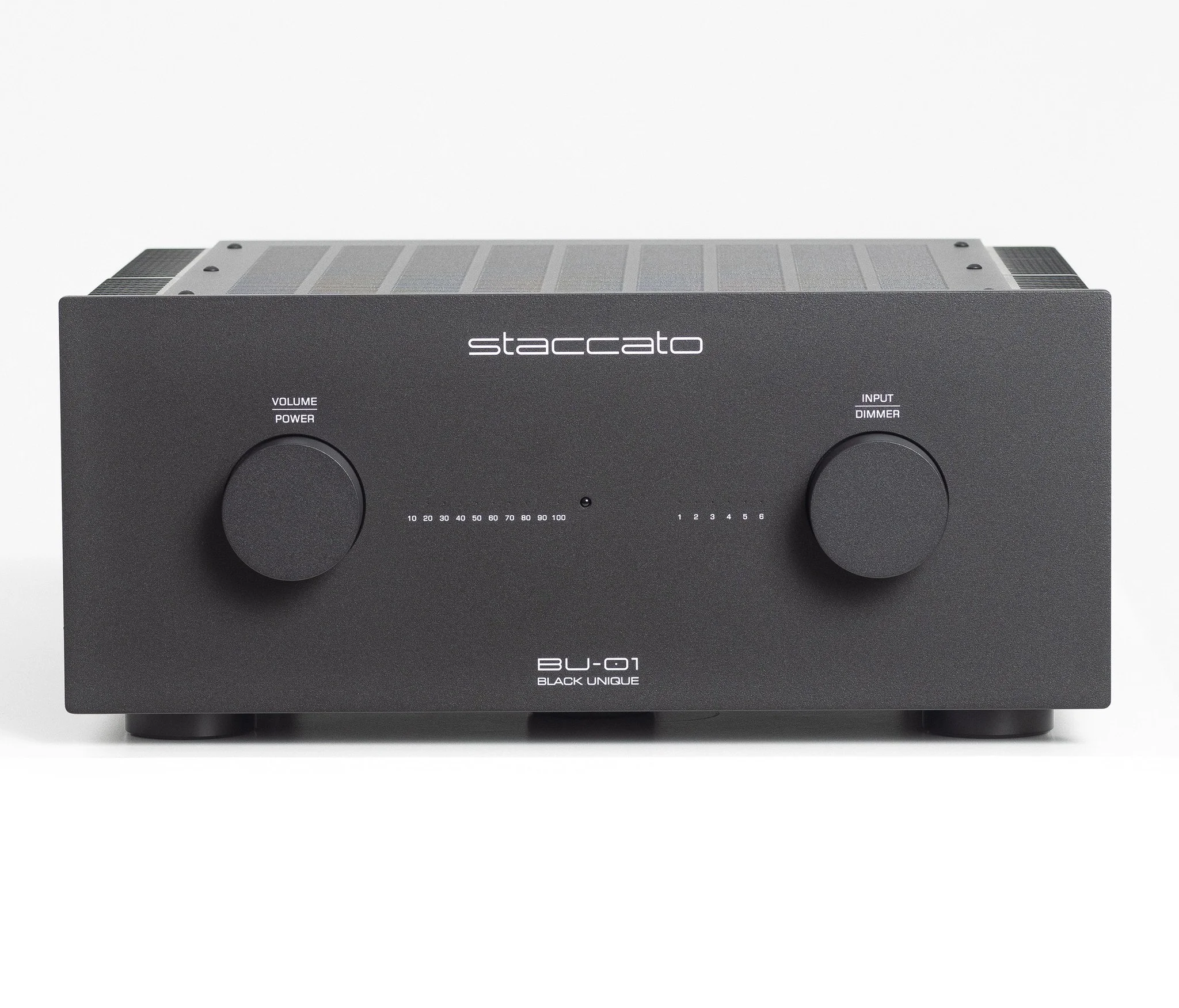
Serious and simple-looking, it has a meticulous metal chassis with ample black grills on the right and left sides and small holes in the top plate (in an attractive swirling design with a large “S” in the center), all of which help it cool down when in use. The front has two large metal knobs: the left one for VOLUME/POWER, the right one for INPUT/DIMMER. Near the top of the front, “staccato” is sketched in large white letters; near the bottom, in small letters, is sketched “BU-01” with “BLACK UNIQUE” beneath it. You can choose from among 10 different color configurations for the knob and chassis. My unit was grey with black knobs.
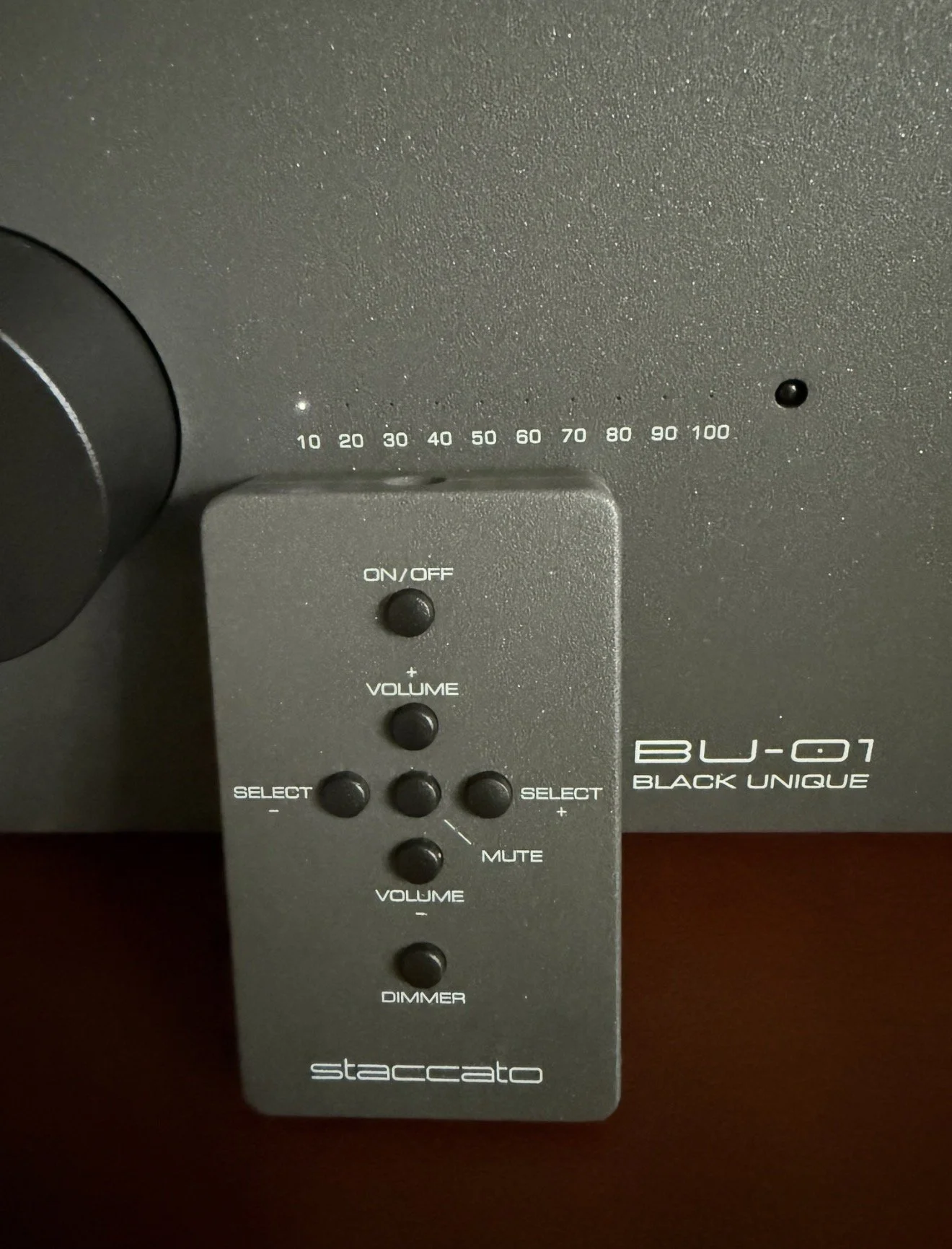
Pressing the left knob turns the power on, and the volume levels are etched to its right in small white numbers from 10 to 100, in multiples of 10, with tiny lights above each number. Once on, the amp slowly and automatically cycles through the numbers up to 90, making clicking noises along the way, then snaps back to 10 (or whatever level you left it at when you last turned it off). A soft-start warm-up. The right knob controls small white numbers 1 to 6 representing the line inputs, with the current line in use having its tiny light lit up. Turning the left knob controls the volume, while turning the right knob controls the line in use. The tiny lights can be dimmed by using the right knob. But the unit comes with a well-made, simple-to-use heavy-metal remote control that fits in your hand (see the photo below). In general, I used the remote because of its simplicity and convenience, and it has a mute button.
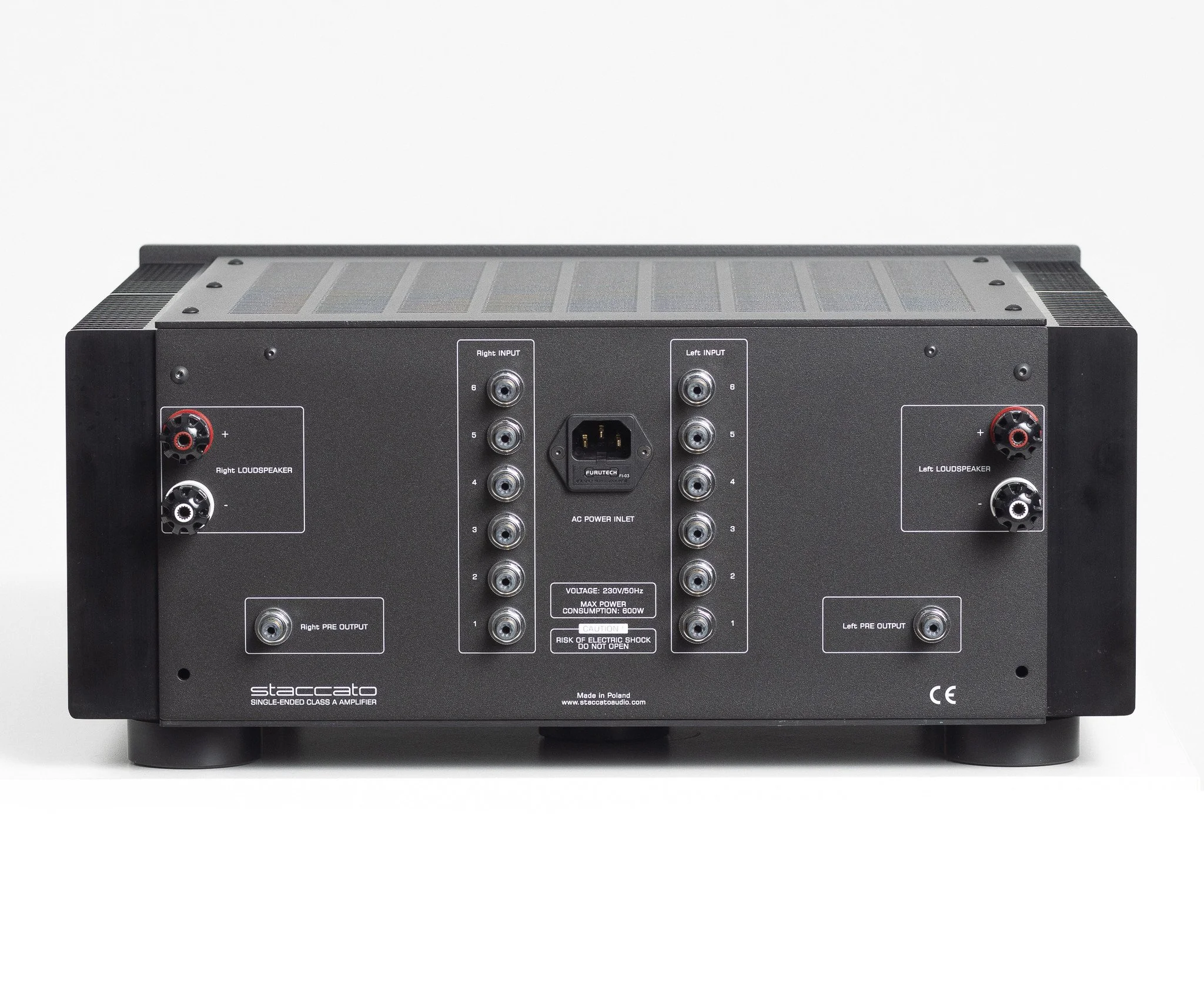
The back has a power cord IEC in the middle (you can use your own high-end cord), with the 6 RCA line inputs (L/R) close to it on either side in vertical rows. The speaker posts are further to the left and right of the back, and near the bottom are the left and right “PRE OUTPUT.” Those outputs are for if you wish to use the unit as a preamplifier only.
The bottom comes with 5 footers installed (I eventually replaced them with 4 IsoAcoustics Orea Bordeaux footers)
NOTE: It is a good practice to let the unit sit for (say) 15-20 minutes or so when turning it on before playing music (after it has been off for a long time) so it can warm up.
Questions and answers with Jakub Honkisz:
(Over email, I asked him several questions.)
Q: What got you interested in "Class A" versus other types of amps; did you try working on other types before focusing on Class A?
A: Nice question. What initially drew me to Class A was its naturalness and coherence of sound. I was fascinated by how fluid, open, and effortless music could feel when crossover distortion was completely eliminated.
Before focusing on Class A, I experimented with other amplifier topologies, including Class AB designs. They can achieve excellent measured performance and efficiency, but I often felt that something subtle was missing in the presentation — especially in terms of microdynamics, harmonic texture, and spatial realism.
Class A simply sounded more emotionally convincing to me, even if it comes with obvious drawbacks like heat and lower efficiency. Over time, I became somewhat obsessed with refining that sound and pushing the design further. I’ve spent hundreds of hours listening, measuring, and tuning various circuits, components, operating points, and power supply solutions to achieve the presentation I was hearing in my head.
Q: Are there types of music that you use in particular to help listen to, so as to help get the quality of sound you aim for?
A: Yes, definitely. I use many different types of music when tuning and evaluating an amplifier, because each genre reveals different aspects of the sound.
For example, acoustic jazz and vocal recordings are excellent for evaluating timbre, harmonic richness, and the naturalness of voices and instruments. Classical music helps me judge soundstage, depth, dynamics, and separation. I also use well-recorded electronic and rock music to evaluate bass control, transient response, energy, and the amplifier’s ability to stay composed at higher levels.
One of the most important things for me is whether the amplifier can convey emotion and realism convincingly, regardless of genre.
Q: Live concert versus studio recordings for adjusting/tuning your design?
A: Live, not very often. In many cases, I find live music less detailed and less refined from a sound-quality perspective, mainly because the acoustics and sound reinforcement are rarely ideal.
I personally prefer high-quality studio recordings with a lot of detail, texture, and microinformation, because they let me hear very subtle differences in timbre, space, dynamics, and resolution when tuning an amplifier.
One of the tracks I use most often for tuning is Diana Krall’s “Temptation.” I know that recording extremely well, and it’s excellent for evaluating vocal texture, intimacy, bass control, atmosphere, and low-level detail.
Music
Jennifer Warnes, “If It Be Your Will” (Reprise) from Famous Blue Raincoat, The Songs of Leonard Cohen, 20th Anniversary Edition (1987). (FLAC, 16/44.1)
This was one of the first pieces I played in which I immediately detected something special in the presentation by the Black Unique. I was mesmerized. The intimacy was startling; she was so vivid, up in the middle at standing height, all on an enormous, pure-black, huge 3-D soundstage. The acoustic guitar was so beautiful, real-sounding and delicate, like a gently played harp. A relatively quiet double bass, in the background from the left channel, assisted so tastefully and gently, too. At the end, when she finishes, it is dead quiet. I was in awe; I kept playing it over and over, so struck by the presentation.
Leonard Cohen, Ten New Songs (2001). Columbia. (FLAC 24/44.1)
This entire album sounds stunning through the Black Unique. Cohen's gravelly, guttural but rich and masterful deep voice exhibits complex textures I have never heard so vividly before; earthy and precise at the same time, with lingering trinkets scattered across the depth and width of the soundstage (he commands the soundstage mainly up high in the center). It is joined so tastefully with the gentle, delicate harmony of Sharon Robinson (who arranged and programmed this album). And all on a dead quiet soundstage. The harmonics are so rich in detail and subtleties. I now listen regularly to the entire album at once, rather than just 2-3 tracks I used to favor.
Aurélien Pontier (piano), Bach: Chaconnes BWV 1178 & 1179 (World Premiers), 2026, Warner Classics. (Qobuz 24/96). Apparently, this Bach piece was only recently discovered, let alone authenticated. Pontier jumped to it and recorded the first rendition (transcribed by him to piano) of its kind. It is deeply moving emotionally (especially “Chaconne and Fugue in D Minor, BWV 1178”), and the piano acoustics are superbly real and live-sounding through the Black Unique.
Zuill Bailey (Cello), Simone Dinnerstein (Piano), Beethoven Complete Works For Piano And Cello, Telarc, 2009, CD. In particular, the track 12 Variations on “See the Conqu’ring Hero Comes.” This is an exceptional piece from the album with Zuill Bailey (cello) and Simone Dinnerstein (piano), which I have enjoyed for years. The way these two interact and work together (close, emotional, and deep) is special (see some YouTube videos). Now, the back-and-forth between the two is captured with much more detail and emotion through the Black Unique than I have ever heard. And the natural timbre of the piano and cello is presented with such realism; listen to the next track too, “Beethoven: 12 Variations on 'Ein Mädchen oder Weidchen.”
“I Feel Free”, from Fresh Cream (1966), Polydor; remastered in 2014 from the original tapes. (24/192 FLAC). (I have chosen this as my parting (send off) song for retirement.) Composed by Jack Bruce with lyrics by the poet Pete Brown, this was Cream’s debut, showing off with confidence their new approach to music, mixing Blues with both rock and psychedelic pop, and the extraordinary musicianship of each of the three (the “Cream of the crop”): Clapton (guitar), Bruce (6-string, and 4-string bass guitars, harmonica, primary lead singer), Baker (drums/percussion). As with many stereo recordings from then, the recording is very right/left, with drums and bass guitar on the right, guitar on the left. The harmonies of Bruce with the other two as background vocalists are captured brilliantly, and even Clapton’s guitar work is, at times, in essence, contributing to the harmony like a voice, and the drums sound very natural throughout. Once again, the Black Unique excelled.
Finally, for testing percussion, I listened to two of my standard (live) favorite albums for that: Bill Bruford’s Earthworks, Random Acts of Happiness, the track “With Friends Like These”; and The Chick Corea Trio, Trilogy, the track “Piano Sonata: The Moon.”
The performances through the Black Unique were immersive, presenting an earthy yet pristine natural sound; in particular, I never heard Brian Blade's intricate drumming in the Piano Sonata so convincing and detailed before.
Specifications:
2 x 82wpc into 8 ohms or 2 x 110wpc into 4 ohms.
2 x 58w RMS into 8 ohms or 2 x 78w RMS into 4 ohms.
0.05% THD+N (20 Hz - 20 kHz, 4 ohms, 1W).
Frequency Response 1Hz - 90kHz (-0,1dB to -3dB).
Signal-to-Noise ratio (SNR) 91dB at full output.
Harmonic distortion 0,05% at 1kHz/1W
Bandwidth 1Hz – 150kHz +/-3dB
Noise level -91dBV
Dual-mono balanced CLCLC power supplies.
1 x Vintage paper-in-oil capacitor per leg per channel.
2X Mundorf M-Lytic capacitors per leg per channel.
2X vintage mil-spec air-core chokes per leg per channel.
6 pairs Furutech FT-903 low-mass RCA input jacks.
WBT 0703 CU low-mass gold-plated copper binding posts.
Furutech rhodium-plated copper IEC power inlet.
Remote-controlled 64-step 1dB stepped attenuator.
Individual startup volume memory for each input.
Dimmable LEDs with an LED off option.
Soft-start warm-up for extended life.
Available in several different color combinations.
Durable high-temperature baked-on powder-coated finish.
Available in 115 VAC or 230 VAC, 50/60Hz, mains power.
17.7" W x 7.1" H x 16.3" D and 66 pounds.
Reference equipment:
Alta Audio Aphrodite loudspeakers
PS Audio PMG Signature Preamplifier
Audio by Van Alstine DVA M750 Monoblock Power Amplifiers
Infigo Audio Method IS-1 Cryogen Streamer
Mojo Audio Mystique Z DAC
2 x Connected Fidelity Six Star Distribution Block with RFI Filter (with power cables)
LHY Audio SW6-SFP Network Switch
Jay’s Audio CDT-3 MK3 CD Transport
VPI Industries HW-40 Black Edition turntable
Pass Labs XP-7 Phono Preamplifier
Cabling by Wireworld Cable Technology: Platinum Starlight Ethernet, Platinum Eclipse 10 RCA interconnect, Micro Series 10 Reference Tonearm Cable.
Speaker Cables: Waveform Fidelity GS Mk 3
Isolation: IsoAcoustics for all, in particular, 4 OREA Bordeaux for the Stacatto BU-01)
Summary
The Staccato BU-01 (USD 15,990) is an artisanal gem. It is meticulously crafted with the finest components, features an astonishing black background that reveals delicate microdetails and textures, and delivers smooth, remarkably open dynamics with superb clarity and instrument separation across a wide, deep soundstage. The overall musicality and realism in its presentation are addictive. I feel like my system has moved from presenting in black and white to presenting in color. Finally, it proves that less can be more: the number of cables required to use it in an audio system is considerably fewer than with a standalone preamplifier and two monoblocks. A must hear.
Further information: Staccato Audio