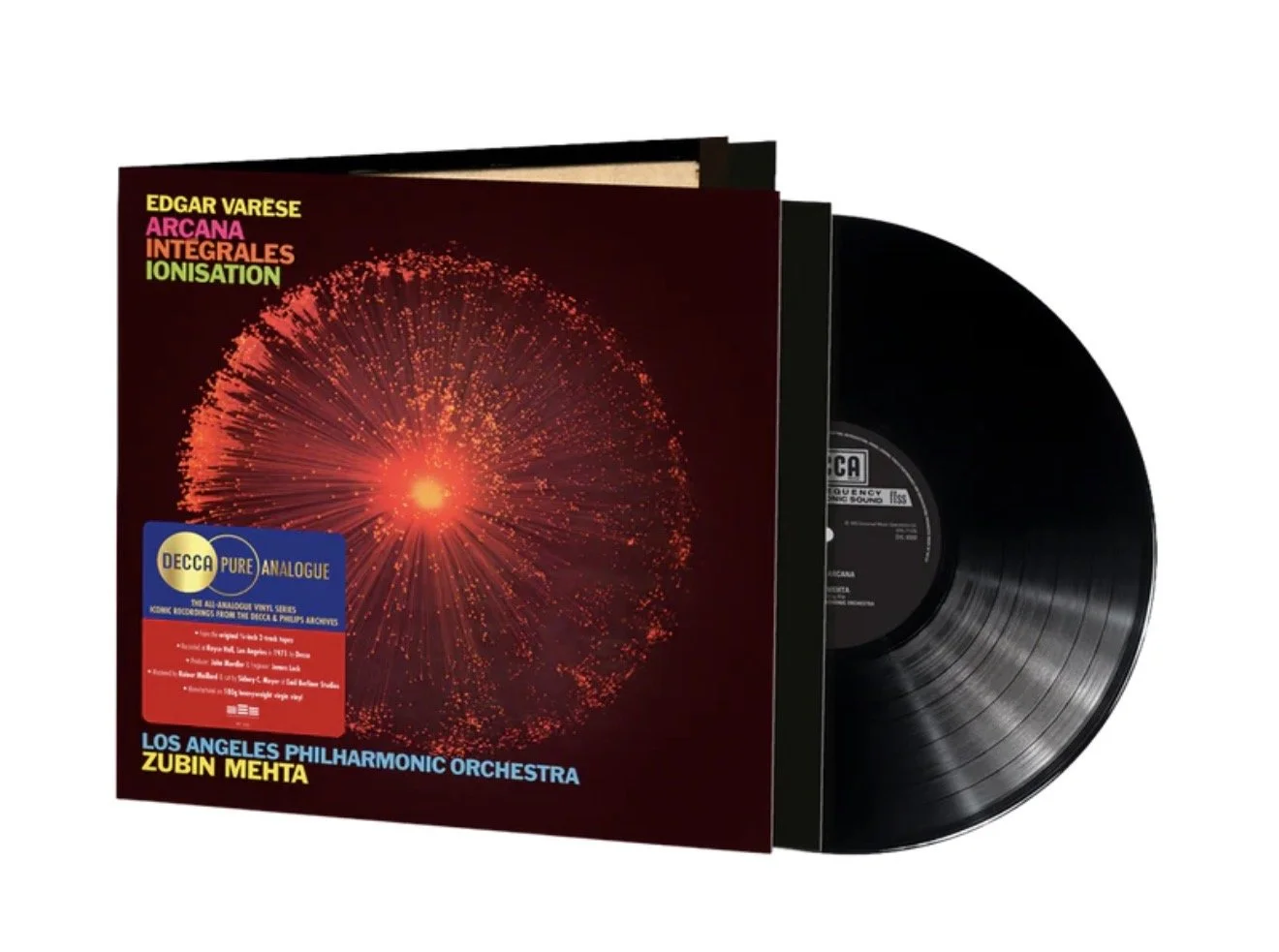
Edgard Varèse: Arcana • Intégrales • Ionisation—Zubin Mehta / Los Angeles Philharmonic—Decca Pure Analogue (2026)
My introduction to Edgard Varèse’s Arcana came through Robert Craft’s 1962 Columbia recording.
The music made an immediate impression. Its sheer audacity, highly individual musical language, and refusal to conform to conventional orchestral expectations felt unlike anything else in my collection. Even more surprising was the realization that this music had been composed nearly a century ago. It sounded less like a historical artifact than a glimpse into the future.
A decade later, Decca released Zubin Mehta’s celebrated Los Angeles Philharmonic recording, recorded in Royce Hall in 1971 and issued in 1972. Pairing Arcana with Intégrales and Ionisation, it presented these landmark works in sound that proved every bit as memorable as the music itself.
More than fifty years later, I still find it one of the most impressive orchestral recordings in my collection. So when Decca announced a new Pure Analogue edition mastered from the original tapes, my curiosity was immediate.
The Recording
Composed between 1924 and 1931, Arcana, Intégrales, and Ionisation represent some of Varèse’s most influential and enduring works. While often described as avant-garde, the music remains remarkably accessible on a purely sonic level. Few composers were as concerned with the physical properties of sound itself, and these works continue to sound decidedly modern today.
The performances by Zubin Mehta and the Los Angeles Philharmonic combine precision, power, and conviction in a way that serves this music exceptionally well. Together with producer John Mordler and engineer James Lock, they captured both the power of the music and the spacious acoustic of Royce Hall with extraordinary success.
The recording’s reputation among collectors rests on its combination of deep bass, explosive percussion, enormous dynamic range, and a vivid sense of acoustic space.
The Decca Pure Analogue Release
The latest entry in Decca’s Pure Analogue series was mastered by Rainer Maillard at Emil Berliner Studios and cut by Sidney C. Meyer from the original quarter-inch two-track master tapes. Pressed on 180-gram vinyl at Pallas in Germany, the release is presented in a matte-finish gatefold jacket.
Visually, the presentation departs from earlier editions. The familiar artwork remains, but the colors have been softened and muted compared to original pressings. Inside, new notes provide historical context on the recording and the significance of these performances within the Varèse discography.
Like other releases in the Pure Analogue series, this edition returns to the original source tapes in an effort to present the recording with the greatest possible transparency.
Listening
The majority of my listening focused on Arcana, although all three works were used in the comparison. Before turning to the new Decca Pure Analogue edition, it helps to establish a reference point. For this recording, that reference remains the original UK Decca mastered by Harry Fisher.
What immediately distinguishes the original Decca is its sense of perspective. The listener is presented with a natural view into the venue from a few rows back in the hall. The enormous percussion forces retain their impact, bass extends effortlessly, and dynamic contrasts remain startling, yet nothing calls attention to itself. The presentation feels integrated, organic, and completely at ease.
Repeated listening revealed another quality that is difficult to quantify but impossible to ignore. The recording retains an element of mystery. Hall ambience, instrumental textures, and transient attacks are all clearly present, yet they are woven naturally into the musical fabric rather than isolated as separate sonic events. The result is an immersive listening experience that consistently places the focus on the performance rather than the recording itself.
This quality proved especially important in Arcana and Ionisation. Both works can sound almost overwhelming in their complexity, yet the original Decca provides a remarkable sense of coherence. Individual elements remain easy to follow, but the larger musical picture is never sacrificed in favor of detail. The Harry Fisher mastering remains a compelling demonstration of how much information can be conveyed without ever sounding analytical.

The Orphic Egg Edition
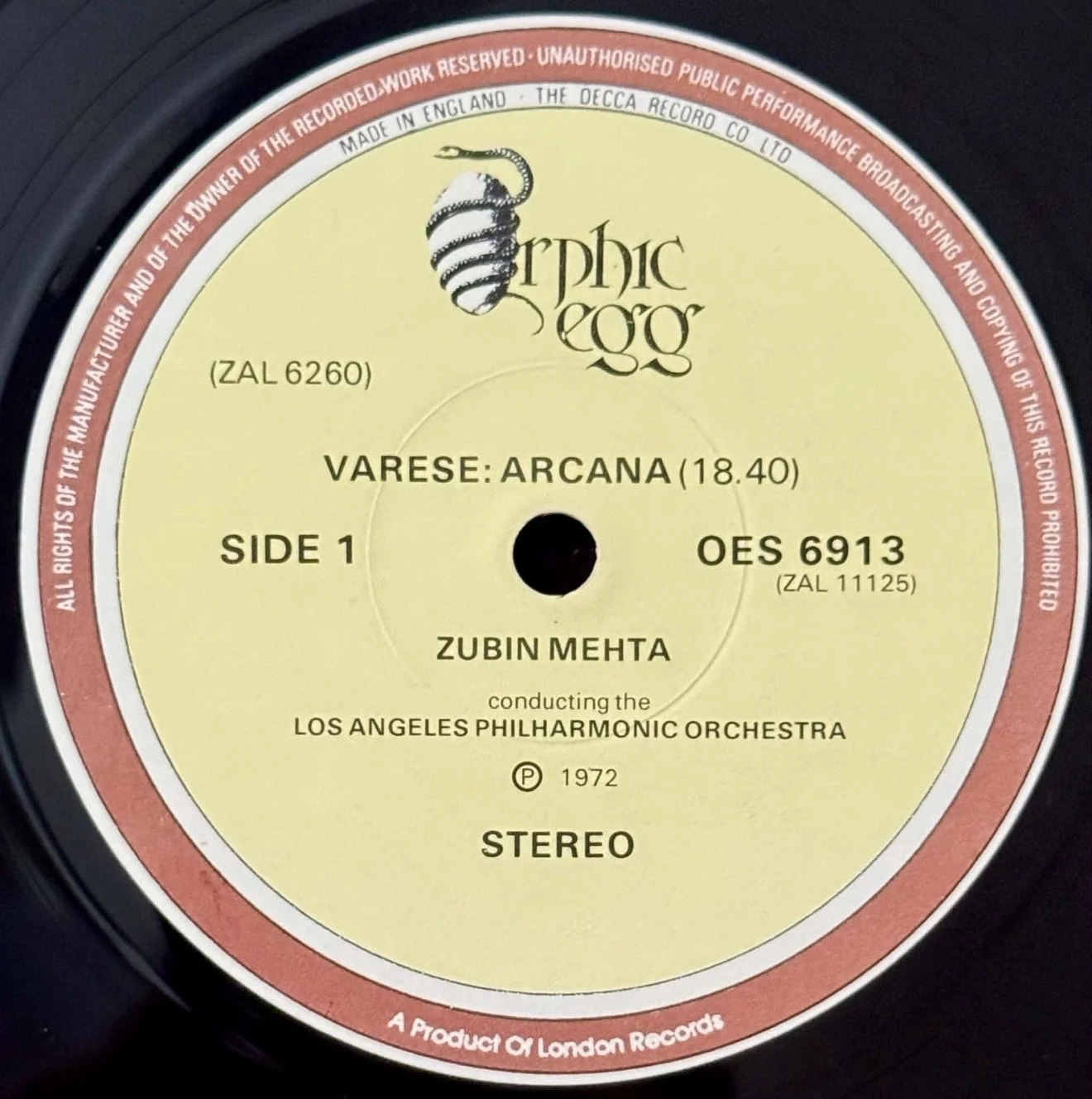
One of the more intriguing discoveries during this comparison was the 1973 Orphic Egg edition. Released exclusively for the U.S. market, the album was repackaged with surrealist artwork clearly intended to appeal to a younger audience. The visual presentation could hardly be more different from the original release, suggesting an effort to reposition the recording for a very different market. What makes the release particularly interesting is its timing. Appearing only a year after the recording’s initial release, the Orphic Egg was not a distant reissue but an alternative presentation of the same recording, released alongside the already available London edition and aimed at a different audience.
The records were pressed in the UK by Decca and carry the same Harry Fisher 1W stampers associated with the original release, helping to explain why the Orphic Egg sounded so much like the original Decca.
While collectors may debate the finer points of individual pressings, the Orphic Egg delivers much of the same sonic character that has made the original Decca and London editions so highly regarded among collectors.
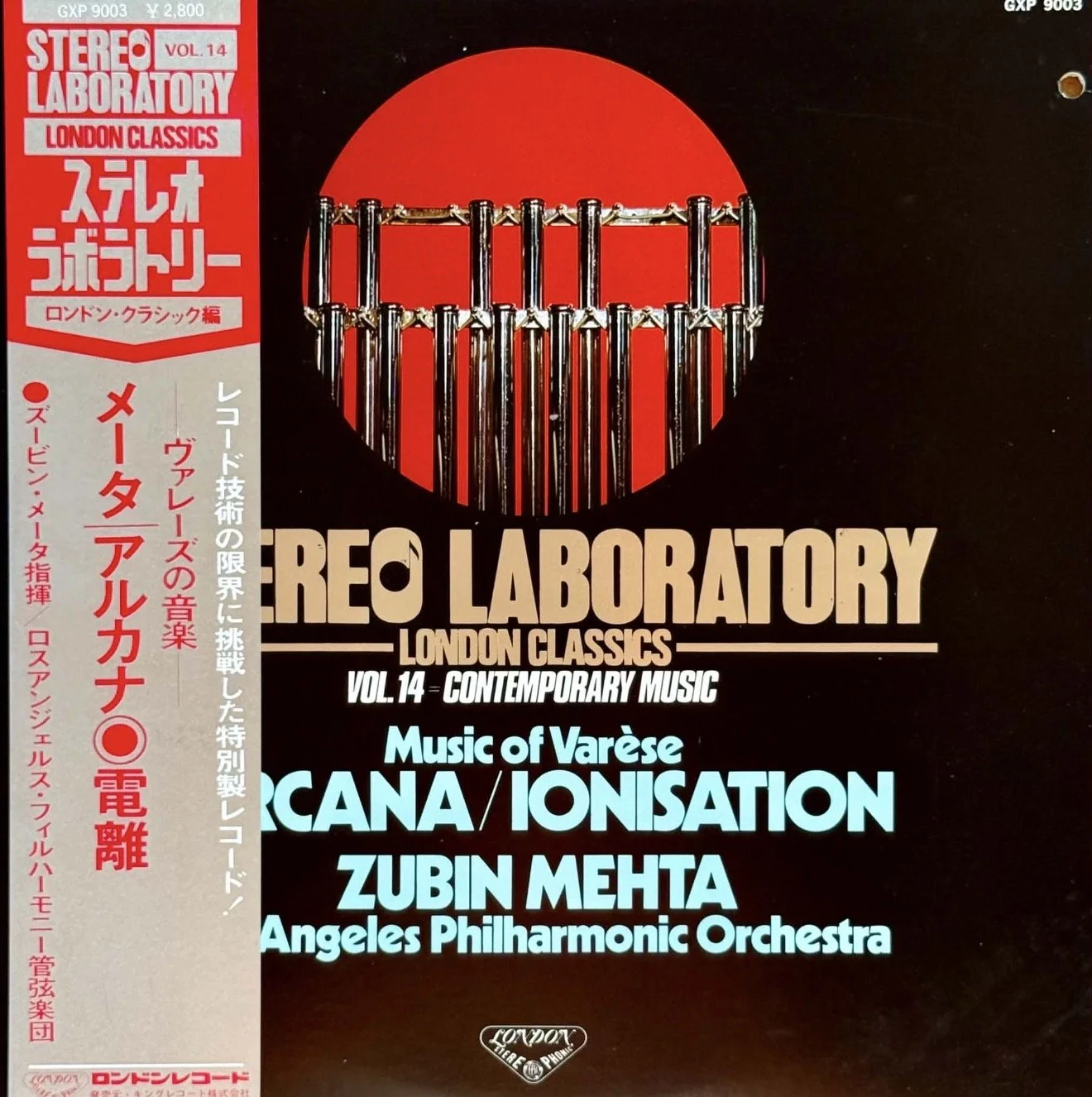
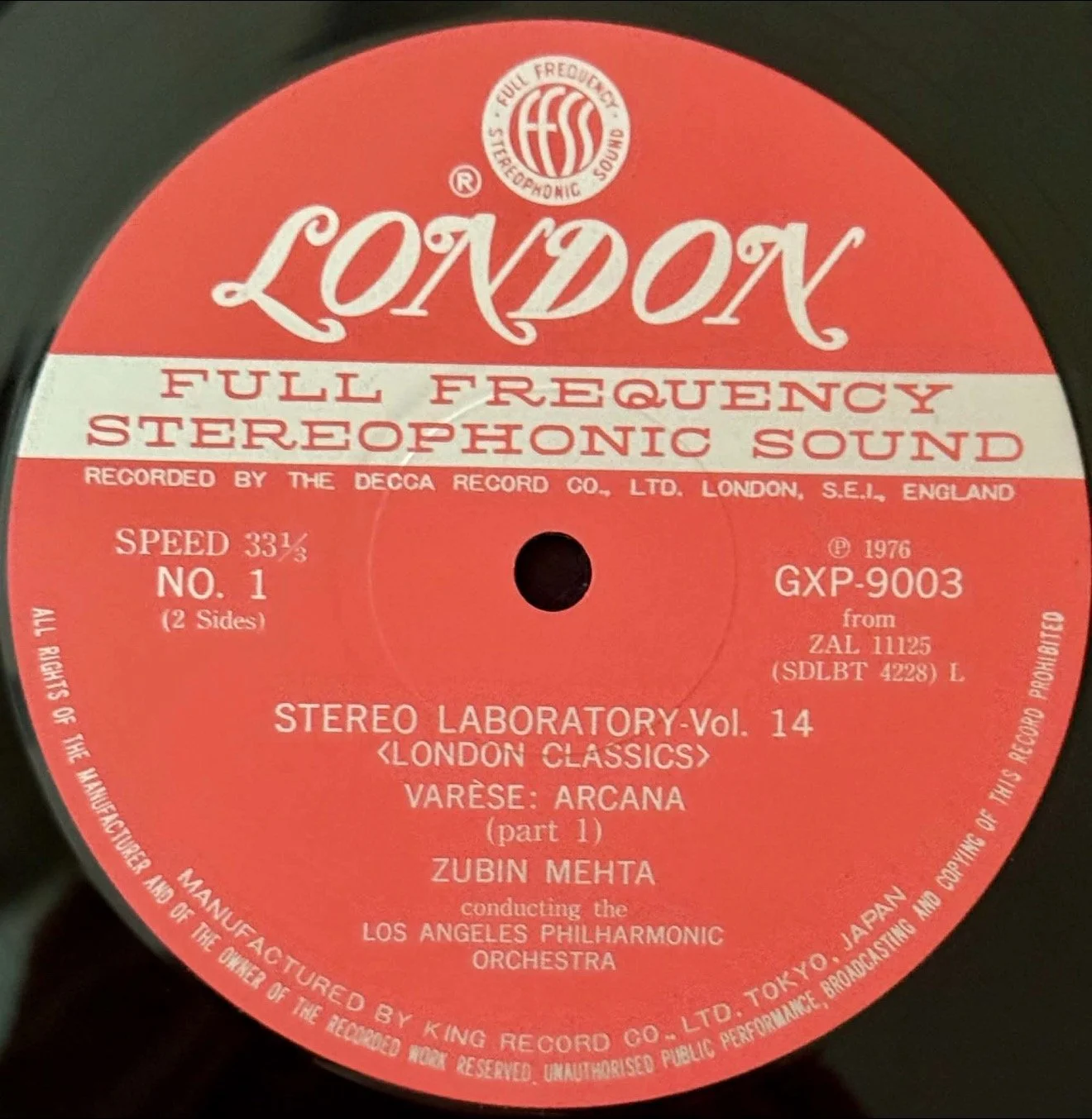
The Japanese Stereo Laboratory Pressing
The Japanese London Classics Stereo Laboratory release, issued as Volume 14: Contemporary Music, differs significantly from every other version in this comparison. Clearly conceived as a demonstration-oriented release, it also departs from the original program sequence. Rather than fitting Arcana, Intégrales, and Ionisation onto two sides as originally issued, the producers omitted Intégrales entirely and spread the eighteen-minute Arcana across two sides of vinyl, with the roughly six-minute Ionisation occupying the remainder of side two.
That decision comes with both advantages and disadvantages. On the positive side, the generous groove spacing may help explain the pressing’s extraordinary sense of scale and physical impact. Unlike many Japanese pressings of the era, tonal balance was never an issue. The top end remained natural and well balanced, while the bass extended to truly impressive depths.
On Ionisation in particular, the exceptionally quiet vinyl surfaces proved beneficial. Varèse’s writing frequently relies on the relationships between sounds and the spaces that surround them. Individual percussion elements emerge from silence, decay into the acoustic, and leave moments of anticipation before the next gesture arrives. The Japanese pressing allowed these spaces to be heard with unusual clarity, making them feel an integral part of the composition rather than simply the absence of sound.
The same qualities benefited Arcana as well. The low noise floor made it easier to appreciate the wide separation between instrumental groups, an important part of the work’s architecture. Instrumental images were enormous, percussive attacks could be explosive, and the largest drums possessed a convincing sense of weight and physical presence, their impact evident not only in the sound itself but in the movement of air throughout the room. There were moments when one could feel not only the sound of a drum, but the vibration of the drumhead itself. Several attacks in Arcana were startling enough to make me physically jump from my seat.
The drawback is equally obvious. Arcana was conceived as a continuous work, and interrupting it midway through for a side change inevitably breaks the musical flow. Whether the sonic gains justify that compromise will be a matter of personal preference. For my part, I ultimately preferred the atmosphere, mystery, and uninterrupted presentation of the original Decca, yet the Japanese pressing proved so exciting, tactile, and musically convincing that it ultimately emerged as one of my favorite discoveries in the comparison.
Speaker’s Corner
The Speaker’s Corner reissue occupied a middle ground between the original Decca and the newer Pure Analogue edition. It retained much of the power and scale that make this recording so impressive, but it never established as clear a personality as the other editions in this comparison.
Compared with the original Decca, I heard slightly less atmosphere and ease, while high-frequency percussion occasionally took on a more forward character. Unlike the Japanese Stereo Laboratory pressing or the new Pure Analogue edition, the Speaker’s Corner never quite distinguished itself in a particular area.
It remained a thoroughly competent and enjoyable presentation of the recording, but in a comparison that included several highly individual masterings, it was ultimately the version that left the least lasting impression on me.
The New Decca Pure Analogue Edition
The new Decca Pure Analogue edition proved to be the most revealing and thought-provoking pressing in this comparison. From the opening moments of Arcana, it was apparent that the recording was being presented from a different perspective. Where the original Decca places the listener within the acoustic of the hall, the Pure Analogue edition creates the impression of moving noticeably closer to the performers. Images are vividly defined, instrumental textures are exceptionally clear, and the entire presentation feels more illuminated.
One of the most noticeable differences involves the presentation of percussive transients. On the original Decca, attacks from woodblocks, tambourines, and other percussion instruments emerge naturally from the surrounding acoustic. Their edges are present but slightly softened by the ambience of the hall. The Pure Analogue edition presents these same events with greater definition and precision. Leading edges are more sharply drawn, making individual instrumental textures easier to follow and contributing to the pressing’s highly revealing character.
Throughout the comparison, I found myself returning to the distinction between hearing a performance and hearing a recording. The original Decca consistently encouraged me to focus on the larger musical event unfolding within the acoustic. The Pure Analogue edition, by contrast, often gives the impression that the stage has been flooded with light, revealing details that might otherwise remain part of the larger musical picture. Hall ambience, orchestral color, and transient detail are presented with unusual clarity.
Importantly, none of this should be interpreted as criticism. In fact, I can easily understand why some listeners might prefer this presentation. The sheer amount of information being retrieved from the tape is impressive, and the level of clarity achieved by Rainer Maillard and Sidney C. Meyer is difficult to ignore.
Yet over time, I found myself drawn back to the slightly more integrated and atmospheric perspective of the original Decca. For me, some degree of mystery remains an important part of the experience.
That said, the Pure Analogue edition offers a compelling new way of experiencing this celebrated recording. Listeners who value maximum transparency, vivid imaging, and the retrieval of the finest low-level details may well consider it the definitive version. Whether one prefers the hall perspective of the original Decca or the more illuminated presentation offered here ultimately becomes a matter of taste rather than quality.
Conclusion
Edgard Varèse’s Arcana remains one of the most ambitious and sonically adventurous works of the twentieth century, and the Mehta recording continues to demonstrate why it has long been admired by collectors and music lovers alike.
In the end, I found myself returning to the original UK Decca. Not because it revealed more information, but because it communicated the music in a way that felt more complete. Yet the Pure Analogue edition remains a fascinating achievement, offering listeners another way to experience one of the most visionary recordings in the Decca catalog.