The PS Audio Aspen FR5 Loudspeaker
The song playing on my setup right now is HM Surf’s “Making Love and Sweet Noodles” from the fabulous album Mujura (2018). It sounds reminiscent of what you might hear if you were to combine the soft sounds from a Radiohead album with the delicacy of “Zero 7”. A few minutes ago, I was listening to the new album (2026) Mountail Call (Miroslav Vitous, Jack DeJohnette, Esperanza Spalding), any ECM recording should be on some kind of legislative requirement for audiophiles. These albums seem to be perfectly adequate for trying out the new PS Audio FR5 Loudspeakers for this review (USD 3999 with floor stands [used for this review], $3499 sans floor stands).
Specifications
Color options: Satin White and Satin Black.
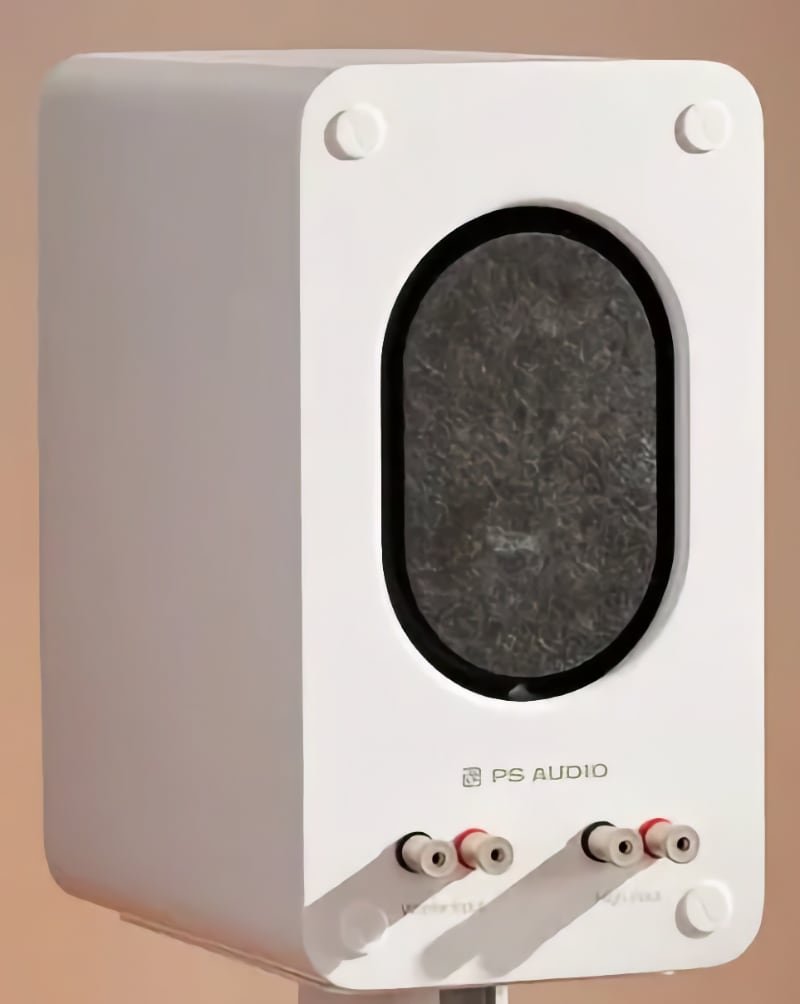
Enclosure type: Passive radiator (one 6 x 9” oval rear-firing).
High frequency transducer: 2.5” planar magnetic with Teonex diaphragm
Low frequency transducer: 1 x 6.5” woofers, cast frame, curb woven polypropylene, advanced magnet structure.
Crossover frequency: 1750Hz Linkwitz-Riley 6th order acoustic.
Sensitivity: 83.5 dB
Nominal Impedance: 6 ohm (5.6 ohm minimun impedance).
Recommended Amp Power: 50-150W.
Frequency Response: (-6dB) half space, 30 Hz (-6dB) in-room.
Dimensions (HxWxD): 14.5” x 8” x 13” speaker only, and 28.25” x 11.75” x 14” stand only.
Net Weight: Speaker 26.6 lbs (12.1 kg) each, stand 13.7 lbs (6.2 kg) each.
The Look and Build
Every time I receive a PS Audio component, I get the sense that there’s a degree of weight on my shoulders, well, not me, but my audio gear. I have always regarded PS Audio as a high-end company that always delivers on its components, and with very helpful and knowledgeable people to boot. Frank Doris, our contact at the company, let us know when PS Audio comes out with another gem, so he contacted us to see if we were interested in listening to PS Audio's new baby, the FR5 Loudspeakers.
I was very excited, I had never reviewed PS Audio's speakers from the Aspen series. Yes, I confess, I am a PS Audio fan boy. I have a lot of their gear. When they arrived, I expected the same packaging care and quality from the company, and these FR5 loudspeakers did not disappoint. I received the black ones; the colour seemed to be characterized by a more neutral aura that appealed to my home.
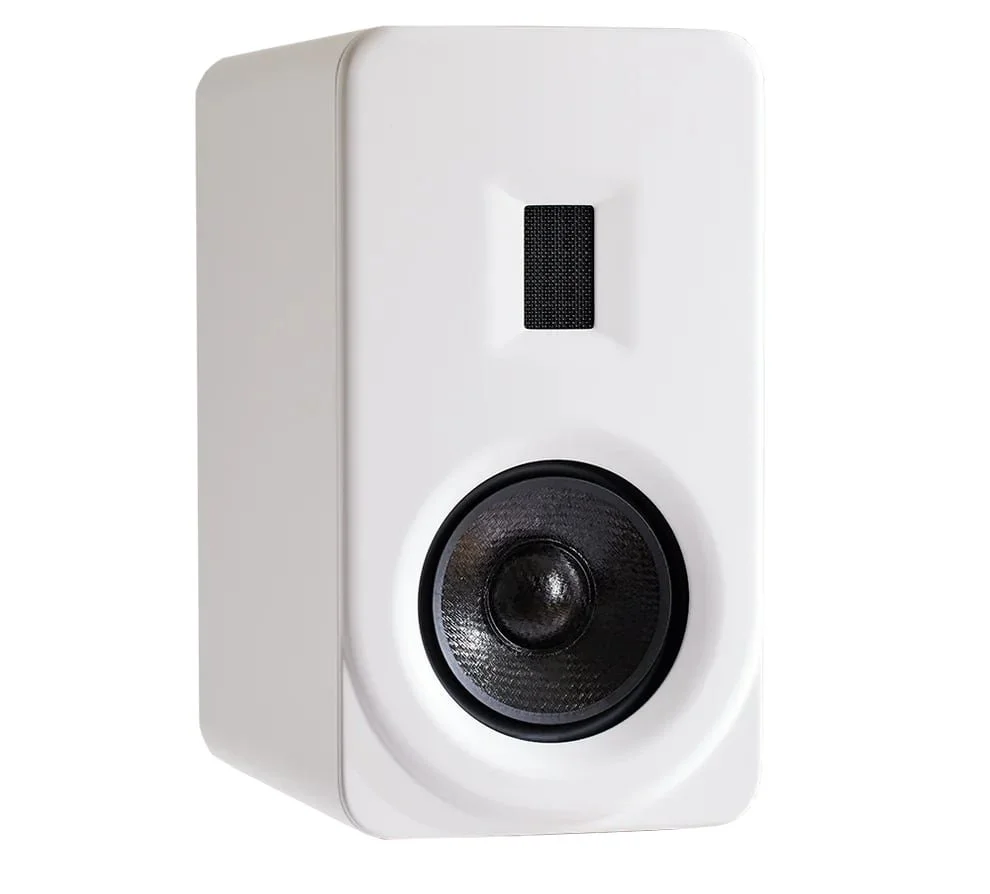
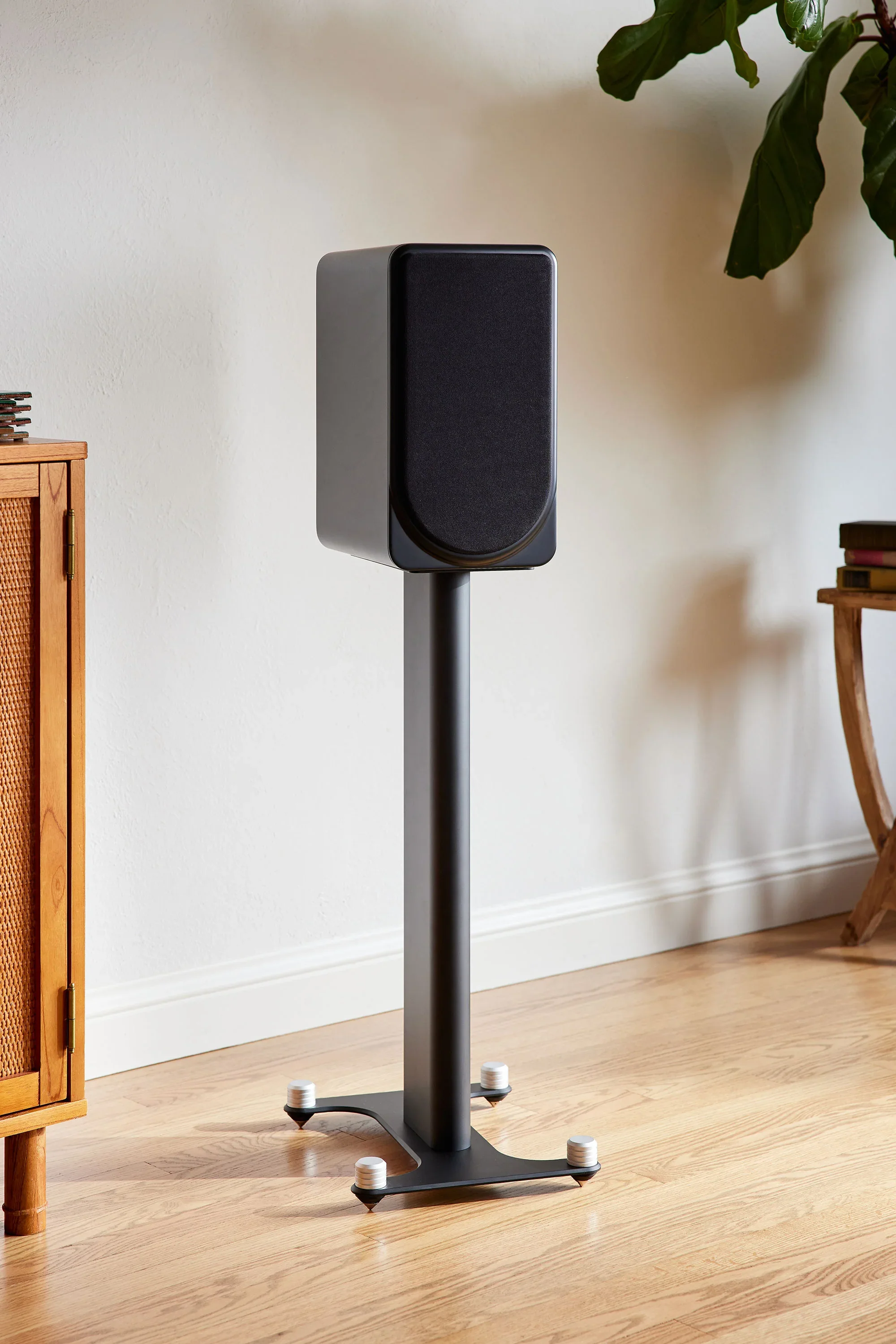
A fibreglass-resin front baffle and a non-glossy finish make this two-way stand-mount speaker, which can go right off the bat from a bass response of 35Hz to beyond 20kHz, fit very well in my room, I must say. The FR5 has a metal screen to protect it, but I always took it off. The design intrigued me because it seems very different from what I am used to seeing in new speakers (high-gloss and overly aesthetic). So I did some research, and it turns out PS Audio works with Studio 63, a well-known company that has also helped them with their AirLens streamer (a favourite of mine) and other Aspen-line speakers. The approach is elegant and dynamic; their designs really do focus on the flow of the music. I couldn't wait to set them up.
From the PS Audio site: "The enclosures are lovingly finished with 7 coats of high-quality lacquer for a beautiful satin finish. While the main body and baffling structure are built with MDF, the sculpted front baffle is formed from a dense, rigid and well-damped high-tech thermoset fibreglass resin composite material with integrated high-frequency acoustic waveguides. The front baffle is mounted from the rear of the cabinet with 13” long shoulder screws, holding the cabinet in compression for superior stiffness and enclosure performance".
It took a few tries in the room to get them right where they needed to be. My room has a large opening on one end, so it's always tricky to find the sweet spot, but after years of reviews, I think I finally tamed the room. The low-end sound immediately made a statement with a 6.5" curv woven Polypropylene woofer, a "rear-mounted high-compliance 6x9-inch passive radiator" for that deep bass (the passive radiator dampens the woofer driver, which then has more control of the bass). These FR5s can be bi-wired or bi-amped, or they can also just be used with jumper cables (included), as I did. I haven't said much about the stands, but suffice it to say they look awesome and were very easy to assemble; they did the job, and I was able to put them on my wooden floor without issue.
The FR5 loudspeakers are the baby brother in the Aspen series; we have the FR30, FR20, and FR10. They share the same planar tweeter and PS Audio comments: "On the FR5, we chose to go with a technology that has the speed of an electrostat with the dynamics of a cone. Planar Magnetics".
Since I don't plan on getting any of the older brothers of the FR5, I was happy that they share some similarities. I was cautiously optimistic to listen to what PS Audio had in mind with the FR5's, seeing that they are clearly the more affordable loudspeakers for most of us.
PS Audio mentions that: "The driver is equally driven with front and rear magnetic structures that offer inherent linearity through symmetrical 'push-pull' neodymium motor structures and directly driven ultra-low mass diaphragms with none of the cone or dome breakup, inductance modulation, or hysteresis distortion that plagues traditional drivers."
Audio Setup
Important as it is to mention the specs and the brand new technology, care, and quality of these beautiful speakers, let me get to the meaty part of this review. Let me begin with the gear used, then we'll get to how they sound. So a lot of components were used for these FR5's. For cables, the Allnic ZL series cables. I also compared the FR5's with my Alta Audio Alyssa reference speakers ($6999). I have the Integrated Stellar Strata amp, the Galion Audio TS A75 Poweramp, and the Margules I-240 tube integrated. For streaming (Qobuz and Tidal through Roon), I used the PS Audio AirLens, the Primo Plus (streamer-DAC), and the separates Rivo Plus (streamer) and Preciso (DAC), from Volumio. For CDs, the PerfectWave SACD and the StellarGold DAC from PS Audio, and the Stellar Phono Preamp and the Mark Levison 5105 turntable for my vinyl addiction.
Sound
Jane’s Addiction’s "Mountain Song” from the album Nothing’s Shocking is not just a power-chord masterpiece. At the 3-minute mark, the solo begins, and Dave Navarro’s bends seem otherworldly. There’s a degree of separation without too much sibilance that you can always hear in the recording; this is perhaps because of the bass in these monster speakers. When I compared my Alyssa speakers to the FR5, I could hear the tuning for the Alta Audio component to be of the soft-silk side of the sound, whereas the FR5's have a more pronounced neutral sound; the Alyssas still had a little more pop in the highs. The neutral side of the FR5 (though the bass was always present) was more welcoming to some of the music I played than the Alyssa (which almost doubles the price). I'll give a few examples.
In the last few years, Mary Halvorson has become one of my favourite artists; her sound is original, the layers of her compositions are volatile, and their unpredictability shows her mastery of the instrument. She just recorded an album with Ambrose Akinmusire, Slo-Mo Neon Luminate Hoverings (2026). I invite you to listen to it. The air of Akinmusire's trumpet is palpable, and Halvorson's Guild archtop guitar sings with phrasing that fragments your mind. The FR5's make this album not just enjoyable, but an unforgettable listening experience. I ordered the vinyl of this recording as soon as I listened to it. The low bass and open mids of the FR5's draw out the creativity and uniqueness of these artists.
Then the Concertos filled the room. First, it was Weinberg's with Rostropovich in D minor Op. 43, from 1964. This album (2013), remastered by JSC Firma Melodiya, features Mstislav, for many, the greatest of the instrument, who handles the twists of Weinberg's compositions with ease, and you hear it, the left side of the room opened with the strings (USSR State Symphony Orchestra), while Rozhdestvensky managed to keep everyone on the correct pace. I had never heard this version with such a natural sound. Again, there's an experience to these loudspeakers; the left and right crossover carries the symphony, and Rostropovich raises his cello hand and leads.
Of course, Gustav Mahler made an appearance, and it was a treat.
His Ninth Symphony with Kenneth Woods conducting Klaus Simon's chamber version with the English Symphony Orchestra (2026). The standard listening for any speaker in this house is a Mahler symphony. So I threw in a curveball to the FR5's, a chamber sound to this masterpiece. See, the Ninth starts by hovering over you, like waves. Think of the sea with this symphony. Then this comfort and peace of a sound-wave shape quickly turns into a rip curl, it has you in its grip and won't let go. And here is when a good soundstage demands your attention, the wind instruments (pun intended) in this composition are crucial as they set the tone. The FR5s acted like a large boat that was able to handle the large waves and the storm. I slightly toed in the speakers for this chamber version because it needed a bit more center-focused sound. This is what I liked about these speakers: they did not flinch at the big moments. Music is like this: it sets up possibilities, and your audio setup has to step up; the FR5's did just that.
Conclusion
Let me conclude by saying, I consider these speakers to be some of the best I’ve heard, competing neck and neck with more expensive ones like the Alta Audio Alyssa speakers. Don't let a neutral sound with a sharp bass scare you; in my opinion, it invites more music to the table. Although these speakers might seem like audiophile entry-level considering PS Audio’s FR line (the mentioned FR10, FR20, and FR30), I can assure you these FR5 are fantastic top-of-the-line speakers. The price (USD 3999) sits right on the edge of affordable (yes, this is subjective, and I might be criticized in the comments for saying this), but if there’s something an audiophile cannot live without, it’s great speakers. This audio component might be the most expensive in your audio chain, and I believe there’s a reason for this: it is the heart of your setup. Yes, amps, preamps, and DACs are the blood, but what pumps the blood? Your speakers. The design, the craftsmanship, the sound, yes, all make for a great listening experience. These are perfect speakers for your home. Save up and get them. The sea is waiting; go get them.