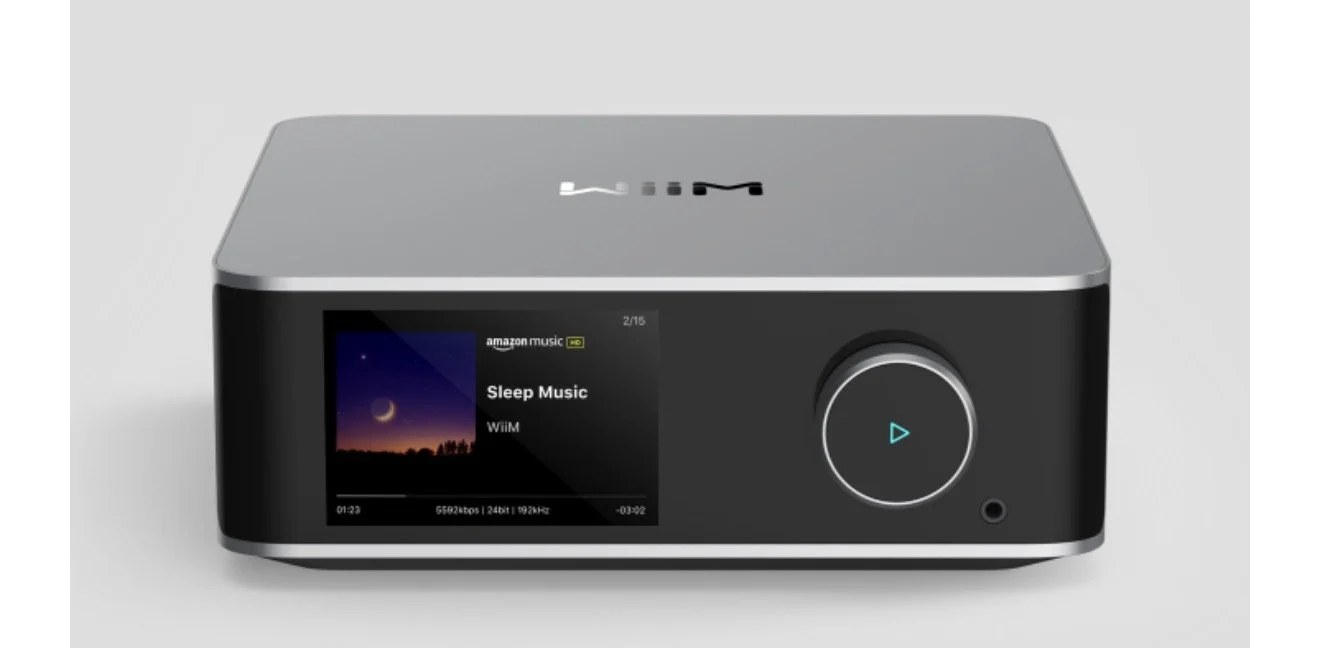
The WiiM Ultra Music Streamer
I thought I had settled on the way I wanted to experience music.
Vinyl had always remained at the center of my system. I enjoyed a brief affair with the compact disc, but records never really surrendered their place. My curiosity about digital, however, remained. As computer audio gave way to standalone DACs, music servers, and eventually streaming, I watched the technology mature from a distance. Yet I continued to be content with my analog front end.
But every time I considered taking the next step, I found reasons to hesitate.
Part of that hesitation was practical. Streaming appeared expensive. It seemed to require multiple components - separate DACs, servers, software, subscriptions, and a degree of computer knowledge that felt completely at odds with the simple pleasure of placing a record on a turntable.
The other reason was more personal.
I wasn’t convinced streaming could provide the qualities I value most in music reproduction: musicality and emotional involvement. Convenience alone has never interested me. If a source component couldn’t create an emotional connection with the music, I simply wasn’t interested, regardless of how many millions of tracks it could access.
My first encounter with streaming came almost by accident when I was asked to review the Auris BluMe Pro. It was a Bluetooth receiver that allowed me to play music from my phone through my audio system. I soon found myself using it to audition unfamiliar music before deciding whether an album deserved a place in my record collection. Before long, the Auris had earned a permanent place in my system.
Even then, I never thought of it as a true source component. It remained a useful tool, while my turntable continued to occupy the center of my listening life.
Everything changed when WiiM contacted me about reviewing the Ultra.
By then I had been hearing increasingly enthusiastic reports from reviewers and friends whose opinions I respected. The WiiM Ultra wasn’t simply being praised as remarkable value for the money. People were describing it as a genuinely serious source component capable of integrating into highly revealing systems without apology.
I expected to review another piece of audio equipment.
What I discovered instead was an entirely new way of experiencing music
The first surprise came before I heard a single note. The moment I opened the box, it became clear that as much thought had gone into the presentation as the product itself. Nothing felt incidental. Each component occupied its own place, every accessory was easy to identify, and the presentation reflected a level of care that suggested the same thoughtful approach had been applied to the product itself.
That impression continued once I lifted the contents from the box. Rather than providing only the bare essentials, WiiM includes virtually everything needed to begin listening immediately: RCA interconnects, HDMI, optical, and power cables. It was a small but welcome touch that eliminated the familiar search through drawers for the right cable before I could even begin listening.
By that point, I already had the feeling that this was a company that had carefully considered the owner’s experience from beginning to end.
Only then did another long-held assumption quietly disappear.
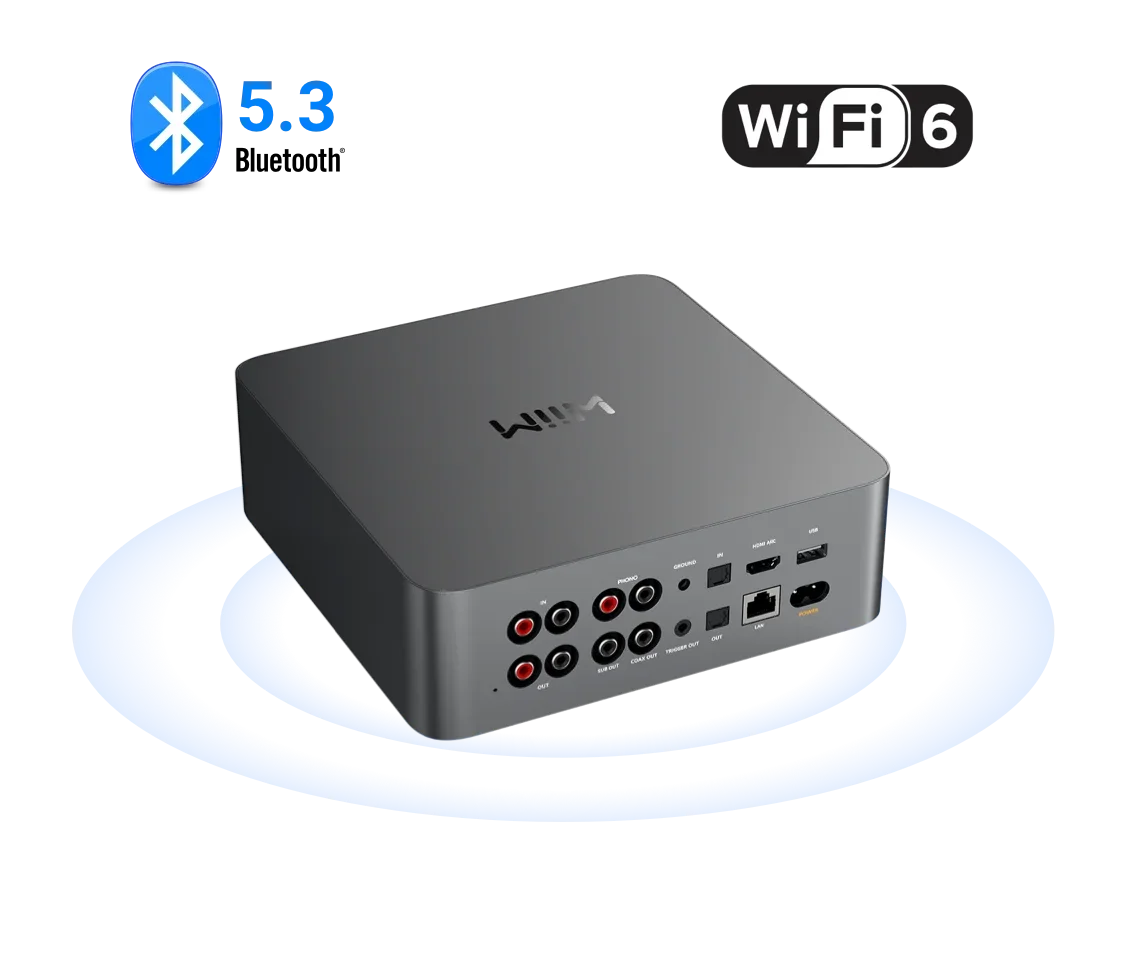
For years I had imagined that adding streaming to a high-end audio system would involve unfamiliar hardware, complicated wiring, and a frustrating setup process. Instead, installing the WiiM Ultra was no more difficult than connecting any other line-level source component. A single pair of RCA interconnects was all it took. In practice, it was no more complicated than adding a CD player, cassette deck, or tuner.
In hindsight, I had to laugh at myself a little. For years I had imagined streaming to be technically intimidating, but the actual installation couldn’t have been much simpler.
The software setup proved equally reassuring. After downloading the WiiM Home app and entering my Wi-Fi credentials, the app guided me through every step with clear instructions and visual progress indicators. It never left me guessing. Each step was completed and confirmed before the next began. If you know your Wi-Fi password and are comfortable downloading an app to your phone, you’ve already mastered the most complicated part of the process. Within about twenty minutes, I was ready to begin listening.
One small surprise came afterward. Although the WiiM Ultra includes a thoughtfully designed remote control, I found myself using it very little. The responsive touchscreen, together with the excellent WiiM Home app, quickly became my preferred way of interacting with the streamer.
The next choice was selecting a streaming service.
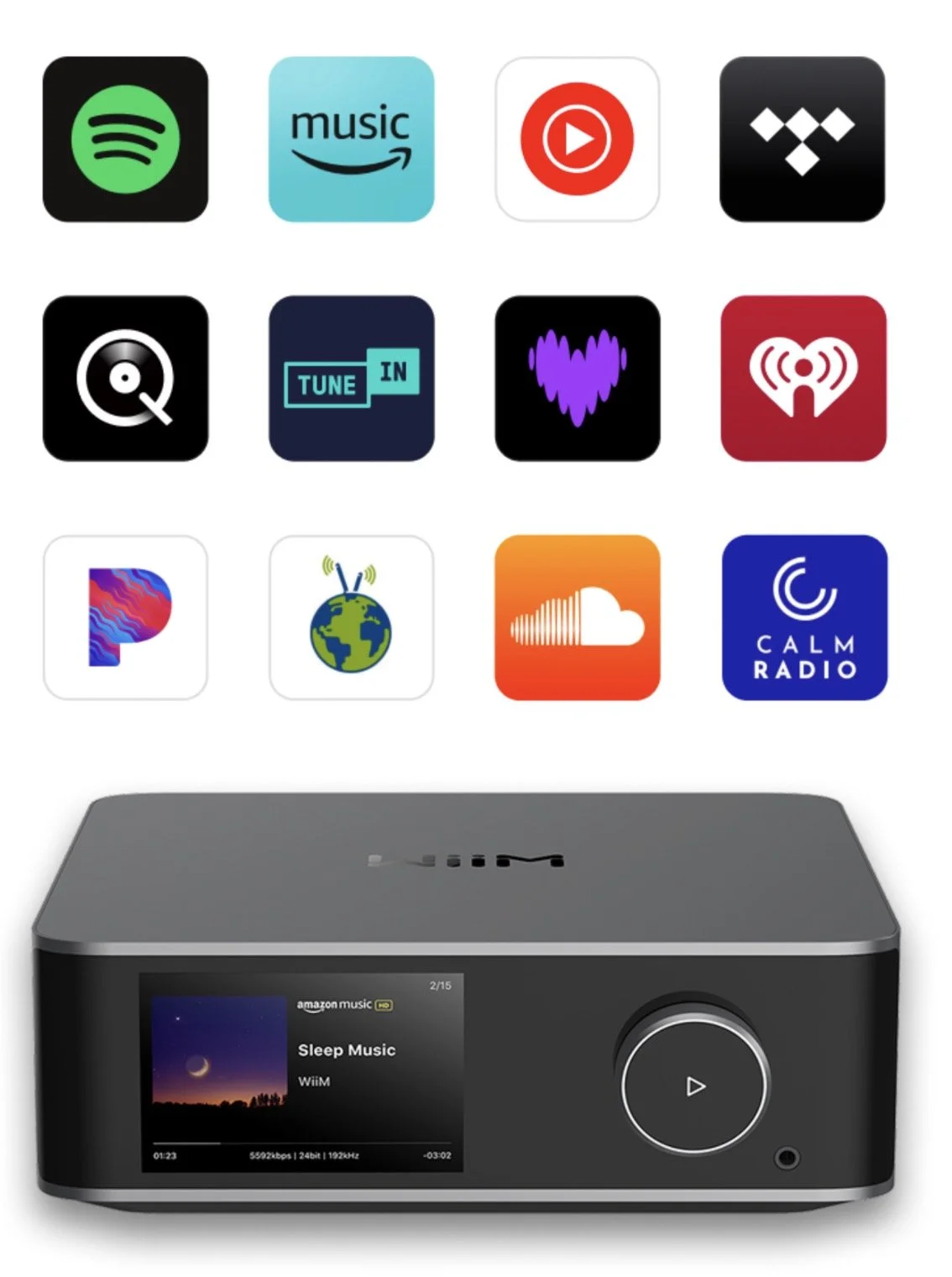
My previous experience with streaming had been limited to the services I used with the Auris BluMe Pro, but this review felt like an opportunity to begin with a clean slate. Almost immediately, I found myself thinking about the Florida Audio Expo.
One observation had stayed with me long after the show had ended. Room after room, regardless of the price of the equipment or the manufacturer demonstrating it, Qobuz seemed to be the streaming service of choice. I assumed there was a good reason so many experienced designers, dealers, and exhibitors had gravitated toward the same platform, and it seemed like the natural place to begin my own exploration.
Qobuz became the sole music source for this evaluation.
One feature I came to appreciate was the ability to customize the WiiM Home app by hiding the services I wasn’t using. Rather than looking at a screen crowded with services, I was able to create a clean, uncluttered interface focused entirely on Qobuz. It was another example of good design quietly removing complexity instead of adding it.
With the system configured and Qobuz ready to explore, I found myself facing an unexpected question.
Where do you begin when virtually the entire world of recorded music is suddenly at your fingertips?
The answer, at least for me, wasn’t a spectacular demonstration recording or an audiophile showpiece. It was something deeply familiar.
It was evening. The lights were low. I wasn’t in the mood to analyze equipment. I simply wanted to relax. Almost instinctively, I searched for Arthur Rubinstein’s recording of Chopin’s Nocturnes, a performance I have treasured on vinyl for many years but rarely experience from beginning to end in a single sitting.
What happened over the next hour surprised me.
What struck me first wasn’t simply the beauty of the piano, but the remarkable sense of presence. As the recital unfolded, I gradually experienced the suspension of the idea that I was listening to a recording at all. Instead, I found myself transported into Rubinstein’s presence, as though occupying an ideal seat in a quiet recital hall.
Freed from the subtle distractions that inevitably remind us of the playback medium, my attention settled on something far more important: Rubinstein’s touch, his phrasing, and the quiet intention behind every musical thought. Each phrase seemed to bloom naturally into silence before yielding effortlessly to the next. I wasn’t admiring a hi-fi system. I was following the thoughts of one of the twentieth century’s greatest pianists.
Perhaps that was the greatest revelation. The WiiM Ultra quietly disappeared, leaving only the artist, the music, and the emotional communication between them.
When the recital ended, I didn’t immediately begin searching for another demonstration recording. Instead, I sat there reflecting on what had just happened. In the weeks that followed, I returned to Rubinstein’s Nocturnes again and again—far more often than I ever had before. Streaming hadn’t simply made the performance more convenient to hear; it had deepened my relationship with it.
That evening planted a question that would guide the rest of my evaluation.
If streaming could create this kind of intimacy with a solo piano recital, what other musical discoveries were waiting?
My thoughts drifted almost immediately to Brian Eno’s On Land.
I’ve lived with this album for many years. It’s one of those recordings that doesn’t ask to be listened to so much as inhabited. Rather than presenting melodies or songs in the traditional sense, Eno creates an environment. Tiny sonic events emerge from somewhere in the distance, dissolve almost imperceptibly into silence, and reappear elsewhere. The music feels earthy, misty, almost organic, as though it were quietly describing a landscape rather than performing within one.
What surprised me wasn’t simply the quiet background. It was the completeness of the illusion.
As the album unfolded, the listening room gradually gave way to Eno’s world. I stopped noticing loudspeakers. I stopped noticing the equipment. The boundaries of the room itself seemed to soften as the music quietly surrounded me. There was an uninterrupted continuity that felt completely natural to this kind of work, allowing its atmosphere to develop without ever calling attention to the mechanics of playback.
For the first time, I felt I was experiencing On Land in exactly the way the music had always invited me to experience it—not as a collection of individual tracks, but as a single, unfolding environment.
That realization stayed with me long after the album had ended.
If uninterrupted presentation could deepen my appreciation of a forty-minute ambient work, what might happen when the music stretched far beyond the limits of any physical format?
That experience naturally led me to another work I’d long been curious about: Robert Rich’s Somnium, an extraordinary composition lasting nearly eight hours.
I had sampled portions of it over the years, but I had never experienced the work as a whole. In retrospect, I don’t think that was ever enough. Somnium isn’t a composition built around individual moments. Its scale is part of the composition itself.
Streaming changed that.
One evening I simply pressed play and allowed the work to unfold at its own pace. Sometimes I listened attentively. At other times it quietly occupied the room as I read, reflected, or gradually drifted toward sleep. I never felt compelled to interrupt it because, for the first time, there was no interruption.
It suddenly became clear that this wasn’t merely a convenient way to hear a very long work. It was the way the music itself wanted to be experienced.
That realization expanded my understanding of streaming once again. Some music isn’t simply reproduced by the medium—it is liberated by it.
Another discovery arrived from an entirely different direction.
Not long before the WiiM Ultra entered my system, I had reviewed a vinyl sampler that included an excerpt from John Rutter’s Requiem, recorded by the legendary Keith Johnson for Reference Recordings. The moment I heard it, I did what most vinyl enthusiasts would probably do—I immediately began searching for a copy of the LP.
The LP had long been out of print, and the few copies I found were expensive enough that I never added it to my collection. Eventually, I accepted that it was one of those recordings I simply might never own.
Only later, after the WiiM Ultra had become part of my system, I remembered that recording. I wondered if it might be available on Qobuz.
It turned out to be one of the most rewarding discoveries of the entire review.
Keith Johnson’s recording brings together orchestra, chorus, organ, and solo soprano, all captured with the spaciousness and realism that have made Reference Recordings so highly regarded among audiophiles. As the performance unfolded, I found myself captivated not only by its scale but by the extraordinary coherence of the presentation. The organ anchored the foundation with effortless authority while the orchestra expanded naturally across the room. When the soprano entered, her voice floated free of the ensemble with breathtaking ease. Later, as the chorus gradually emerged, it seemed less as though voices were joining the performance than as though they were slowly being illuminated across the soundstage, one section after another, until the entire musical canvas stood before me.
It was a deeply moving experience.
What surprised me most wasn’t the scale of the recording or how convincingly it was reproduced. It was how completely the music drew me in. Long before the final notes faded, I had stopped thinking about streaming altogether. I was simply absorbed in the performance.
When the performance ended, I realized that something far more significant had happened. Up until that point, I had still been thinking of the WiiM Ultra primarily as an exceptionally capable streamer. After hearing Rutter’s Requiem, I found myself thinking of it differently. This was no longer a convenient way to audition music or explore unfamiliar recordings. It had become a source component in every sense of the word—one capable of delivering the musical involvement, emotional communication, and complete sense of immersion that I had always associated with a truly exceptional analog front end.
I also realized that my desire to continue searching for the vinyl pressing had quietly disappeared. Streaming hadn’t replaced my love of records. It had simply allowed me to experience an extraordinary performance so completely that owning a physical copy no longer felt essential.
One final discovery brought everything together.
When I attended the Florida Audio Expo, I repeatedly heard exhibitors demonstrating their systems with Marcin’s remarkable interpretation of “Kashmir”. I already knew Led Zeppelin’s original recording, but this performance was something entirely different. After hearing it in several rooms, I did what came naturally to me as a record collector. I asked where I could buy a copy.
The answer surprised me.
There wasn’t one.
The performance wasn’t available on vinyl, compact disc, or any other physical format. Streaming wasn’t simply the most convenient way to hear it—it was the only way.
Months later, after the WiiM Ultra had become part of my system, I searched for the recording on Qobuz and finally experienced it at home.
The same qualities that had made it such a compelling demonstration at the Florida Audio Expo were immediately apparent. The enormous bass foundation, explosive dynamic contrasts, startling transient attack, and expansive soundstage were all reproduced with the same sense of energy and excitement that had first captured my attention. Yet impressive as those qualities were, they ultimately weren’t what stayed with me.
What remained was the realization that streaming had quietly expanded my musical world once again. For years I had thought of it primarily as another way to hear music I already knew. Marcin’s “Kashmir” revealed something different. Streaming wasn’t simply preserving access to the past. It was providing access to remarkable performances that never existed on any physical format to begin with.
By the time I reached the end of this evaluation, I realized I had been reviewing far more than a streamer.
When WiiM first contacted me, I expected to evaluate another source component. Instead, the WiiM Ultra quietly challenged assumptions I had carried for years. It showed me that streaming wasn’t simply about convenience or access to millions of recordings. At its best, it offered new ways to discover music, experience familiar performances more deeply, and encounter extraordinary recordings that might never exist on any physical format.
In the end, that may have been the WiiM Ultra’s greatest accomplishment. It never asked me to abandon the listening habits I already valued. Instead, it expanded them.
When I began this journey, I thought I had already settled on the way I wanted to experience music. What I discovered instead was that there was still another door waiting to be opened.
My turntable remains at the heart of my system, and I have no desire to change that. But thanks to the WiiM Ultra, it no longer stands alone. Together they have created a listening experience that is richer, broader, and more rewarding than either could have been by itself.
For someone who believed the story had already been written, that may have been the greatest discovery of all.
Further information: Wiim
![Ella Fitzgerald Sings the Cole Porter Song Book: Acoustic Sounds Verve Jazz Reissue [2026]](https://images.squarespace-cdn.com/content/v1/55787f0ae4b02f0501debbeb/1783642413754-Z447M08YVKOH85MBQLO2/IMG_1076.jpeg)