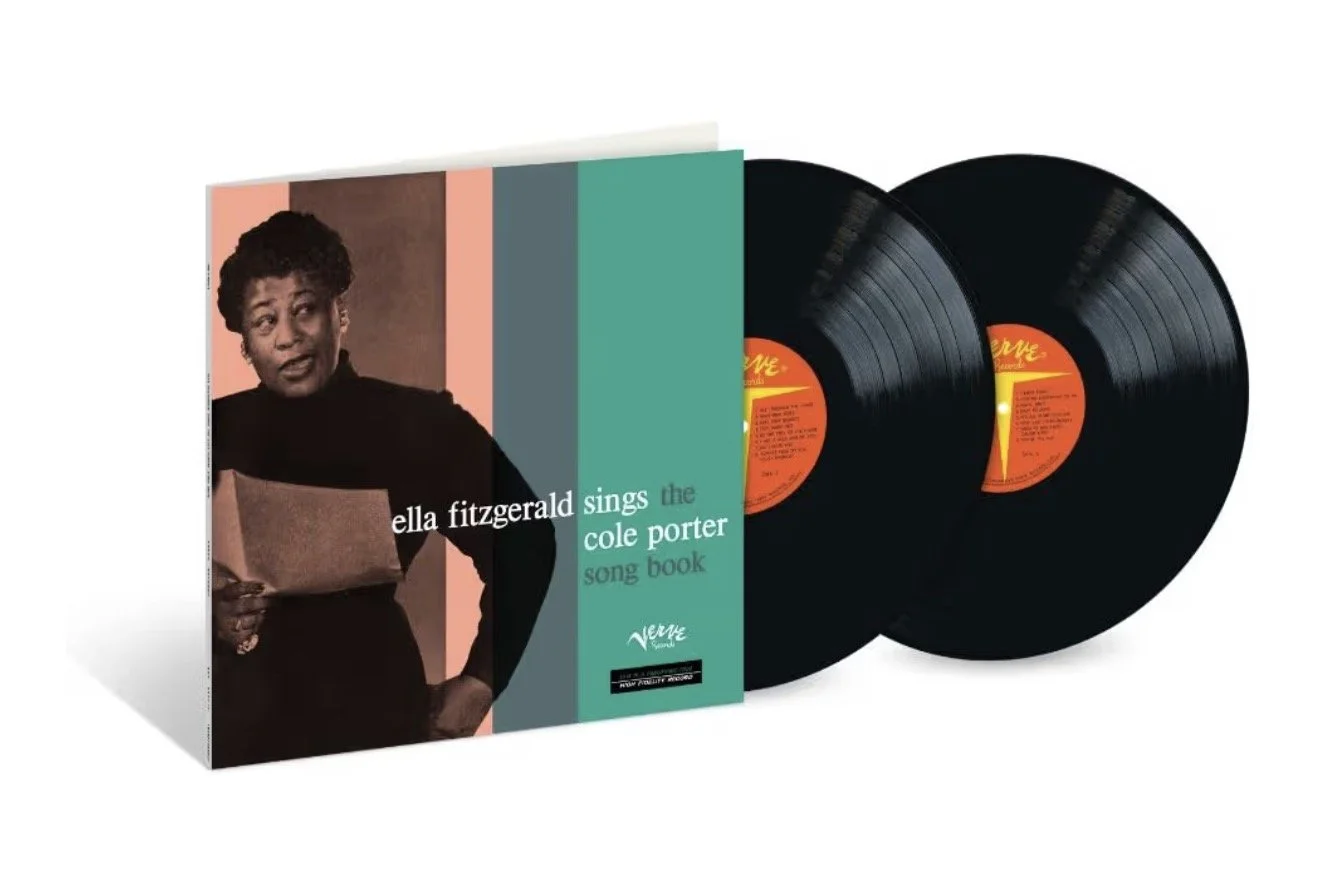
![Ella Fitzgerald Sings the Cole Porter Song Book: Acoustic Sounds Verve Jazz Reissue [2026]](https://images.squarespace-cdn.com/content/v1/55787f0ae4b02f0501debbeb/1783642413754-Z447M08YVKOH85MBQLO2/IMG_1076.jpeg)
Ella Fitzgerald Sings the Cole Porter Song Book: Acoustic Sounds Verve Jazz Reissue [2026]
The Acoustic Sounds Verve Jazz Series has become one of the most consistently rewarding reissue programs in recent years. Last year’s reissue of Ella Fitzgerald Sings the Rodgers & Hart Song Book impressed me deeply and convinced me that these classic recordings are in the right hands. When the Cole Porter Song Book was announced, I couldn’t wait for it to arrive.
The experience began the moment I opened the package. I had seen that jacket many times over the years, but never quite like this. What I had once dismissed as old-fashioned now revealed its beauty in the muted colors, elegant typography, and beautifully balanced design. The substantial, glossy gatefold felt lavish by any standard. Imagining it as a new release in 1956 made it seem all the more impressive.
This wasn’t simply another Ella Fitzgerald release. Produced by Norman Granz for Verve, it launched one of the most ambitious recording projects in American popular music: a two-record set devoted entirely to the songs of Cole Porter.
I sat down with the album and listened from beginning to end.
The liner notes helped me realize how many of the songs I already knew. Some had been familiar to me for years; others I knew only in passing. What caught my attention, though, wasn’t the titles themselves but their Broadway origins. What emerged was a clearer sense of the extraordinary body of work Cole Porter had created for the stage and screen.
The playful opening to “Anything Goes” was an early moment that made me stop and smile. It suggested the theatrical world these songs came from. Porter’s introductions often establish a mood, sketch a character, or quietly set the scene before the familiar melody arrives.
Porter’s lyrics drew me in next. What impressed me most was not simply the humor, although Porter can certainly be funny, but his complete command of language. The writing has an ease that continually took me by surprise. Porter seemed to delight in language itself, filling these songs with ingenious rhymes, effortless wordplay, and perfectly turned phrases that felt both elegant and natural.
Lyrics this sophisticated require an interpreter who understands not only what the words mean, but how they should land. Fitzgerald never feels the need to underline Porter’s humor or call attention to his wit. Even when Porter is genuinely funny, as in “Always True to You in My Fashion,” she trusts the lyric, adding only the smallest inflection or wink. That restraint is central to the performance.
But restraint never comes at the expense of expression. Fitzgerald treats each song as a miniature drama, shaping her delivery to its individual character while remaining unmistakably herself. At one moment she can be playful and exuberant; at another, quietly reflective and tender. In “Too Darn Hot,” she seems to bounce effortlessly on top of the lyric with infectious joy; in “Ev’ry Time We Say Goodbye,” she reveals a quieter, more tender side of her artistry. She seems to understand what each song asks of her, giving every performance its own emotional life.
Buddy Bregman’s arrangements are essential to the album’s variety. The string writing brings romance and longing to the ballads. The brighter swing arrangements add energy and exuberance. On a few occasions, a light Latin rhythm introduces another color. Nothing feels imposed or decorative. Like Fitzgerald herself, Bregman seems to understand exactly how much is enough.
This range is essential to the album’s success. With more than thirty songs spread across two records, the project could easily have begun to feel repetitive. Instead, the sequencing keeps the album moving naturally from one mood to the next. It never wears out its welcome.
By the time I reached the end of the album, I was filled with admiration—not for any single element alone, but for the achievement as a whole. As I closed the jacket, I realized I hadn’t simply listened to another classic album. I had come away with a much deeper appreciation for what this project represents.
That is precisely why this reissue matters. An album like Ella Fitzgerald Sings the Cole Porter Song Book should not be judged only by how impressive it sounds. It has to preserve the elegance, variety, and emotional intelligence of the performances themselves.
This reissue gets Fitzgerald’s voice exactly right. She has a natural, lifelike presence, and the sound serves the interpretation, revealing every pause, subtle shift, and knowing wink.
The mono presentation is one of the reissue’s strengths. The orchestral arrangements sit behind Fitzgerald in a way that gives the recording real depth and dimension. The balance seems just about perfect.
The orchestral textures are equally well served. The strings have sweetness, body, and natural warmth. The brass has presence and energy. Even the simplest accompaniments have delicacy, supporting Fitzgerald’s voice and the shape of the melody.
Mastering engineer Matthew Lutthans, working at The Mastering Lab, presents the recording with taste, clarity, and restraint. This is exactly the kind of mastering the album deserves. The original recording is honored, not reshaped. Pressed at Quality Record Pressings, my copies were wonderfully quiet, allowing the music to unfold without distraction. The classic Verve labels provide a final touch on a beautifully executed reissue.
Ella Fitzgerald Sings the Cole Porter Song Book is not simply an important title in the Verve catalog; it is one of the great achievements in American popular music, and this Acoustic Sounds edition gives it the treatment it deserves. I began by admiring the jacket. I ended with a deeper understanding of the album itself. This is a superb reissue, and one of the most rewarding releases yet in the Acoustic Sounds Verve Jazz Series.