
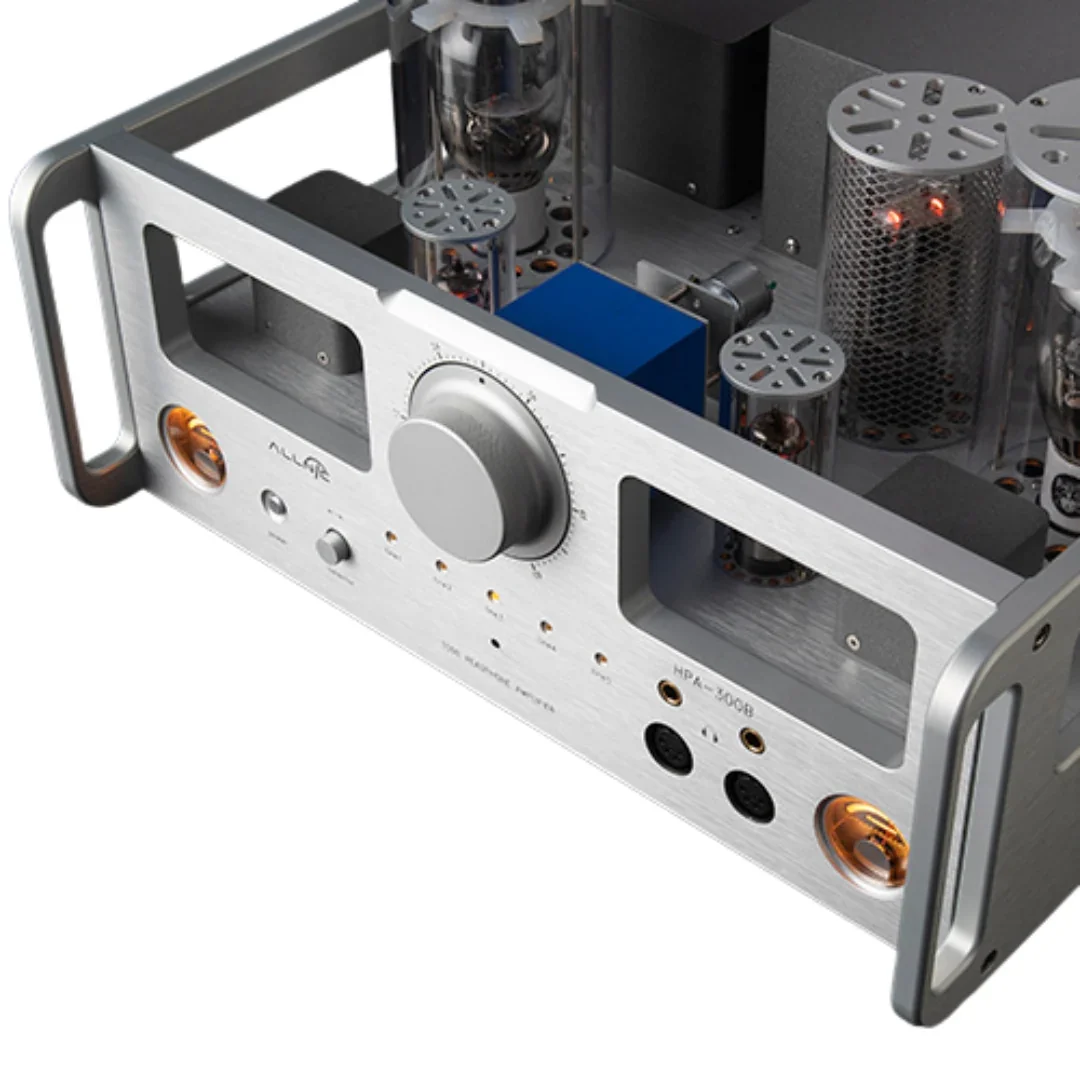
Allnic HPA-300B Headphone Integrated Amplifier
USD 13,200.
Intrigued by the Allnic ASRA RHPA-7500 Headphone Integrated Amplifier I recently reviewed, I set out on a bit of a tour through their product line. Allnic has a unique approach to amplifiers that gives truly equal consideration to headphone and loudspeaker listening, which suits my daily listening habits. Here I am moving up the Allnic ranks to the HPA-300B. Like the ASRA, it features multiple headphone outputs and a set of speaker taps. Many tube and solid-state integrated amplifiers include excellent headphone amplifiers. Often it’s a dedicated headphone circuit that lives inside the amplifier chassis. Many headphone sections in tube amps utilize the main amplifier circuit and step down the power output substantially. With the HPA-300B, speakers and headphones are driven by the same circuit and see the same 8 watts of power.
The 50/50 headphone/speaker concept was not the only aspect that intrigued me about the HPA-300B. This is the first time I’ve had a 300B amplifier in my review system. It’s an exercise in restraint to remember this is a review like any other and not a pilgrimage to worship at the altar of the holy 300B, the most legendary of vacuum tubes.
I wouldn’t take on a run of reviews from one brand if it wasn’t a pleasure to work with them. Thanks are to John Ketcham of Kevalin Audio, Allnic importer, who makes logistics and technical questions extremely easy. If customers receive the same level of access and service, no wonder Allnic ownership gets such positive remarks.
Features & Specifications
On its surface, the HPA-300B has typical features for a high-end tube integrated amplifier. Five inputs (four single-ended RCA, one XLR) and one set of speaker outputs on the rear and headphone outputs on the front. It’s the implementation that gets interesting. There are two areas where Allnic invests extraordinary effort in terms of research and craftsmanship that distinguish their products from other brands. First is the namesake nickel permalloy transformers (Allnic stands for “all nickel”), which are designed and wound in-house. To be fair, many high-end amps use in-house transformers, but permalloy is a rare material choice. The Constant Impedance Attenuator (CIA) volume control is another implementation unique to Allnic, which aims to minimize channel imbalance and achieve consistent soundstage and dynamics at all listening levels. The HPA-300B includes a 61-step version, while the ASRA includes the slightly less expensive 41-step version of the CIA.
The headphone capabilities get even more interesting. There are two ¼” unbalanced outputs which can be run simultaneously. There is also a balanced male XLR output for dynamic headphones and a female balanced XLR output for ultra-low impedance ribbon headphones like those from RAAL, which works closely with Allnic on this capability.
There are some creature comforts as well, like a substantial aluminum remote that handles mute, volume and input switching. Tube biasing is automatic, which makes tube rolling a breeze for the connoisseurs.
Convenience features found on amplifiers like the recently departed PS Audio Stellar Strata MkII, such as volume trim setting for headphones and automatic speaker muting when headphones are inserted, are not available.
HPA-300B is certainly not basic, but the emphasis is on achieving the absolute best performance, rather than modern convenience.
Specifications
Inputs: Three (3) pairs Unbalanced (RCA). Two (2) pairs Balanced (XLR)
Headphone Outputs: Two (2) one-quarter-inch (1/4”). Two (2) four-pin balanced (XLR)
Speaker Outputs: One (1) stereo pair of banana-only connectors. Compatible with
high sensitivity, nominal 4/8 ohm speakers.
Frequency Response: 20Hz ~ 20KHz (±0.5dB)
Voltage Gain: +28dB
Optimum Headphone Impedance: Fifteen (15) to six hundred (600) ohms
Output Wattage: Eight (8) watts
Maximum Input Voltage: Three (3) volts RMS
THD (Total harmonic distortion): Less than 0.1% (1KHz, Output 1V)
S/ N Ratio: -90db (CCIR, 1KHz)
Power Consumption: 168 Watts
Tubes:
• One (1) NOS 5U4G or 5U4GB – Rectifier (GZ34/5AR4 and exact
equivalents will also work. Others are too weak and not
recommended.)
• Two (2) NOS 6DR7 - First gain stage and driver
• Two (2) 300B Power tubes
Fuse: AC 3A, 250V slow-blow for 110/120V regions
AC 2A, 250V slow-blow for 230/240V regions
Dimensions: 430mm (~17 inches) x 420mm (~16.5inches) x 240mm (~9.4inches) (W x D x H)
Weight:
Unpacked: 23.64 Kg (~52.1 lbs)
Packaged: 29 Kg (~64 lbs)
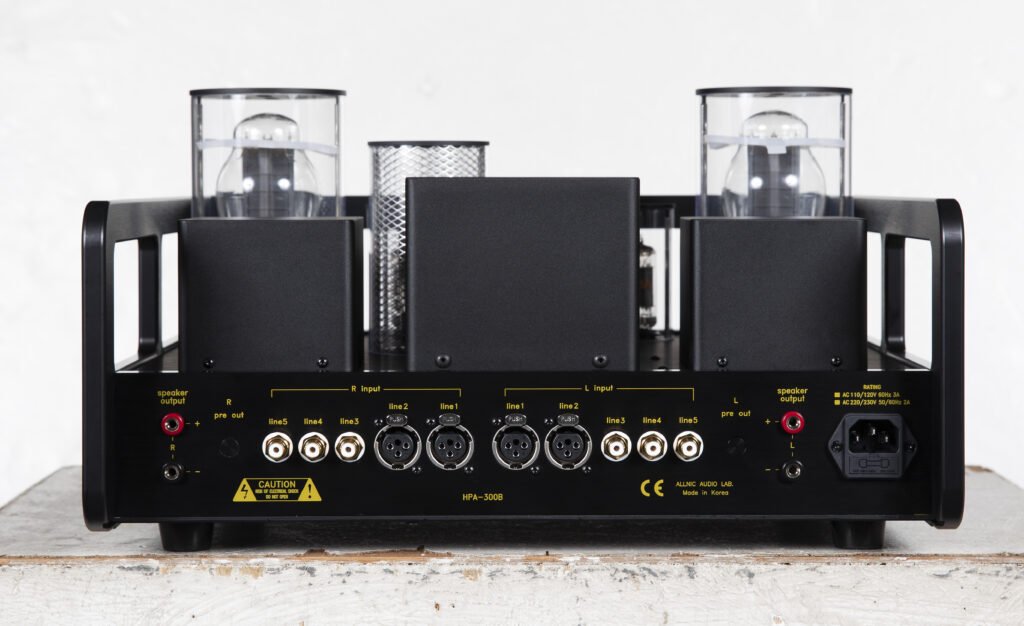
Design & Build
Allnic amplifiers are visually distinct even among the diverse designs in high-end audio. The consistent design language of their products makes them instantly recognizable to those in the know. The ever-so-slightly eccentric proportions of their otherwise traditional-leaning fascias create mysterious attraction to the uninitiated.
A singular visual feature of many Allnic amplifiers, including the HPA-300B, is the acrylic cylinders housing the tubes. In my imagination, these conjure images of alien species preserved in formaldehyde, and I mean that with nothing but affection. They protect the tubes from curious fingers and errant Nerf missiles, but they serve multiple purposes. For power tubes specifically, they serve a structural purpose. A silicone ring with spokes that contact the inner walls of the cylinder fits above the shoulder of the 300B tube. This clearly is designed to dampen microphonics in the tube. Contact with the cylinder actually provides support because the tube socket ‘floats’ to isolate it from microphonic potential picked up through the chassis from footfalls or other sources. Without the silicone damping ring and acrylic cylinder holding them in place, the 300Bs flop around even when inserted properly. For the rectifier tube specifically, a mu-metal mesh inside the acrylic cylinder acts as a Faraday cage to reject radio frequency interference. And finally, for all tubes, the acrylic cylinders encourage laminar flow of air from the bottom out the top, which apparently keeps the tubes cooler than if the heat radiated randomly.
Switchgear is no joke on this unit, and the massive knurled aluminum volume knob is a visual and tactile centrepiece. There is serious resistance when turning it, but it’s also buttery smooth. I never once minded getting up to adjust the level, even when I had the remote.
HPA-300B is meticulously designed and assembled with the clear purpose of realizing the Allnic vision of musical enjoyment.
Review System
My review system was quite simple and consistent throughout my time evaluating the HPA-300B. It’s a new product category for me, and I wanted to play around with tube rolling, so keeping variables to a minimum seemed wise. My reference speakers were the Care Orchestra Celestial Deep Breath Evo from Italy, and reference headphones were the Sendy Audio Peacock Planar Magnetic headphones and the all-time classic Sennheiser HD6XX. My source was high-res streaming from the Wiim Mini, routed through the Ferrum ERCO DAC.
Listening
Break-in time, if any is required at all, seems to vary widely by product in my experience. The HPA-300B had a noticeable change in personality after several days of playing almost all day. While it certainly sounded wonderful out of the box, the spatial presentation became more expansive with more imaging definition. In my perception, the response at the extremes of the frequency range woke up as well. While there is little science to this impression, I did get to experience the phenomenon twice. Ketcham sent along some premium Stradi 300B tubes from Korea. I learned a couple of things from this, my first tube rolling experiment. First, a similar break-in period occurred, so at least in part I can attribute the break-in requirement to the tubes. Second, the ability to hear the difference between tubes was not subtle. With cables, both in my system and at dealer demos, I pick up minute differences, if any, between products. And those differences are not easily characterized as better or worse. With the Stradi tubes, more of the stereotypical 300B characteristics were obvious: liquid midrange, air around instruments, gentle sparkle to the highs. While this is obviously a testament to the quality of these expensive tubes, I was impressed that this difference was so readily apparent when playing them in the Allnic amplifier. Would an entry-level 300B amp so transparently reveal the benefits of tube upgrades? I am not sure, but it makes me question the strategy of saving money on the amp and upgrading tubes right away.
An audiophile buddy recently introduced me to Don Cherry’s ambitious but accessible masterpiece of world jazz, Brown Rice (EMI, 1975), featuring a host of master players and interesting instrumentation. The HPA-300B highlights the best of 300B magic with the transparent midrange and convincing spatial presentation. Rather than being laser-etched, instruments and vocals appeared in three-dimensional space, free-floating. Instruments and eerily realistic whispered vocals were thoroughly decoupled from the speakers. The ability to excite by creating illusions is something I love in a system, and this was a fantastic start in that direction.
Exploring how the HPA-300B rendered vocals in my room was thrilling as well. Elizabeth LaPrelle is a Virginia singer and scholar of American folk music who has recorded several albums of traditional Appalachian song, some a cappella, some with accompaniment and harmonies. On Lizard in the Spring (Old 97 Wrecords, 2007), “Texas Rangers” features Elizabeth and her mother Sandy in a close parallel harmony recounting a harrowing battle. The mix is dense, and the vocals can sound mashed together, but in my room with the HPA-300B, both singers could be clearly differentiated without the analytical edginess that usually comes with such separation. With the Sendy Peacock headphones, the effect was even more profound. Their harmony is so tight and yet the singers are rendered simply as two individuals in space, channelling traumatized soldiers recounting the terror, excitement and relief of surviving a skirmish on the frontier.
Moving away from ‘easy’ recordings, I spent some time with Can’s Tago Mago: 40th Anniversary Edition (Spoon Records, 2011). This Krautrock landmark features a band that loosely and freely jams while staying telepathically connected. Singer Damo Suzuki’s vocals are ethereal and abstract and always deeply appealing to me because I love the energy, texture and emotion, even if I hardly understood what was going on. The level of detail I heard in his vocals on speakers and especially through the Sennheiser HD6XX headphones was a brand new experience. Sure, Suzuki’s singing was brilliantly ad-libbed, but there was nuance and consideration to the actual vocal performance that I had not appreciated previously. A beautiful example of the HPA-300B revealing more of my favourite music to me.
Even after spending several weeks playing with the HPA-300B with my personal reference speakers and headphones, I feel like I barely scratched the surface of its capabilities. Running more efficient speakers and trying the HPA-300B in a larger space would surely be thrilling. On the personal listening side, driving some of the extremely inefficient flagship headphones or current-hungry RAAL models would more thoroughly flex its eight watts of muscle.
In general, headphone listening was a trip. While the HPA-300B is the lowest power speaker amplifier I’ve had in my system, it is the most powerful headphone amplifier I’ve used by a long shot. It absolutely manhandled the Sennheiser HD6XX. The Sennheiser maintained its famously intimate personality but became more insightful, more detailed and more expansive. In my long experience with these headphones, the reputation for limited bass is amplifier-based, and the Allnic proves it. Eight watts of tube power brings out the low end in these 300-ohm headphones.
For speaker matching with 300B amplifiers, I hear competing recommendations about sensitivity. Some say 90dB is fine; others insist that 95dB is a minimum. Based on my usage with 91dB efficient (but decidedly not ‘exotic’) two-way monitors, I see both takes have merit. On the one hand, 91dB provides enough output for listening above my comfort level without diminishing the HPA-300 B's performance. Part of this is due to the modest size of my room. Where the HPA-300B flexes by appearing to be unbothered by the current-hungry 4-ohm impedance, which is likely a testament to the quality of the output transformers. On the other hand, I see how an efficient, ‘faster’ speaker could draw even more magic from the HPA-300B. It would be informative to pair the HPA-300B with a speaker that utilizes cone area instead of excursion to achieve output levels.
Conclusion
Reflecting on my listening impressions, my notes appear focused on discovering nuances of the music as opposed to broad generalizations. The baseline performance expectations of high-end audio equipment hardly registered because the HPA-300B clearly exceeded them all before it was broken in. Wide frequency response, broad soundstage, distinct imaging and convincing timbre are table stakes in this price bracket. For audiophiles prepared to orient their system around the glorious but power-limited 300B tube, the Allnic HPA-300B offers a path beyond achieving a ‘high-end’ sound toward deeper musical insight and appreciation. Bringing the HPA-300B into a system is beyond an achievement or destination; it is the start of a musical journey.
Further information: Allnic Audio




![Ella Fitzgerald Sings the Cole Porter Song Book: Acoustic Sounds Verve Jazz Reissue [2026]](https://images.squarespace-cdn.com/content/v1/55787f0ae4b02f0501debbeb/1783642413754-Z447M08YVKOH85MBQLO2/IMG_1076.jpeg)