![Pines of Rome, Feste Romane, Fountains of Rome: Boston Symphony Orchestra conducted by Seiji Ozawa—DG The Original Source vinyl reissue [2026]](https://images.squarespace-cdn.com/content/v1/55787f0ae4b02f0501debbeb/1786122645101-3NOB71QJI7K5WA89L6M3/IMG_1206.jpeg)
Pines of Rome, Feste Romane, Fountains of Rome: Boston Symphony Orchestra conducted by Seiji Ozawa—DG The Original Source vinyl reissue [2026]
For many years, if audiophiles wanted a sonic spectacular Pines, they picked up an original Shaded Dog or Classic Reissue of the Reiner/Chicago performance. Magnificent in every way. Slightly less so was the Maazel Cleveland on Decca. Now add this new DG reissue to the pick-of-the-litter list.
Some recordings are simply revived by a superior reissue, and then there are recordings that seem to be rediscovered. Deutsche Grammophon’s new Original Source edition of Seiji Ozawa conducting Respighi’s Pines of Rome, Roman Festivals and Fountains of Rome belongs emphatically to the latter category. Originally recorded in Boston in 1977, these performances have long been admired, but this new analogue treatment reveals a level of orchestral colour, spatial definition and dynamic scale that makes the recording sound remarkably contemporary. It is one of those releases that invites the listener to forget, at least temporarily, that the source material is nearly half a century old. It is certainly one of the finest DG The Original Source remasterings.
The album was recorded with the Boston Symphony Orchestra under Seiji Ozawa, with the sessions dating from 1977 and taking place at Boston’s Symphony Hall. The recording was made on eight-track analogue tape, an important factor in the spectacular results achieved by the Original Source team. Deutsche Grammophon’s Emil Berliner Studios has returned to the original analogue material and prepared the release entirely in the analogue domain, using the specialized techniques developed for the Original Source series. DG describes the process as a 100-percent analogue remaster and cut.
Of the three works, Pines of Rome is naturally the star attraction, and it is here that the new pressing really announces itself. Respighi’s (movie score!) orchestration is an audiophile’s dream: huge forces, massive brass choirs, deep percussion, strings capable of extraordinary delicacy, and an almost cinematic use of orchestral colour. Yet the danger in a recording of Pines is that all of this can become a wall of sound. Ozawa avoids that problem. His reading is powerful without being crude, and the Boston Symphony’s remarkable precision allows the enormous orchestral climaxes to emerge from a carefully controlled soundstage.
After the birdsong, the spectacular finale, I pini della Via Appia, is where the system gets its workout. The famous distant procession begins with extraordinary anticipation, gradually building toward the enormous climax. What makes this new pressing so impressive is not simply the volume or bass extension. It is the scale. The orchestra seems to expand horizontally and vertically, with percussion, brass and organ contributing to an immense but remarkably organized sonic picture. The bass is deep, firm and controlled rather than artificially emphasized, while the upper registers retain considerable sweetness even at full orchestral power.
The same virtuosic precision you’ll find on Feste Romane and Fountains of Rome. The same sonic splendour, too. The volumes achieved on Feste are remarkable with zero distortion, blur or incoherence.
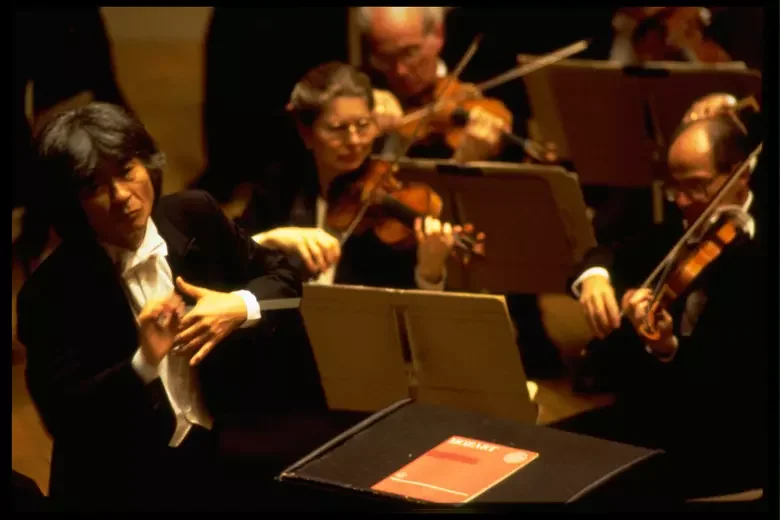
Ozawa’s interpretation is also deserving of more attention than it sometimes receives. He was never a conductor who needed to bludgeon an orchestra into producing excitement. His strength was his ability to maintain control over complex orchestral textures while allowing the music to retain spontaneity. That quality is particularly apparent in Respighi. The temptation with this repertoire is to treat it as a kind of early twentieth-century orchestral fireworks display. Ozawa goes further. He recognizes that Respighi was an exceptionally sophisticated colourist. The music may be spectacular, but the spectacle is built from hundreds of carefully calculated instrumental details.
The Boston Symphony responds magnificently. The brass section is magnificent, the percussion has tremendous authority, and the woodwinds provide an enormous range of colour. Above all, the ensemble possesses the precision necessary for Respighi’s densely scored music to remain intelligible.
Sound
From an audiophile standpoint, this is one of the most impressive releases in the Original Source series.
The first thing one notices is clarity. Instruments are not merely louder or more prominent; they occupy more believable positions within the acoustic. The second is depth. The orchestra has a convincing front-to-back perspective, and the recording possesses a sense of three-dimensional space that is particularly apparent during the quieter passages.
The bass response is equally impressive. The lower strings, bass drum, timpani and organ have real authority, but the low frequencies remain tuneful and controlled. There is no sense that the mastering engineer has simply boosted the bass to create an artificial impression of scale.
The midrange is arguably the greatest strength. Woodwinds have natural body, strings have texture rather than simply brightness, and brass instruments possess both weight and harmonic complexity. The treble is extended and exceptionally open, but never seems artificially etched.
Most impressive of all is the dynamic range.
My pressing was flat and centred with silent surfaces.
The physical presentation is consistent with the high standards established by the Original Source series. The set is pressed on 180-gram vinyl by Optimal and presented in a deluxe gatefold package with the original artwork, additional photographs and facsimiles of recording documentation.
Very highly recommended.